Flemish Baroque painter, Peter Paul Rubens, was born on the 28th of June 1577 in Siegen, modern day Germany. When he was 10 years old his father died and two years later he and his mother moved to Antwerp. At the age of 14 Rubens was apprenticed to the artist Tobias Verhaecht, and he later studied under the painters Adam van Noort and Otto van Veen.
His education complete, Rubens went to Italy where he was influenced by the works of Michelangelo, Raphael, Leonardo da Vinci and Caravaggio.
In addition to being an artist, Rubens was employed as a diplomat and his work took him to Spain in 1603 where he saw paintings by Raphael and Titian in the King's collection, before he returned to Italy.
[readmore]
Rubens concentrated on his artistic career between 1609 - 1621 after he had returned to Antwerp. Then in 1621, he was commissioned by the Queen of France to paint a series of paintings celebrating her life. He was also given more diplomatic missions which enabled him to paint leading figures who he encountered on his travels. He was knighted twice; once by Philip II of Spain, and again by Charles I of England.
The last ten years of Rubens' life were spent in and around Antwerp. His first wife had died in 1626, and four years later he married his niece. In 1635 he purchased an estate where he amused himself by painting landscapes which were not commissioned works.
Rubens died on the 30th of May 1640 at the age of 62.
[/readmore]
For a closer look at the pictures, please click on them to enlarge.
|
1.
|
Painted around 1612, this picture shows the Roman gods Venus and Cupid being given wine and food by which other two gods? 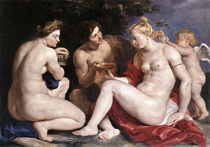
|
|
| [ ] |
Jupiter and Juno |
| [ ] |
Apollo and Diana |
| [ ] |
Mercury and Minerva |
| [ ] |
Baccchus and Ceres |
|
|
|
2.
|
Painted between 1612 - 1614 as an altarpiece for the Cathedral of Our Lady, in Antwerp, The Descent from the Cross, was a subject which Rubens returned to. How many other versions of the same scene is he known to have painted? 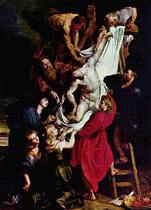
|
|
| [ ] |
Two other versions |
| [ ] |
Four other versions |
| [ ] |
Six other versions |
| [ ] |
Eight other versions |
|
|
|
3.
|
The goddess Venus is again featured in this work of 1615. What is its title? 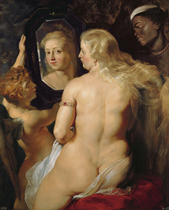
|
|
| [ ] |
Venus Dressing |
| [ ] |
Venus in Front of the Mirror |
| [ ] |
Venus and Servants |
| [ ] |
Venus' Reflection |
|
|
|
4.
|
One of four paintings commissioned by the Elector of Bavaria, Miximillian I, to decorate the Schleissheim Palace, this painting shows the hunting of which creature? 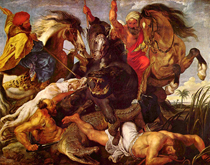
|
|
| [ ] |
A rhinoceros |
| [ ] |
A panther |
| [ ] |
A hippopotamus |
| [ ] |
A gorilla |
|
|
|
5.
|
This is one of a series of 24 paintings commissioned by Marie de' Medici, the widow of which French king? 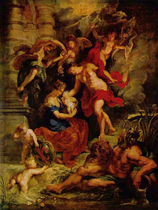
|
|
| [ ] |
Louis XIII, the Just |
| [ ] |
Charles VIII, the Affable |
| [ ] |
Henry IV, Good King Henry |
| [ ] |
Louis XV, the Beloved |
|
|
|
6.
|
Painted around 1628, this painting of Adam and Eve has what title? 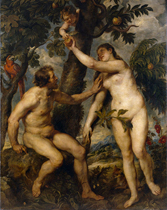
|
|
| [ ] |
The Fall of Man |
| [ ] |
The Garden of Eden |
| [ ] |
Paradise Lost |
| [ ] |
The Temptation of Eve |
|
|
|
7.
|
More than once Rubens was commissioned to paint portraits of royalty. This 1629 painting is of which monarch? 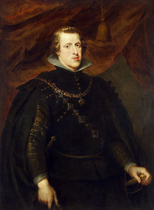
|
|
| [ ] |
Louis XIII of France |
| [ ] |
Philip IV of Spain |
| [ ] |
James I of England |
| [ ] |
Alphonse VI of Portugal |
|
|
|
8.
|
This is a portrait of Helena Fourment painted by Rubens in 1630. What relationship was Fourment to Rubens? 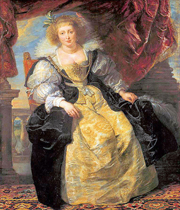
|
|
| [ ] |
She was his grand-daughter |
| [ ] |
She was his mother |
| [ ] |
She was his sister |
| [ ] |
She was his wife |
|
|
|
9.
|
Painted in 1635, this is a picture of which biblical figure seated beside a fountain? 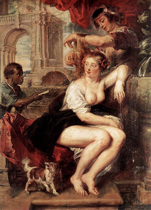
|
|
| [ ] |
Eve |
| [ ] |
Ruth |
| [ ] |
Delilah |
| [ ] |
Bathsheba |
|
|
|
10.
|
This landscape is a view of Het Steen, an estate which Rubens had acquired in 1635. What time of day does the painting show? 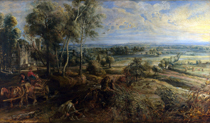
|
|
| [ ] |
The early morning |
| [ ] |
Noon |
| [ ] |
Mid afternoon |
| [ ] |
The late evening |
|
|
|
1.
|
Painted around 1612, this picture shows the Roman gods Venus and Cupid being given wine and food by which other two gods?
|
|
| [ ] |
Jupiter and Juno |
| [ ] |
Apollo and Diana |
| [ ] |
Mercury and Minerva |
| [x] |
Baccchus and Ceres |
|
|
|
2.
|
Painted between 1612 - 1614 as an altarpiece for the Cathedral of Our Lady, in Antwerp, The Descent from the Cross, was a subject which Rubens returned to. How many other versions of the same scene is he known to have painted?
|
|
| [x] |
Two other versions |
| [ ] |
Four other versions |
| [ ] |
Six other versions |
| [ ] |
Eight other versions |
|
|
|
3.
|
The goddess Venus is again featured in this work of 1615. What is its title?
|
|
| [ ] |
Venus Dressing |
| [x] |
Venus in Front of the Mirror |
| [ ] |
Venus and Servants |
| [ ] |
Venus' Reflection |
|
|
|
4.
|
One of four paintings commissioned by the Elector of Bavaria, Miximillian I, to decorate the Schleissheim Palace, this painting shows the hunting of which creature?
|
|
| [ ] |
A rhinoceros |
| [ ] |
A panther |
| [x] |
A hippopotamus |
| [ ] |
A gorilla |
|
|
|
5.
|
This is one of a series of 24 paintings commissioned by Marie de' Medici, the widow of which French king?
|
|
| [ ] |
Louis XIII, the Just |
| [ ] |
Charles VIII, the Affable |
| [x] |
Henry IV, Good King Henry |
| [ ] |
Louis XV, the Beloved |
|
|
|
6.
|
Painted around 1628, this painting of Adam and Eve has what title?
|
|
| [x] |
The Fall of Man |
| [ ] |
The Garden of Eden |
| [ ] |
Paradise Lost |
| [ ] |
The Temptation of Eve |
|
|
|
7.
|
More than once Rubens was commissioned to paint portraits of royalty. This 1629 painting is of which monarch?
|
|
| [ ] |
Louis XIII of France |
| [x] |
Philip IV of Spain |
| [ ] |
James I of England |
| [ ] |
Alphonse VI of Portugal |
|
|
|
8.
|
This is a portrait of Helena Fourment painted by Rubens in 1630. What relationship was Fourment to Rubens?
|
|
| [ ] |
She was his grand-daughter |
| [ ] |
She was his mother |
| [ ] |
She was his sister |
| [x] |
She was his wife |
|
|
|
9.
|
Painted in 1635, this is a picture of which biblical figure seated beside a fountain?
|
|
| [ ] |
Eve |
| [ ] |
Ruth |
| [ ] |
Delilah |
| [x] |
Bathsheba |
|
|
|
10.
|
This landscape is a view of Het Steen, an estate which Rubens had acquired in 1635. What time of day does the painting show?
|
|
| [x] |
The early morning |
| [ ] |
Noon |
| [ ] |
Mid afternoon |
| [ ] |
The late evening |
|
|

