Lucy
Ask the AI Tutor
Need help with Verbs - Past Tense (Irregular) 1? Ask our AI Tutor!
Lucy AI Tutor - Lucy
Connecting with Tutor...
Please wait while we establish connection
Lucy
Hi! I'm Lucy, your AI tutor. How can I help you with Verbs - Past Tense (Irregular) 1 today?
now
Logo

English Quiz - Verbs - Past Tense (Irregular) 1 (Questions)

Some verbs change in surprising ways. Learn how go becomes went and run becomes ran, helping your sentences sound right when you talk about yesterday.

Explore the Topic →
(quiz starts below)

Fascinating Fact:

In the playground, run flips to ran, a quick irregular past tense step to show the race is done.

In KS1 English, children meet irregular past tense verbs. These special verbs do not use -ed. Learning them helps children write and speak clearly about things that already happened.

  • Verb: A word that shows an action or a state of being, like run, jump, think or is.
  • Past tense: A way of writing or speaking that shows something has already happened.
  • Irregular verb: A verb that changes its whole form in the past, like go → went or run → ran.
What is an irregular past tense verb for KS1?

For KS1, an irregular past tense verb is a doing word that does not just add -ed. For example, children learn that go becomes went and see becomes saw.

How can I help my child learn irregular past tense verbs?

Use simple pairs in sentences, such as I run/I ran and I eat/I ate. Read stories together and pause to spot verbs that change in unexpected ways.

Do irregular verbs ever use -ed for the past tense?

No. Irregular verbs change differently, like buy → bought. If a verb uses -ed, such as jump → jumped, it is a regular verb, not irregular.

1. What do we mean by 'irregular past tense'?
[ ] It is a verb.
[ ] It is a verb that changes spelling when it happens in the past.
[ ] It's a verb that you need to add 'ed' to the end of the word to show it's in the past.
[ ] It's a noun that happened yesterday.
2. The word 'say' is present tense; which word is used to show it happened in the past?
[ ] say
[ ] sayed
[ ] said
[ ] sed
3. The word 'begin' is present tense; which word is used to show it happened in the past?
[ ] began
[ ] beginned
[ ] begined
[ ] beginning
4. The word 'blow' is present tense; which word is used to show it happened in the past?
[ ] blowed
[ ] blowing
[ ] blows
[ ] blew
5. The word 'bring' is present tense; which word is used to show it happened in the past?
[ ] bringed
[ ] brought
[ ] bought
[ ] brunged
6. The word 'buy' is present tense; which word is used to show it happened in the past?
[ ] bought
[ ] buyed
[ ] buy
[ ] brought
7. The word 'catch' is present tense; which word is used to show it happened in the past?
[ ] catched
[ ] catching
[ ] caughted
[ ] caught
8. Using the verb 'to draw', which sentence is written in the past tense?
[ ] She drawed on the floor.
[ ] She drew on the floor.
[ ] She draws on the floor.
[ ] She drews on the floor.
9. Using the verb 'to drink', which sentence is written in the past tense?
[ ] They drank their coffee.
[ ] They drink their coffee.
[ ] They drunked their coffee.
[ ] They dranking their coffee.
10. Using the verb 'to make', which sentence is written in the past tense?
[ ] I make you something.
[ ] I maked you something.
[ ] I made you something.
[ ] I maded you something.

You can find more about this topic by visiting BBC Bitesize - What are past, present and future tense?

Logo
English Quiz - Verbs - Past Tense (Irregular) 1 (Answers)
1. What do we mean by 'irregular past tense'?
[ ] It is a verb.
[x] It is a verb that changes spelling when it happens in the past.
[ ] It's a verb that you need to add 'ed' to the end of the word to show it's in the past.
[ ] It's a noun that happened yesterday.
Sometimes, to show a verb happened yesterday, we can add 'ed'. However, for irregular past tense verbs, the word completely changes.
2. The word 'say' is present tense; which word is used to show it happened in the past?
[ ] say
[ ] sayed
[x] said
[ ] sed
Many children spell 'said' wrong, unfortunately, it's a word that can't be spelt phonetically.
3. The word 'begin' is present tense; which word is used to show it happened in the past?
[x] began
[ ] beginned
[ ] begined
[ ] beginning
Today I will begin to clean my house but yesterday I began to clean my bedroom.
4. The word 'blow' is present tense; which word is used to show it happened in the past?
[ ] blowed
[ ] blowing
[ ] blows
[x] blew
The flower the girl is blowing is called a dandelion. She blew off all the petals.
5. The word 'bring' is present tense; which word is used to show it happened in the past?
[ ] bringed
[x] brought
[ ] bought
[ ] brunged
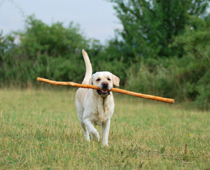
The dog brought me a stick. Make sure you don't write 'bought' as that means he went to the shop and bought it for you!
6. The word 'buy' is present tense; which word is used to show it happened in the past?
[x] bought
[ ] buyed
[ ] buy
[ ] brought
'Bought' is the word you use if you bought something from the shop yesterday.
7. The word 'catch' is present tense; which word is used to show it happened in the past?
[ ] catched
[ ] catching
[ ] caughted
[x] caught
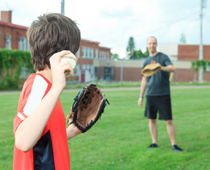
He caught the ball.
8. Using the verb 'to draw', which sentence is written in the past tense?
[ ] She drawed on the floor.
[x] She drew on the floor.
[ ] She draws on the floor.
[ ] She drews on the floor.
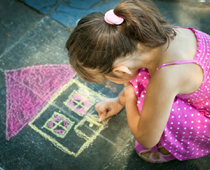
You may hear your friends saying they 'drawed a picture' but really, they should say they 'drew a picture'.
9. Using the verb 'to drink', which sentence is written in the past tense?
[x] They drank their coffee.
[ ] They drink their coffee.
[ ] They drunked their coffee.
[ ] They dranking their coffee.
I will ask you to drink something, if you do, then you drank it.
10. Using the verb 'to make', which sentence is written in the past tense?
[ ] I make you something.
[ ] I maked you something.
[x] I made you something.
[ ] I maded you something.
I will make you something similar to what I made yesterday.