Lucy
Ask the AI Tutor
Need help with Painter - Peter Paul Rubens? Ask our AI Tutor!
Lucy AI Tutor - Lucy
Connecting with Tutor...
Please wait while we establish connection
Lucy
Hi! I'm Lucy, your AI tutor. How can I help you with Painter - Peter Paul Rubens today?
now
Logo

Art Quiz - Painter - Peter Paul Rubens (Questions)

Peter Paul Rubens was a leading Baroque painter. Discover his dramatic style, his famous subjects, and why Antwerp became such an important base for his work.

Explore the Topic →
(quiz starts below)

Fascinating Fact:

He lived and trained in Antwerp from a young age, and later became one of the city’s leading artists. Antwerp remained his main base for much of his career.

Peter Paul Rubens is best known for energetic Baroque paintings filled with movement, strong contrasts, and powerful figures. His work includes religious scenes, mythological stories, portraits, and large-scale commissions made for public display.

  • Baroque: A style of art known for drama, movement, and strong light and shadow.
  • Altarpiece: A painting or artwork placed behind or above an altar in a church.
  • Commission: A piece of art made because a person or organisation requested and paid for it.
Who was Peter Paul Rubens?

Peter Paul Rubens was a Flemish painter from the seventeenth century, famous for large Baroque artworks full of movement and emotion. He produced religious, mythological, and portrait paintings for important clients.

What is Rubens most known for in art?

Rubens is most known for dynamic compositions, rich colour, and figures shown in action. Many of his best-known works are large paintings designed for churches, palaces, and public buildings.

How did Rubens create so many paintings?

Rubens ran a busy studio where assistants helped prepare parts of a painting under his direction. This workshop system allowed him to complete big commissions while still controlling the overall design and finish.

For a closer look at the pictures, please click on them to enlarge.
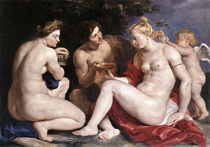
1. Painted around 1612, this picture shows the Roman gods Venus and Cupid being given wine and food by which other two gods?
[ ] Jupiter and Juno
[ ] Apollo and Diana
[ ] Mercury and Minerva
[ ] Baccchus and Ceres
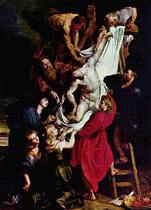
2. Painted between 1612 - 1614 as an altarpiece for the Cathedral of Our Lady, in Antwerp, The Descent from the Cross, was a subject which Rubens returned to. How many other versions of the same scene is he known to have painted?
[ ] Two other versions
[ ] Four other versions
[ ] Six other versions
[ ] Eight other versions
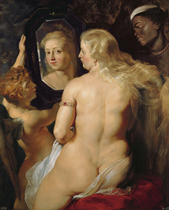
3. The goddess Venus is again featured in this work of 1615. What is its title?
[ ] Venus Dressing
[ ] Venus in Front of the Mirror
[ ] Venus and Servants
[ ] Venus' Reflection
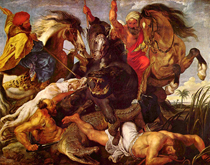
4. One of four paintings commissioned by the Elector of Bavaria, Miximillian I, to decorate the Schleissheim Palace, this painting shows the hunting of which creature?
[ ] A rhinoceros
[ ] A panther
[ ] A hippopotamus
[ ] A gorilla
5. This is one of a series of 24 paintings commissioned by Marie de' Medici, the widow of which French king?
[ ] Louis XIII, the Just
[ ] Charles VIII, the Affable
[ ] Henry IV, Good King Henry
[ ] Louis XV, the Beloved
6. Painted around 1628, this painting of Adam and Eve has what title?
[ ] The Fall of Man
[ ] The Garden of Eden
[ ] Paradise Lost
[ ] The Temptation of Eve
7. More than once Rubens was commissioned to paint portraits of royalty. This 1629 painting is of which monarch?
[ ] Louis XIII of France
[ ] Philip IV of Spain
[ ] James I of England
[ ] Alphonse VI of Portugal
8. This is a portrait of Helena Fourment painted by Rubens in 1630. What relationship was Fourment to Rubens?
[ ] She was his grand-daughter
[ ] She was his mother
[ ] She was his sister
[ ] She was his wife
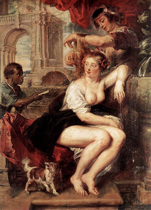
9. Painted in 1635, this is a picture of which biblical figure seated beside a fountain?
[ ] Eve
[ ] Ruth
[ ] Delilah
[ ] Bathsheba
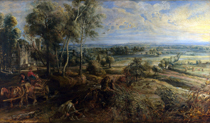
10. This landscape is a view of Het Steen, an estate which Rubens had acquired in 1635. What time of day does the painting show?
[ ] The early morning
[ ] Noon
[ ] Mid afternoon
[ ] The late evening


Logo
Art Quiz - Painter - Peter Paul Rubens (Answers)
1. Painted around 1612, this picture shows the Roman gods Venus and Cupid being given wine and food by which other two gods?
[ ] Jupiter and Juno
[ ] Apollo and Diana
[ ] Mercury and Minerva
[x] Baccchus and Ceres
Baccchus was the god of wine and Ceres the goddess of crops and harvests. Rubens is illustrating a 16th century phrase "Love is impossible without food and drink". Instead of showing a boisterous feast (for which Bacchus was famed), Rubens has painted a more restrained scene - perhaps indicating that we should be moderate in our pleasures!
2. Painted between 1612 - 1614 as an altarpiece for the Cathedral of Our Lady, in Antwerp, The Descent from the Cross, was a subject which Rubens returned to. How many other versions of the same scene is he known to have painted?
[x] Two other versions
[ ] Four other versions
[ ] Six other versions
[ ] Eight other versions
Two other versions are known to exist: one painted in 1617 which is in the Lille Palace of Fine Arts, and another painted in 1618 which is in the Hermitage Museum in Saint Petersburg. The original was removed from the Cathedral of Our Lady by Napoleon and placed in the Louvre - it was however returned after Napoleon's defeat and exile
3. The goddess Venus is again featured in this work of 1615. What is its title?
[ ] Venus Dressing
[x] Venus in Front of the Mirror
[ ] Venus and Servants
[ ] Venus' Reflection
It is also referred to as Venus at the Mirror. Venus, the personification of beauty, can be seen sitting naked before a mirror in which her gaze meets that of the viewer. This is a sensual painting which depicts the softness of the goddess' skin and the silk like quality of her hair
4. One of four paintings commissioned by the Elector of Bavaria, Miximillian I, to decorate the Schleissheim Palace, this painting shows the hunting of which creature?
[ ] A rhinoceros
[ ] A panther
[x] A hippopotamus
[ ] A gorilla
The Hippopotamus and Crocodile Hunt is regarded by some as one of Rubens' masterpieces, although its realism is questionable. It is symbolic of man's struggle with nature and it contrasts the smooth with the rough, darkness with light, the high with the low, beauty with ugliness, and the civilised with the barbaric
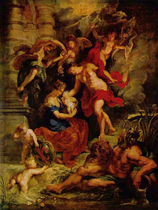
5. This is one of a series of 24 paintings commissioned by Marie de' Medici, the widow of which French king?
[ ] Louis XIII, the Just
[ ] Charles VIII, the Affable
[x] Henry IV, Good King Henry
[ ] Louis XV, the Beloved
Marie de' Medici was Henry's second wife and she ruled as regent after his death, until her son reached maturity. The series depicts scenes from Marie's life such as the one pictured, The Birth of the Princess. The pictures serve to illustrate her struggles and her victories
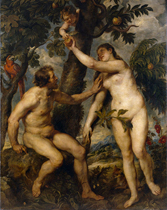
6. Painted around 1628, this painting of Adam and Eve has what title?
[x] The Fall of Man
[ ] The Garden of Eden
[ ] Paradise Lost
[ ] The Temptation of Eve
The piece is a copy of a work by Venetian painter Titian, though Rubens has added some details of his own. The parrot at the left is not in the original painting and Adam’s position and his age have both been changed
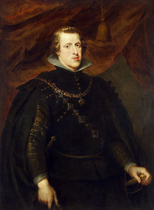
7. More than once Rubens was commissioned to paint portraits of royalty. This 1629 painting is of which monarch?
[ ] Louis XIII of France
[x] Philip IV of Spain
[ ] James I of England
[ ] Alphonse VI of Portugal
Amongst other royals Rubens painted portraits of Wladyslaw IV Vasa - King of Poland, Elizabeth de Bourbon - Princess of France, Anna of Austria - Queen of France, and Isabella Clara Eugenia - Infanta of Spain and Portugal and sovereign of the Spanish Netherlands. Some quite illustrious names indeed!
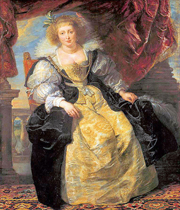
8. This is a portrait of Helena Fourment painted by Rubens in 1630. What relationship was Fourment to Rubens?
[ ] She was his grand-daughter
[ ] She was his mother
[ ] She was his sister
[x] She was his wife
Rubens had become a widower in 1626 and Helena was his second wife. They married in 1630 when Rubens was 53 years old and Helena was 16!
9. Painted in 1635, this is a picture of which biblical figure seated beside a fountain?
[ ] Eve
[ ] Ruth
[ ] Delilah
[x] Bathsheba
Bathsheba was the wife of Uriah who King David spied upon as she bathed. Bathsheba at her Bath is a popular scene amongst artists, with different versions by Rembrandt, Veronese, Gentileschi, and William Blake
10. This landscape is a view of Het Steen, an estate which Rubens had acquired in 1635. What time of day does the painting show?
[x] The early morning
[ ] Noon
[ ] Mid afternoon
[ ] The late evening
A View of Het Steen in the Early Morning was not a commission, but was painted by Rubens for his own pleasure. Landscape paintings were not fashionable at the time, but this piece is thought to have influenced 19th century landscape artist John Constable