




Ask the AI Tutor
Need help with Level 3-4 Shapes - Shape Identification? Ask our AI Tutor!
AI Tutor - Lucy
Connecting with Tutor...
Please wait while we establish connection
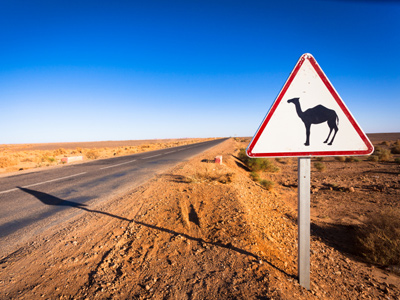
This roadsign has the shape of a triangle.
Level 3-4 Shapes - Shape Identification
Know your shapes by sight and properties. Identify triangles, quadrilaterals and polygons using sides, angles and symmetry, then match names to features quickly for KS3 problems.
1 .
Which of the shapes below is NOT a polygon?

A
B
C
D
The circle does not have any straight sides or angles and is therefore not a polygon
2 .
Can you pick out the hexagon in the picture below?

A
B
C
D
HeXagons have siX sides
3 .
Which shape below is a circle?
A
B
C
D
Circles are round. Each point on their circumference is the same distance from their centre
4 .
Which of the shapes below is a triangle?
A
B
C
D
'Tri' means 3, as in 'tricycle'
5 .
Which of the shapes below is a pentagon?
A
B
C
D
A pentagon is a 5-sided polygon
6 .
How many of the shapes below are polygons?

1
2
3
4
A polygon has at least 3 straight sides and angles
7 .
Which of the shapes below is the parallelogram?
A
B
C
D
Parallelograms are quadrilaterals with two pairs of parallel sides
8 .
Which of the shapes below is the trapezium?
A
B
C
D
A trapezium is a quadrilateral with only one pair of parallel sides
9 .
Which of the shapes below is a rectangle?
A
B
C
D
Rectangles have 4 straight sides and 4 right angles
10 .
From the shapes below, can you recognise the octagon?
A
B
C
D
It is in fact a regular octagon as all eight sides are of equal length and all internal angles are of the same size
Our Social Circles




**Unlimited Quizzes Await You! 🚀**
Hey there, quiz champ! 🌟 You've already tackled today's free questions.
Ready for more?
Ready for more?
🔓 Unlock UNLIMITED Quizzes and challenge yourself every day. But that's
not all...
not all...
🔥 As a Subscriber you can join our thrilling "Daily Streak" against other
quizzers. Try to win a coveted spot on our Hall of Fame Page.
quizzers. Try to win a coveted spot on our Hall of Fame Page.
Don't miss out! Join us now and keep the fun rolling. 🎉
**Unlimited Quizzes Await You! 🚀**
Hey there, quiz champ! 🌟 You've already tackled today's free questions. Ready for more?
🔓 Unlock UNLIMITED Quizzes and challenge yourself every day. But that's not all...
🔥 As a Subscriber you can join our thrilling "Daily Streak" against other quizzers. Try to win a coveted spot on our Hall of Fame Page.
Don't miss out! Join us now and keep the fun rolling. 🎉
© Copyright 2016-2026 - Education Quizzes
Work Innovate Ltd - Design | Development |
Marketing
