




Ask the AI Tutor
Need help with Writing 04 - Write a Magazine Article? Ask our AI Tutor!
AI Tutor - Lucy
Connecting with Tutor...
Please wait while we establish connection
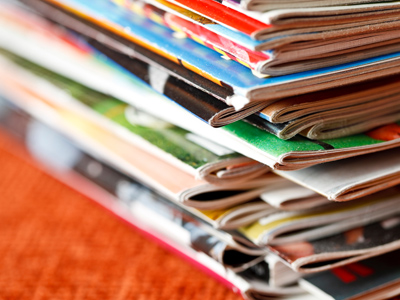
There are lots of different magazines. Could you write an article for one of them?
Writing 04 - Write a Magazine Article
Writing is more art than science and we have heard of fabulous writers from Shakespeare to R K Narayan, from Charles Dickens to V S Naipaul and from Paulo Coelho to Anita Nair. Writing manifests itself in several forms. The writers named earlier are ones who are associated with fiction writing. Fiction writing is written from imagination but non-fiction writing is about real situations and real life incidents.
There are several types of non-fiction writing, such as news reporting, biographies, autobiographies and magazine article writing. You would have your own favourite magazines such as India Today, Outlook or Week among the English magazines from India and Time, Fortune and Forbes among the foreign magazines. Within these favourite magazines you could also have your favourite writer.
There are several types of non-fiction writing, such as news reporting, biographies, autobiographies and magazine article writing. You would have your own favourite magazines such as India Today, Outlook or Week among the English magazines from India and Time, Fortune and Forbes among the foreign magazines. Within these favourite magazines you could also have your favourite writer.
1 .
A magazine article can do what?
Provide information.
Provide alternate viewpoints.
Criticise.
All of the above.
A magazine article is meant to inform, give balanced viewpoints, criticise and offer suggestions
2 .
Which statement is not true of a magazine article?
A magazine article is a work of fiction.
A magazine article describes an experience or an event.
A magazine article describes a person or a place.
A magazine article offers advice and suggestions.
A magazine article is different from short stories and novels, which are fictional works
3 .
You are writing an article on the subject of the Internet. Choose the title that will best attract the reader's attention.
The Internet has Many Pitfalls and Many Highs.
The Internet and its Advantages and Disadvantages.
The Pluses and Minuses of the Internet.
Do You Need To Be Connected?
The purpose of the article is to catch the interest of the reader. Because the title is the first stimulus that the reader gets it has to be catchy. The titles in options 1, 2 and 3 are too bland whereas the title in option 4 is asking a question connected with the subject and therefore more likely to catch the reader's attention
4 .
The following four options refer to a magazine article. Which of the four would you consider as the best suited for a magazine article?
The article is excellently written and well researched but contains no references to the latest research reports.
The article is well written and well researched and contains references to the latest research reports without citations.
The article is well written and well researched and contains references to the latest research reports with clear citations.
The article is excellently written and contains references to opinions of celebrities.
A magazine article that is well written with back up from the latest research reports that are clearly cited would be better appreciated than excellently written articles with only opinions to back them
5 .
Which of the following four descriptions would fit a magazine article most?
The article is written by a prominent personality with a good command of the language.
The article is written by a celebrity with a good command of the language.
The article is written by a subject expert with a poor command of the language.
The article is written by a subject expert with a good command of the language.
For a good magazine article the writer should be a domain expert who has a good command of the language. Just because a celebrity is popular it does not mean that he would be read unless he has knowledge of the subject he is writing on
6 .
A magazine article has to have a particular format. Choose the correct format from the following options.
The article's format should follow the sequence: introduction - title - body - conclusion.
The article's format should follow the sequence: title - body - introduction - conclusion.
The article's format should follow the sequence: introduction - body - conclusion.
The article's format should follow the sequence: title - introduction - body - conclusion.
The four components of a magazine article are: title - introduction - body - conclusion. The article should follow this sequence in order to be well accepted and understood.
Option 3 is all right but it lacks the 'title', which is a vital component used to catch the reader's attention in the first place
Option 3 is all right but it lacks the 'title', which is a vital component used to catch the reader's attention in the first place
7 .
A magazine editor would be more likely to accept which of these articles for publication?
One which is tailored to suit the magazine's target readers and written in a style that the writer is known for.
One which is tailored to suit the magazine's target readers and written in a style that mirrors the style of the magazine.
One which is tailored to suit the raging topic of the day and written in a style that mirrors the style of the magazine.
One which is tailored to suit the raging topic of the day and written in a style that the writer is known for.
By its very nature a magazine article differs from newspaper articles as the magazine allows more column space to develop a story and also more time for research. Segmentation is the key to magazines and they have core readers so any article should match the magazine's style and appeal to its readers
8 .
The following four options refer to a magazine article. Which of the four would you consider as the best suited for a magazine article?
The article is well written and well researched and contains references to the latest research reports and an interview with a renowned subject expert.
The article is well written and well researched and contains references to latest research reports.
The article is well written and well presented with lots of opinions.
The article is well written and contains references to research reports that are not the latest.
A good magazine article has to be well written and well researched and it would gain more attention if it carries an interview with a renowned subject expert
9 .
A good magazine article should not do which of these options?
Over personalise.
Over emotionalise.
Extol the virtues of the writer.
All of the above.
Remember the magazine article is for a magazine with the general public as its audience. Over personalisation or over emotionalisation and self praise will put off the reader who is looking for a balanced view of the topic under consideration
10 .
Which of these four sentences is true of a magazine article?
A magazine article should leave out relevant information.
A magazine article should leave out irrelevant information.
A magazine article should not be well researched.
A magazine article should not be written in clear and understandable language.
The nature of a magazine article is to inform with relevant facts and therefore it should be well researched and written in good understandable language, leaving out all irrelevant information
Our Social Circles




© Copyright 2016-2026 - Education Quizzes
Work Innovate Ltd - Design | Development |
Marketing
