




Ask the AI Tutor
Need help with Jazz Improvisation 01? Ask our AI Tutor!
AI Tutor - Lucy
Connecting with Tutor...
Please wait while we establish connection
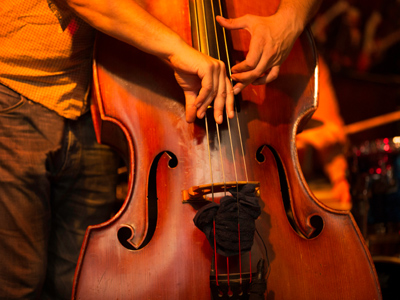
Piano, double bass and drums all feature in a rhythm section in a band.
Jazz Improvisation 01
Jazz improvisation is creating music in the moment. This KS3 quiz helps you understand solos, backing parts, and how musicians listen and respond during a performance.
1 .
Blues music originated in .......
African-American communities (USA) in late 19th century
France - in the 1970s in revolt to mainstream rock
London - in the 1960s
USA - 1999, as a new music to celebrate the millennium
Particularly from the Deep South, it is derived from spirituals, work songs, chants, shouts and simple ballads
2 .
A blue note is a .......
dynamic function
note played a bit lower than its pitch in a major scale
rhythmic function
special painted key on a keyboard instrument
Its function is entirely expressive and is a key element of the blues scale
3 .
What best describes a motif (or 'motive')?
A type of sheet music printing font
A type of 18th century dance
A short and recurring characteristic musical fragment
None of the above
A motif is a short musical idea (usually a series of notes) that is characteristic of a piece of music
4 .
In that case, what best describes a riff?
A repeated backing progression/melodic figure
A swishing sound generated by an electric guitar
A type of Indian flute
None of the above
A riff is an ostinato figure that forms the basis of a composition. It's very commonly found in rock and jazz music
5 .
Music derived from modes and transpositions of the 'white note scale' is commonly referred to as .......
balugan
diatonic
ionian
melorhythmic
Diatonic refers to the notes in a scale (eg C-D-E-F-G-A-B). It's the opposite of chromatic which also includes semitones (eg C-C#-D-D#-E-F-F#-G-G#-A-A#-B)
6 .
'Call and response' is a succession of .......
different dynamics
different key signatures over 8 bars
different time signatures over 4 bars
two distinct phrases often played by different musicians
Second phrase = often heard as commentary/'response' to the first
7 .
Which chord symbols move from tonic to dominant?
I - IV
I - II
II - V - I
None of the above
Tonic to dominant = I - V. V - I = dominant to tonic!
8 .
Which chord/bar structure is common in blues/jazz?
1-bar
2-bar
3-bar
12-bar
12-bar blues, as it's called, has become one of the most popular chord progressions in pop music
9 .
Which instruments make up a rhythm section in a band?
Piano
Double-bass
Drums
All of the above
The rhythm section provides the 'beat', 'pulse', or 'background' for the rest of the music
10 .
Which was a famous blues/jazz musician?
J.S. Bach
Lang Lang
Ludwig Van Beethoven
Miles Davis
Bach and Beethoven were classical composers while Lang Lang is a concert pianist
Our Social Circles




**Unlimited Quizzes Await You! 🚀**
Hey there, quiz champ! 🌟 You've already tackled today's free questions.
Ready for more?
Ready for more?
🔓 Unlock UNLIMITED Quizzes and challenge yourself every day. But that's
not all...
not all...
🔥 As a Subscriber you can join our thrilling "Daily Streak" against other
quizzers. Try to win a coveted spot on our Hall of Fame Page.
quizzers. Try to win a coveted spot on our Hall of Fame Page.
Don't miss out! Join us now and keep the fun rolling. 🎉
**Unlimited Quizzes Await You! 🚀**
Hey there, quiz champ! 🌟 You've already tackled today's free questions. Ready for more?
🔓 Unlock UNLIMITED Quizzes and challenge yourself every day. But that's not all...
🔥 As a Subscriber you can join our thrilling "Daily Streak" against other quizzers. Try to win a coveted spot on our Hall of Fame Page.
Don't miss out! Join us now and keep the fun rolling. 🎉
© Copyright 2016-2026 - Education Quizzes
Work Innovate Ltd - Design | Development |
Marketing
