Lucy
Ask the AI Tutor
Need help with 23 November 2025 - AI News Quiz for Children Aged 11-14 Years Old? Ask our AI Tutor!
Lucy AI Tutor - Lucy
Connecting with Tutor...
Please wait while we establish connection
Lucy
Hi! I'm Lucy, your AI tutor. How can I help you with 23 November 2025 - AI News Quiz for Children Aged 11-14 Years Old today?
now
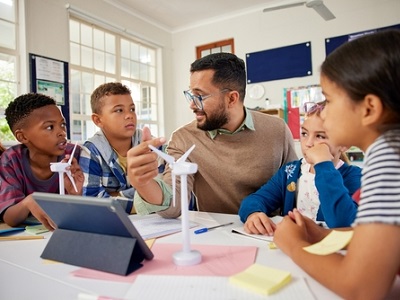
Teacher sitting at a classroom table with a mixed group of children, explaining a science activity that uses small model wind turbines and a digital tablet, as the pupils listen and discuss their ideas together in a bright, modern classroom.
Planning the next GPT-5 science project: one group tests wind turbines, the other checks whether AI can keep up with their questions.

23 November 2025 - AI News Quiz for Children Aged 11-14 Years Old

This quiz turns real AI news stories into friendly questions for young people aged 11-14. You will explore how scientists, teachers, companies and governments are using artificial intelligence in schools, science labs and everyday life. Some stories are serious, others are a bit weird or funny, but all of them show how fast AI is changing the world. You will see examples from the UK and around the globe.

If you do not know an answer, do not worry – just have a sensible guess and see what happens. After every question, the quiz will tell you straight away if you were right and explain the news in clear language. Play on your own, with friends or as a class and see who becomes the AI News Champion for this week. You might be surprised how much real science sits behind the headlines.


1 .
When researchers pointed AI at recordings of wild lions, what surprising thing did they discover?
Lions sometimes roar so quietly that only bats can hear them
Lions have a second “in-between” roar that hadn’t been catalogued before
Every lion in a pride roars in perfect musical harmony
Lions secretly copy other animals’ calls better than parrots
Using AI to analyse thousands of recordings from Tanzania, University of Exeter researchers found that lions don’t just use one famous full roar. There is also a shorter “intermediary roar” with its own pattern, helping scientists identify individual lions and track threatened populations more accurately.
2 .
When the UK announced a new AI Growth Zone in South Wales, what did it say this zone should do for local people?
Attract billions of pounds of data-centre investment and create thousands of jobs
Turn every school into a theme park with rollercoaster classrooms
Ban all non-AI businesses from the region for 20 years
Build a single mega-office where every UK tech company must move
The UK government’s plan for the South Wales AI Growth Zone says it should attract around £10 billion of investment from data-centre companies and support at least 5,000 jobs along the M4 corridor, helped by faster planning and skills funding.
3 .
What is the main “prize” scientists can apply for in the UK’s new AI for Science scheme using the Isambard-AI and Dawn supercomputers?
A free robot lab assistant that makes perfect tea for the whole team
Lifetime tickets to every science museum in the country
Huge chunks of supercomputer time to run AI-powered research
A luxury office on the Moon with zero-gravity whiteboards
The AIRR “AI for Science” call lets UK researchers apply for between 200,000 and 1,000,000 GPU hours on the Isambard-AI and Dawn supercomputers. There’s no cash prize – the reward is raw computing power for AI projects in areas like medical research, fusion energy and quantum tech.
4 .
What is the University of Bristol’s new “British Library for the AI age” mainly supposed to be?
A giant underground bunker where robots secretly swap memes and movie quotes all night long
A museum that only displays dusty, half-broken computers from the 1980s and nothing newer
A training camp where AI systems practise until they can beat every human at every video game ever made
A national data library that stores and shares high-quality AI research data
The University of Bristol is planning a multimillion-pound National AI Data Facility, described as a “British Library for the AI age.” It will hold trusted, well-organised datasets so researchers and companies can train and test AI systems more safely and fairly, boosting UK science and innovation.
5 .
Which medical problem are GSK and the Fleming Initiative mainly aiming at by teaming up with advanced AI?
Antibiotic resistance and dangerous drug-resistant infections
Ordinary colds that clear up in a few days anyway
Bruised knees from badly-timed football tackles
Mild hiccups caused by drinking fizzy drinks too fast
GSK and the Fleming Initiative have launched six new research programmes, backed by £45 million, that use advanced AI to study superbugs and drug-resistant fungi. The aim is to slow antimicrobial resistance, which makes antibiotics stop working and turns routine infections into serious threats.
6 .
What is the main goal of OpenAI’s new GPT-5 science project with universities and labs?
Write every school textbook in the world by itself
Help scientists discover new ideas and proofs faster
Replace all lab workers with robot clones overnight
Decide which subjects every student must study forever
OpenAI and partners at universities and national labs are running “early science acceleration” experiments with GPT-5, seeing how it can support real research from maths to biology. The model helps search huge literatures, suggest new ideas and contribute steps toward proofs and experiments, acting as a research co-pilot rather than replacing scientists.
7 .
When child-safety groups looked closely at new AI-powered toys, what was their biggest worry?
They are so boring that no child will ever want to play with them
They secretly make every toy in the bedroom turn into a robot army at night
They can expose kids to harmful chats and steal their data
They automatically tidy bedrooms and do all the chores so kids forget how to be responsible
Child-safety nonprofit Fairplay and more than 150 experts issued an advisory warning people not to buy AI toys for children. Reports show some chatbot toys having explicit conversations, encouraging unsafe behaviour and quietly collecting large amounts of kids’ data, so groups say traditional toys are safer.
8 .
When Google switched on its new AI scam-detection feature for Pixel phones in India, what is the feature actually designed to do during a phone call?
Translate every call into pirate language in real time
Auto-hang up on any relative who starts talking about exam results
Secretly record every word and send it to Google HQ for storage
Analyse calls on-device and warn you if they look like scams
At its “Safe and Trusted AI” event in New Delhi, Google announced real-time scam detection for Pixel phones in India. Powered by on-device AI, it analyses calls from unknown numbers on the phone itself and pops up warnings if the conversation matches common scam patterns, without saving or uploading the audio.
9 .
When xAI rolled out its Grok 4.1 chatbot update, what was one of the main improvements they bragged about?
It could control real rockets and land them on Mars without human help
It switched to only answering in rhyming song lyrics all the time
It became better at creative chat and cut down on wrong answers
It refused to talk about anything except Elon Musk’s pet projects in extreme detail
xAI says Grok 4.1 is a big upgrade on earlier versions, with more natural, emotionally aware conversations and fewer hallucinated mistakes. Benchmarks show it jumping up the model rankings, and reviewers highlight its stronger creative writing and “friendlier” personality as key changes.
10 .
When UK scientists teamed up at the Hartree Centre and the Faraday Institution, what did they decide to use AI for?
Speeding up next-generation battery design with powerful simulations
Teaching fridges to gossip about which leftovers taste the worst
Designing school chairs that automatically launch you outside at breaktime
Making a social-media app where only robots are allowed to post selfies
UKRI announced a collaboration between STFC’s Hartree Centre and the Faraday Institution to use AI-driven battery modelling and supercomputing. The goal is to discover and improve battery materials faster, boosting UK industry and helping reach net-zero climate targets.
Author:  Tara Kemp

© Copyright 2016-2025 - Education Quizzes
Work Innovate Ltd - Design | Development | Marketing