




Ask the AI Tutor
Need help with Mix and Match? Ask our AI Tutor!
AI Tutor - Lucy
Connecting with Tutor...
Please wait while we establish connection
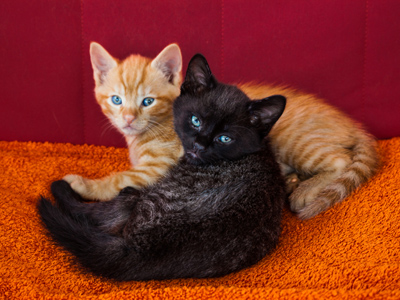
Find out what the kittens have been up to in this quiz!
Mix and Match
English has fixed word pairs like “back and forth” or “safe and sound”. This quiz helps you spot the pattern and choose the natural order.
1 .
In this Question, any of the phrases offered WOULD be acceptable, apart from ONE of them. Which is the 'wrong' one here?
'The house has hardly been quiet since the kittens were born; at any moment you may hear one of them, or probably all five, scampering ... ...'
'The house has hardly been quiet since the kittens were born; at any moment you may hear one of them, or probably all five, scampering ... ...'
... up and down.
... back and forth.
... hither and thither.
... out and back.
There are still plenty of other acceptable phrases that would have provided a fourth Answer, such as 'to and fro', 'hither and yon' etc.
2 .
Pick the answer that provides, or completes, the best pair.
'I've done my best to sort this out for you, but I fear that overall I've been ... ... '
'I've done my best to sort this out for you, but I fear that overall I've been ... ... '
... less of a help than a hindrance.
... more of a block than a boon.
... less of aid than an abomination.
... more of a stress than a service.
The other three Answers are all straight 'fakes'!
3 .
Pick the answer that provides, or completes, the best pair.
You arrive back to where you are staying in Britain after a long walk, during which the weather has turned blustery (windy, perhaps with squalls of rain). Someone very kindly makes you a pot of tea, which could well be described as :
You arrive back to where you are staying in Britain after a long walk, during which the weather has turned blustery (windy, perhaps with squalls of rain). Someone very kindly makes you a pot of tea, which could well be described as :
hot and bothered.
wet, warm and welcome.
firm but friendly.
tired but tasty.
Yes, it's a 'threesome' to start with, rather than a pair ... but such a typically British example, we could hardly resist it!
Answer 1 is an established phrase (suggesting someone who has worked hard, becoming ~ probably ~ sweaty and frustrated), but while the tea is hot and the person has 'bothered' to make it for you, this really doesn't quite fit the circumstances.
Answer 3 might describe a handshake, or the business style of a leader (or teacher): someone who expects their authority to be respected, but is not overly formal for the sake of it.
Answer 4 is an invented 'distractor'; as with Answer 1, it doesn't work well here ~ since the 'tired'-ness applies to 'you' while the 'tastiness' refers to the tea (we hope), rather than both ideas applying to the same side of the situation.
Answer 1 is an established phrase (suggesting someone who has worked hard, becoming ~ probably ~ sweaty and frustrated), but while the tea is hot and the person has 'bothered' to make it for you, this really doesn't quite fit the circumstances.
Answer 3 might describe a handshake, or the business style of a leader (or teacher): someone who expects their authority to be respected, but is not overly formal for the sake of it.
Answer 4 is an invented 'distractor'; as with Answer 1, it doesn't work well here ~ since the 'tired'-ness applies to 'you' while the 'tastiness' refers to the tea (we hope), rather than both ideas applying to the same side of the situation.
4 .
Pick the answer that provides, or completes, the best pair.
'We can all be very glad that the Inspectors' visit is now safely ... ... '
'We can all be very glad that the Inspectors' visit is now safely ... ... '
... over and done with.
... over and out.
... dead and buried.
... fanfared and finished.
Answer 1 is correct, if a rather shabby piece of English; it's certainly what many relieved people say!
Answer 2 dates from the earlier days of voice-radio communication, particularly among uniformed personnel (e.g. the armed and emergency forces): they would say 'Over' when they wanted the person at the other end of a conversation to speak, and 'Over and out' to end the conversation completely.
'Dead and buried' (Answer 3) would be tempting, but inappropriate, in these circumstances; Answer 4 may seem quite fun, but is a made-up example.
Answer 2 dates from the earlier days of voice-radio communication, particularly among uniformed personnel (e.g. the armed and emergency forces): they would say 'Over' when they wanted the person at the other end of a conversation to speak, and 'Over and out' to end the conversation completely.
'Dead and buried' (Answer 3) would be tempting, but inappropriate, in these circumstances; Answer 4 may seem quite fun, but is a made-up example.
5 .
Pick the answer that provides, or completes, the best pair.
'We all hope you get there ... ... by the end of your long journey.'
'We all hope you get there ... ... by the end of your long journey.'
... happy and glorious ...
... safe and sound ...
... hale and hearty ...
... prim and proper ...
Answer 2 also has a sibilant equivalent pair in French ('sain et sauf').
Answer 1 is borrowed from the National Anthem (and was quoted by the Chairman of the Olympic Committee after the 2012 Games had happened successfully in London, in the 60th anniversary year of the Queen's Accession).
Answer 3 refers more to someone who is still in good health at a great age, rather than necessarily after one long and tiring trip.
Answer 4 is a standard pair ~ but surely irrelevant in the circumstances of the Question.
Answer 1 is borrowed from the National Anthem (and was quoted by the Chairman of the Olympic Committee after the 2012 Games had happened successfully in London, in the 60th anniversary year of the Queen's Accession).
Answer 3 refers more to someone who is still in good health at a great age, rather than necessarily after one long and tiring trip.
Answer 4 is a standard pair ~ but surely irrelevant in the circumstances of the Question.
6 .
There is a long British tradition of using-up yesterday's spare odds-and-ends of cooked vegetables by frying them in a pan, as part of a savoury meal 'today' ~ e.g. with fresh bacon, sausages and/or eggs ~ to make a hot breakfast, or perhaps 'brunch'.
What is this dish called?
What is this dish called?
Bangers and mash.
Bubble and squeak.
Back and bake 'em.
Fry and frazzle.
Answer 1 would have been a (relatively!) 'fresh' meal, prepared from scratch; but Answer 2, catching the sounds of the food in the pan during the cooking, is the right one.
Answer 3 is a potential and alliterative 'fake', likewise Answer 4.
Answer 3 is a potential and alliterative 'fake', likewise Answer 4.
7 .
Pick the answer that provides, or completes, the best pair.
'The new Departmental Director seems to be making changes without ... ... '
'The new Departmental Director seems to be making changes without ... ... '
... rum and raisin.
... rhyme or reason.
... thinking or blinking.
... giving or taking.
Answer 2 is the correct one, though the use of 'rhyme' is metaphorical (to suggest any form of consistency or symmetry in what's being done).
'Rum and Raisin' was a very popular ice-cream flavour at around the time of the early home freezers in the 1970s.
As usual, the other two potential Answers were 'distractors' here.
'Rum and Raisin' was a very popular ice-cream flavour at around the time of the early home freezers in the 1970s.
As usual, the other two potential Answers were 'distractors' here.
8 .
Pick the answer that provides, or completes, the best pair.
'Sometimes the traffic along the bypass can be jammed up and running really slowly in the morning; but today, for some reason, it was all ... ... .'
'Sometimes the traffic along the bypass can be jammed up and running really slowly in the morning; but today, for some reason, it was all ... ... .'
... free and frantic.
... fun and games.
... fast and furious.
... flowing and flying.
Answer 3 is the standard phrase; Answer 2 is also a recognised phrase, but hardly appropriate to the serious (& potentially dangerous) matter of moving traffic.
The outer Answers (1 & 4) are each 'fake phrases'.
The outer Answers (1 & 4) are each 'fake phrases'.
9 .
Pick the answer that provides, or completes, the best pair.
There used to be a thriving factory here, but since it closed, the building and machinery have been allowed to go to ... ...
There used to be a thriving factory here, but since it closed, the building and machinery have been allowed to go to ... ...
... weeds and wasteland.
... muck and mess.
... rack and ruin.
... rest and relaxation.
Answer 3 is right, though 'rack' (so some dictionaries suggest) may well be a misspelling of another form of the verb 'wreck'.
Answers 1 & 2 are nicely alliterative but these are each made-up phrases that would not be recognised as standard.
The phrase in Answer 4 certainly does exist and refers to a state of recreation after hard work, but this is not appropriate in scale or nature to the longterm mass redundancies when an industrial plant closes down.
Answers 1 & 2 are nicely alliterative but these are each made-up phrases that would not be recognised as standard.
The phrase in Answer 4 certainly does exist and refers to a state of recreation after hard work, but this is not appropriate in scale or nature to the longterm mass redundancies when an industrial plant closes down.
10 .
Of the Answers offered, which ~ only ONE ~ would NOT complete the following in acceptable everyday English?
'Oh, you may find that somewhere in the drawer or cupboard, in among all the ... ... '
'Oh, you may find that somewhere in the drawer or cupboard, in among all the ... ... '
... odds and ends.
... bits and bobs.
... odds and sods.
... junk and jewels.
All the upper three Answers were fine, and 'bits and pieces' might have made the most obvious 4th acceptable option.
'Odds and sods' (Answer 3) has faintly rude overtones (un-proven, depending on what your hearer might think 'sod' means), and is probably the least formal version in what's already a clearly informal context.
You may also have met a related phrase 'flotsam and jetsam', referring to waste materials washed up on a beach by the tide. Technically, 'flotsam' = floating things, while 'jetsam' = items that have been thrown (e.g. overboard from ships, or off the land or maybe a pier); but by the time the sea has heaved them about, it probably makes little difference. Driftwood, such as a complete tree trunk, would presumably not count as 'jetsam'!
'Odds and sods' (Answer 3) has faintly rude overtones (un-proven, depending on what your hearer might think 'sod' means), and is probably the least formal version in what's already a clearly informal context.
You may also have met a related phrase 'flotsam and jetsam', referring to waste materials washed up on a beach by the tide. Technically, 'flotsam' = floating things, while 'jetsam' = items that have been thrown (e.g. overboard from ships, or off the land or maybe a pier); but by the time the sea has heaved them about, it probably makes little difference. Driftwood, such as a complete tree trunk, would presumably not count as 'jetsam'!



**Unlimited Quizzes Await You! 🚀**
Hey there, quiz champ! 🌟 You've already tackled today's free questions.
Ready for more?
Ready for more?
🔓 Unlock UNLIMITED Quizzes and challenge yourself every day. But that's
not all...
not all...
🔥 As a Subscriber you can join our thrilling "Daily Streak" against other
quizzers. Try to win a coveted spot on our Hall of Fame Page.
quizzers. Try to win a coveted spot on our Hall of Fame Page.
Don't miss out! Join us now and keep the fun rolling. 🎉
**Unlimited Quizzes Await You! 🚀**
Hey there, quiz champ! 🌟 You've already tackled today's free questions. Ready for more?
🔓 Unlock UNLIMITED Quizzes and challenge yourself every day. But that's not all...
🔥 As a Subscriber you can join our thrilling "Daily Streak" against other quizzers. Try to win a coveted spot on our Hall of Fame Page.
Don't miss out! Join us now and keep the fun rolling. 🎉




© Copyright 2016-2026 - Education Quizzes
Work Innovate Ltd - Design | Development |
Marketing
