




Ask the AI Tutor
Need help with Analysing Substances? Ask our AI Tutor!
AI Tutor - Lucy
Connecting with Tutor...
Please wait while we establish connection
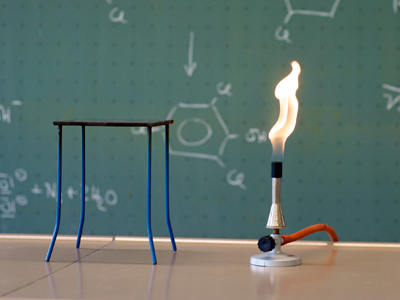
The flame test is used to find out what metal ion (cation) is present in a compound.
Analysing Substances
Learn how GCSE Chemistry identifies unknown substances using practical methods. Explore chromatography, flame tests and chemical tests, then check your understanding with this quiz.
1 .
Which of the following compounds would burn yellow in the flame test?
Sodium chloride
Calcium chloride
Potassium chloride
Barium chloride
Sodium gives a distinctive yellow colour. This is where street lights get their colour from
2 .
Three unknown solutions are added to test tubes of dilute nitric acid and silver nitrate. Each shows a positive result for the test. What ions are present in each tube in order if the colours produced are white, cream and pale yellow?
Iodide, bromide, chloride
Chloride, iodide, bromide
Chloride, bromide, iodide
Iodide, chloride, bromide
The precipitates are silver chloride, silver bromide and silver iodide
3 .
Which of the following can iodine NOT be used for testing for?
Presence of carbon dioxide
Unsaturation of oils
Presence of starch
Unsaturation of hydrocarbons
Limewater is used to test for the presence of carbon dioxide
4 .
A white precipitate results from the reaction between an unknown substance and sodium hydroxide. Which ion CANNOT be present in the unknown substance?
Calcium 2+
Magnesium 2+
Aluminium 3+
Copper 2+
Copper 2+ ions produce a light blue precipitate, the other three produce white precipitates
5 .
The meniscus is the curve in the upper surface of a liquid caused by surface tension. When measuring the amount of liquid held in a burette, which part of the meniscus do you measure from?
The bottom
The edge
The average height
The top
The meniscus is read at the bottom of the curve. Always read the volume with your eye at the meniscus level to avoid parallax error
6 .
A reddish brown precipitate results from the reaction between an unknown substance and sodium hydroxide. Which ion is present in the unknown substance?
Copper 2+
Iron 2+
Aluminium 3+
Iron 3+
Obtaining a white precipitate could indicate several different metals, however, coloured precipitates are more useful as they identify specific metals
7 .
A titration is used to accurately measure volumes of liquids required to carry out chemical reactions such as neutralisation reactions. Name the long glass tube which is required to carry out a titration.
Pipette
Burette
Clamp stand
Conical flask
It can be used to measure the volume of any liquid with great accuracy
8 .
What metal should the wire loop be made of that is holding your unknown compound during a flame test?
Copper
Silver
Gold
Platinum
This is an inert metal and can be heated to a high temperature before it melts. Most school laboratories, however, use nichrome wire as it is cheaper
9 .
A chromatogram is produced in a process called chromatography. There are several types of chromatography. Which of the following is NOT a type of chromatography?
Gas - liquid
Gel permeation
Ion-exchange
UV-Visible
UV-visible is a type of spectroscopy. Chromatography involves the movement of a solvent which separates the chemicals from one-another in a mixture
10 .
Which element produces a green flame when burned in a flame test?
Lithium
Sodium
Potassium
Barium
The flame test wire must be very clean



**Unlimited Quizzes Await You! 🚀**
Hey there, quiz champ! 🌟 You've already tackled today's free questions.
Ready for more?
Ready for more?
🔓 Unlock UNLIMITED Quizzes and challenge yourself every day. But that's
not all...
not all...
🔥 As a Subscriber you can join our thrilling "Daily Streak" against other
quizzers. Try to win a coveted spot on our Hall of Fame Page.
quizzers. Try to win a coveted spot on our Hall of Fame Page.
Don't miss out! Join us now and keep the fun rolling. 🎉
**Unlimited Quizzes Await You! 🚀**
Hey there, quiz champ! 🌟 You've already tackled today's free questions. Ready for more?
🔓 Unlock UNLIMITED Quizzes and challenge yourself every day. But that's not all...
🔥 As a Subscriber you can join our thrilling "Daily Streak" against other quizzers. Try to win a coveted spot on our Hall of Fame Page.
Don't miss out! Join us now and keep the fun rolling. 🎉




© Copyright 2016-2026 - Education Quizzes
Work Innovate Ltd - Design | Development |
Marketing
