UKUK USUSIndiaIndia
Progress you can see
Join Us
Lucy
Ask the AI Tutor
Need help with Atomic Structure 1? Ask our AI Tutor!
Lucy AI Tutor - Lucy
Connecting with Tutor...
Please wait while we establish connection
Lucy
Hi! I'm Lucy, your AI tutor. How can I help you with Atomic Structure 1 today?
now
Atomic Structure 1
The protons of an atom are found in the nucleus of the atom.

Atomic Structure 1

Atoms are tiny building blocks made of protons, neutrons and electrons. This GCSE Chemistry quiz helps you read atomic numbers, work out masses, and understand electron arrangement.

Explore the Topic →
(quiz starts below)

Isotopes are atoms of the same element with the same number of protons but different numbers of neutrons. This means they have different mass numbers.

In GCSE Chemistry, atomic structure explains what atoms are made of and how we use atomic number and mass number to describe them. You also learn how electrons are arranged and how this links to the Periodic Table and chemical reactions.

  • Atomic number: The number of protons in an atom. It tells you which element it is.
  • Mass number: The number of protons plus neutrons in an atom’s nucleus.
  • Electron shell: A region around the nucleus where electrons are found, often shown as rings in simple diagrams.
What is atomic structure in GCSE Chemistry?

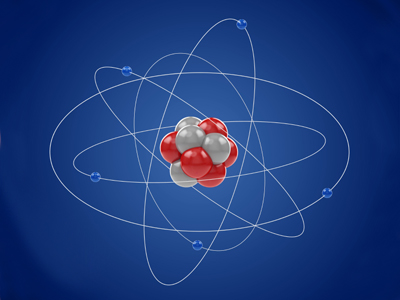
Atomic structure is the model of an atom showing a nucleus containing protons and neutrons, with electrons moving around the nucleus in shells.

How do you work out the number of neutrons in an atom?

You work out neutrons by subtracting the atomic number from the mass number. This works because atomic number counts protons, and mass number counts protons + neutrons.

How are electrons arranged in shells at GCSE?

At GCSE level, electrons fill shells from the inside out. The first shell holds up to 2 electrons, the second up to 8, and the third up to 8 for the first 20 elements.

1 .
Pick the correct combination for the charges of sub-atomic particles.
Proton +ve Neutron 0 Electron -ve
Proton 0 Neutron +ve Electron -ve
Proton +ve Neutron -ve Electron 0
Proton 0 Neutron 0 Electron -ve
The protons attract and keep the electrons in the atom as these two particles have opposite charges
2 .
The numbers in the options below represent the masses of the three sub-atomic particles. Pick the correct combination.
Proton 1 Neutron 0 Electron 1
Proton 0 Neutron 1 Electron 1
Proton 1 Neutron 1 Electron 0
Proton 1 Neutron 1 Electron 1
The mass of an electron is actually about 1/1860 amu, but since this is such a tiny mass, it is referred to as being 0
3 .
The mass number of an element tells us...
the number of protons in the nucleus
the number of protons plus electrons
the number of neutrons plus electrons
the number of neutrons plus protons
It is the total number of protons and neutrons found in the nucleus
4 .
The atomic number of an element tells us...
the number of neutrons in the nucleus
the number of electrons orbiting the nucleus
the number of protons orbiting the nucleus
the number of electrons in the nucleus
The answer mentioning neutrons is incorrect because you need the mass number as well as the atomic number to work this out. Two of the other answers are incorrect because protons don't orbit the nucleus and you don't find electrons in the nucleus.

The atomic number is also called the proton number because it tells you the number of protons in the nucleus. For the GCSE, you need to know that elements are neutral atoms. In a neutral atom, the number of electrons orbiting the nucleus is the same as the number of protons within the nucleus. If you are not sure why, ask your science teacher to explain

5 .
The atomic number of an element is 11 and its mass number is 23. Pick the correct combination of protons, neutrons and electrons.
p=12, n=12, e=11
p=11, n=11, e=12
p=12, n=11, e=11
p=11, n=12, e=11
The number of protons and the number of electrons are both given by the atomic number i.e. 11 of each. The difference between the atomic number and the mass number gives you the number of neutrons
6 .
The protons of an atom are found...
in the nucleus of the atom
in orbit around the outside of the nucleus
dotted throughout the atom
in lines radiating out from the nucleus
They are clustered together with the neutrons
7 .
The electrons are found...
in the nucleus of the atom
in orbit around the outside of the nucleus
dotted throughout the atom
in lines radiating out from the nucleus
They are found in specific areas known as energy levels or electron shells
8 .
The neutrons of an atom are found...
in the nucleus of the atom
in orbit around the outside of the nucleus
dotted throughout the atom
in lines radiating out from the nucleus
They are clustered together with the protons
9 .
Carbon has two isotopes. These atoms have...
The same number of protons, but different numbers of electrons
The same number of electrons, but different numbers of protons
The same number of protons, but different numbers of neutrons
The same number of neutrons, but different numbers of electrons

 The mass number shown in the Periodic Table is an average of the mass of the isotopes

10 .
If an element has 56 protons, 56 electrons and 81 neutrons, what is its mass number?
56
81
137
112
Mass number = number of protons + number of neutrons
You can find more about this topic by visiting BBC Bitesize - Atomic structure

Author:  Kate Gardiner (Chemistry Educator & GCSE Quiz Writer)

© Copyright 2016-2026 - Education Quizzes
Work Innovate Ltd - Design | Development | Marketing