




Ask the AI Tutor
Need help with Electrolysis 1? Ask our AI Tutor!
AI Tutor - Lucy
Connecting with Tutor...
Please wait while we establish connection
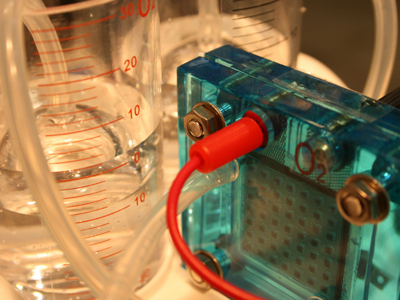
The substance broken down by electrolysis is called the electrolyte.
Electrolysis 1
Electrolysis uses electricity to split ionic substances. This GCSE Chemistry quiz checks electrodes, ion movement, and what forms at each electrode in molten salts and solutions.
1 .
Why does an electrolyte need to be either molten or in solution?
To ensure the atoms can move
To enable the ions to move
So that water ions can be involved in the reaction
So that the electrodes can be put in the electrolyte
If the electrolyte is solid, the ions are unable to move and so electricity cannot flow. You should have discarded the first option the second you read the word 'atoms' - atoms have no overall charge and therfore are unaffected by electrolysis
2 .
Pick the correct combination for the names of the positive and negative electrodes.
+ve anode -ve negode
+ve cathode -ve anode
+ve posode -ve cathode
+ve anode -ve cathode
Electrodes get their names from the type of ion they attract
3 .
When lead bromide is electrolysed...
Pb 2+ is reduced at the cathode, Br- is oxidised at the anode
Pb2+ is oxidised at the cathode, Br- is reduced at the anode
Pb2+ is reduced at the anode, Br- is oxidised at the cathode
Pb3+ is reduced at the cathode, Br- is oxidised at the anode
Reduction is a gain of electrons and oxidation is a loss of electrons. Metals are produced from their ores by reduction of their ions
4 .
Pick the correct half equations to show what happens when an aqueous solution of KCL is electrolysed.
Cathode: K+ + e- → K
Anode: 2Cl- → Cl2 +2e-
Anode: 2Cl- → Cl2 +2e-
Cathode: 2H+ + 2e- → H2
Anode: 2Cl- → Cl2 + 2e-
Anode: 2Cl- → Cl2 + 2e-
Cathode: H+ + e- → H
Anode: 2Cl- → Cl2 +2e-
Anode: 2Cl- → Cl2 +2e-
Cathode: K+ + e- → K
Anode: Cl- → Cl + e-
Anode: Cl- → Cl + e-
Hydrogen gas is produced because it is less reactive than potassium
5 .
Pick the correct combination to show what is collected at each electrode when molten copper bromide is electrolysed.
Copper ions at the cathode, Bromine gas at the anode
Copper metal at the anode, Bromide ions at the cathode
Copper metal at the cathode, Bromine gas at the anode
Copper metal at the anode, Bromine gas at the cathode
Bromine has a red-brown colour and its molecules are diatomic (contain 2 atoms bonded covalently so its formula is Br2)
6 .
Pick the correct half equations to show what happens when PbBr2 is electrolysed.
Cathode: Pb+ + e- → Pb
Anode: 2Br- → Br2 + 2e-
Anode: 2Br- → Br2 + 2e-
Anode: Pb2+ + 2e- → Pb
Cathode: 2Br- → Br2 + 2e-
Cathode: 2Br- → Br2 + 2e-
Cathode: Pb2+ + 2e- → Pb
Anode: Br- → Br + 2e-
Anode: Br- → Br + 2e-
Cathode: Pb2+ +2e- → Pb
Anode: 2Br- → Br2 + 2e-
Anode: 2Br- → Br2 + 2e-
This is only going to come up in the higher tier of the exam
7 .
When a negatively charged ion reaches the positively charged electrode...
It can lose an electron to become a neutral atom
It can lose an electron to become a positive ion
It gains an electron to become a neutral atom
It gains an electron to become a negative ion
Many anions (e.g sulfate - SO42-) are too stable to lose their electron and in those cases oxygen is released from the small quantity of hydroxide ions that are always present in water. Substances containing the stable anions are therefore only electrolytes when in solution
8 .
During electrolysis...
+ve ions move to cathode and -ve ions move to anode
+ve ions move to anode and -ve ions move to cathode
+ve ions and -ve ions move to cathode
+ve ions and -ve ions move to anode
Remember: opposite charges attract
9 .
What do we call the substance broken down by electrolysis?
Solvent
Solute
Substrate
Electrolyte
This word is reasonably easy to remember being so close to electrolysis. An electrolyte must separate into positive and negative ions when it is molten or dissolved in water
10 .
Electrolysis means which of the following?
Splitting up substances using heat
Splitting up substances using electrons
Splitting up substances using electricity
Joining up substances using electricity
It is a chemical decomposition



**Unlimited Quizzes Await You! 🚀**
Hey there, quiz champ! 🌟 You've already tackled today's free questions.
Ready for more?
Ready for more?
🔓 Unlock UNLIMITED Quizzes and challenge yourself every day. But that's
not all...
not all...
🔥 As a Subscriber you can join our thrilling "Daily Streak" against other
quizzers. Try to win a coveted spot on our Hall of Fame Page.
quizzers. Try to win a coveted spot on our Hall of Fame Page.
Don't miss out! Join us now and keep the fun rolling. 🎉
**Unlimited Quizzes Await You! 🚀**
Hey there, quiz champ! 🌟 You've already tackled today's free questions. Ready for more?
🔓 Unlock UNLIMITED Quizzes and challenge yourself every day. But that's not all...
🔥 As a Subscriber you can join our thrilling "Daily Streak" against other quizzers. Try to win a coveted spot on our Hall of Fame Page.
Don't miss out! Join us now and keep the fun rolling. 🎉




© Copyright 2016-2026 - Education Quizzes
Work Innovate Ltd - Design | Development |
Marketing
