




Ask the AI Tutor
Need help with Periodic Table - Group 1 Elements? Ask our AI Tutor!
AI Tutor - Lucy
Connecting with Tutor...
Please wait while we establish connection
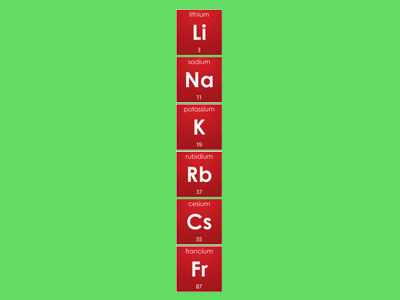
Group 1 metals react with non-metals forming an ionic bond.
Periodic Table - Group 1 Elements
Group 1 metals are highly reactive and form +1 ions. This GCSE Chemistry quiz revises trends, equations, and how alkali metals react with water and halogens.
1 .
Group 1 elements are also known as...
Alkali metals
Alkali earth metals
Noble gases
Halogens
When they react with water they form strong alkalis
2 .
Choose the correct order from the top to bottom of group 1.
Li, Na, Fr, K, Cs, Rb
Fr, Cs, Rb, K, Na, Li
Li, Na, K, Rb, Cs, Fr
Li, K, Na, Cs, Fr, Rb
The size of the atoms increases down the group
3 .
Group 1 elements only form what type of ion?
1+
2+
3+
2-
They all lose one electron to achieve the electron configuration of the nearest noble gas
4 .
What colour flame is seen when potassium reacts with water?
Green
Blue
Orange
Lilac
This is the characteristic colour of the flame when sodium vapour ignites
5 .
What gas is given off when group 1 elements react with water?
Chlorine gas
Water vapour
Hydrogen gas
Carbon dioxide gas
Hydrogen gas burns with a squeaky pop
6 .
When a group 1 element reacts with water, a hydroxide is formed. What colour could Universal Indicator turn in this solution?
Blue
Red
Orange
Green
Hydroxides are alkalis, group 1 metals form strong alkalis. Depending on the quantities of metal and water used in the experiment, the final pH will therefore be 12 - 14, which would show up as blue or purple when Universal Indicator is used. Red and orange indicate acidic conditions, green indicates a neutral solution
7 .
Group 1 metals react with non-metals forming what type of bond?
Covalent
Ionic
Metallic
Hydrogen
One electron is transferred to a non-metal atom during the reaction
8 .
Which of the following is NOT a property of group 1 metals?
Shiny when cut
Low density
Very hard
Low melting point
These metals can easily be cut using a scalpel
9 .
How many electrons are in the outer shell of group 1 elements?
2
8
1
0
That is why their group is named 'group 1'
10 .
The reactivity of group 1 elements increases down the group. This is because...
it becomes easier to lose an electron
it becomes harder to lose an electron
it becomes easier to gain an electron
it becomes harder to gain an electron
It becomes easier because the attraction between the positive protons in the nucleus and the electrons in the outer shell becomes weaker as the distance becomes greater



**Unlimited Quizzes Await You! 🚀**
Hey there, quiz champ! 🌟 You've already tackled today's free questions.
Ready for more?
Ready for more?
🔓 Unlock UNLIMITED Quizzes and challenge yourself every day. But that's
not all...
not all...
🔥 As a Subscriber you can join our thrilling "Daily Streak" against other
quizzers. Try to win a coveted spot on our Hall of Fame Page.
quizzers. Try to win a coveted spot on our Hall of Fame Page.
Don't miss out! Join us now and keep the fun rolling. 🎉
**Unlimited Quizzes Await You! 🚀**
Hey there, quiz champ! 🌟 You've already tackled today's free questions. Ready for more?
🔓 Unlock UNLIMITED Quizzes and challenge yourself every day. But that's not all...
🔥 As a Subscriber you can join our thrilling "Daily Streak" against other quizzers. Try to win a coveted spot on our Hall of Fame Page.
Don't miss out! Join us now and keep the fun rolling. 🎉




© Copyright 2016-2026 - Education Quizzes
Work Innovate Ltd - Design | Development |
Marketing
