




Ask the AI Tutor
Need help with Rates of Reaction 2? Ask our AI Tutor!
AI Tutor - Lucy
Connecting with Tutor...
Please wait while we establish connection
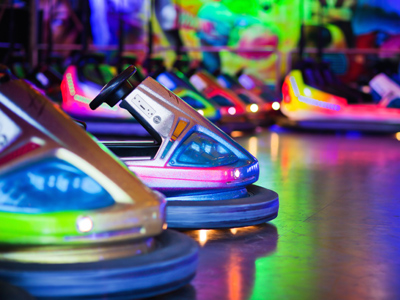
Check out questions 3 and 4 to see what bumper cars and chemistry have in common!
Rates of Reaction 2
Rates of reaction links particle collisions to reaction speed. Learn how concentration, pressure, catalysts and surface area change collision frequency and help you predict which reactions happen faster.
1 .
Increasing the temperature of the reactants in a chemical reaction increases the rate of the chemical reaction. This is because...
particles collide less often, but they have more energy
particles collide more often and they collide with less energy
particles collide more often and they collide with more energy
particles collide less often with less energy
The higher the temperature, the more energy they have and the faster they move
2 .
Around room temperature, if we increase the temperature of a reaction by 10°C, the rate of the reaction will approximately...
halve
triple
stay the same
double
It is just an approximation but for most reactions, it is not far wrong
3 .
Why does increasing the concentration of reactants increase the rate of a reaction?
If the concentration of reactants is increased, there are more particles available to react
If the concentration of reactants is increased, the particles have more energy
If the concentration of reactants is increased, there are fewer particles available to react
If the concentration of reactants is increased, the particles are at the right angle to collide
Imagine bumper cars at the fair. The more cars there are, the more likely they are to 'bump' into each other
4 .
How does increasing the pressure increase the rate of a chemical reaction?
If the pressure is increased, the particles are further away from each other
If the pressure is increased, the particles are moving faster
If the pressure is increased, the particles have more energy
If the pressure is increased, the particles are closer together
Imagine again the bumper cars. If the bumper cars are closer together, they are more likely to collide. Increasing the pressure of a gas is the equivalent of increasing the concentration of a reaction taking place in the liquid state
5 .
A catalyst speeds up a chemical reaction by...
reducing the amount of energy required by the particles to react
increasing the amount of energy required by the particles to react
increasing the pressure of the reactants
increasing the temperature of the reactants
If the activation energy is lower, in any given system, more particles will have sufficient energy to react
6 .
If the surface area of a solid reactant is increased, why is the rate of reaction increased?
There are fewer particles on the surface of the solid available to react
There are more particles on the surface of the solid available to react
The particles are moving more quickly
The particles have more energy
This is why powders react faster than lumps of chemical
7 .
Scientists have developed catalysts that enable reactions to take place at lower temperatures. Why is this advantageous to the manufacturer and the environment?
It is cheaper for the manufacturer because less fuel is needed to provide the high temperatures
It is better for the environment because there is less fuel being burnt and so less carbon dioxide being emitted
It is better for the environment because there is less fuel being burnt and so less carbon dioxide being emitted
It is better for the manufacturer because catalysts are cheap to buy
It is better for the environment because the catalyst does not harm the environment
It is better for the environment because the catalyst does not harm the environment
It is better for the manufacturer because the catalyst can be reused
It is better for the environment because there are more toxic gases being released
It is better for the environment because there are more toxic gases being released
It is better for the manufacturer because the catalyst is often very expensive
It is better for the environment because there are fewer toxic emissions
It is better for the environment because there are fewer toxic emissions
More product can be made in less time, using less energy and producing less pollution - a winning situation for everyone
8 .
Chemical reactions eventually stop. What is the usual reason for this?
Reactants run out
Catalyst runs out
Particles have used up all their energy
Products have taken the particles' energy
Reactions become slower and slower as they proceed because there are fewer and fewer particles to collide. When one or the other (or even both) of the reactants are used up, the reaction stops. We say it has reached completion
9 .
Why can icing sugar cause an explosion but sugar lumps can't?
The icing sugar has more energy
The icing sugar has more particles
The icing sugar has a larger surface area
The sugar lumps have more energy
These types of explosion are known as powder explosions and can happen in places where fine powders are being handled. Care must be taken that there are no naked flames or sparks
10 .
Some chemical reactions may take place twice as quickly if their temperature is raised by 10°C. If a particular reaction takes 32 minutes at 20°C, how long will it take if the temperature is raised to 60°C?
2 minutes
4 minutes
6 minutes
8 minutes
At 20°C = 32 mins, at 30°C = 16 mins, at 40°C = 8 mins, at 50°C = 4 mins, at 60°C = 2 mins



**Unlimited Quizzes Await You! 🚀**
Hey there, quiz champ! 🌟 You've already tackled today's free questions.
Ready for more?
Ready for more?
🔓 Unlock UNLIMITED Quizzes and challenge yourself every day. But that's
not all...
not all...
🔥 As a Subscriber you can join our thrilling "Daily Streak" against other
quizzers. Try to win a coveted spot on our Hall of Fame Page.
quizzers. Try to win a coveted spot on our Hall of Fame Page.
Don't miss out! Join us now and keep the fun rolling. 🎉
**Unlimited Quizzes Await You! 🚀**
Hey there, quiz champ! 🌟 You've already tackled today's free questions. Ready for more?
🔓 Unlock UNLIMITED Quizzes and challenge yourself every day. But that's not all...
🔥 As a Subscriber you can join our thrilling "Daily Streak" against other quizzers. Try to win a coveted spot on our Hall of Fame Page.
Don't miss out! Join us now and keep the fun rolling. 🎉




© Copyright 2016-2026 - Education Quizzes
Work Innovate Ltd - Design | Development |
Marketing
