




Ask the AI Tutor
Need help with Macbeth - Illustrating and Supporting Points? Ask our AI Tutor!
AI Tutor - Lucy
Connecting with Tutor...
Please wait while we establish connection
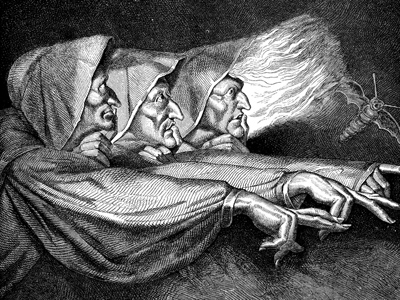
"When the hurly-burly's done..."
Macbeth - Illustrating and Supporting Points
This GCSE English Literature quiz focuses on illustrating and supporting points about Macbeth, helping you choose vivid quotations and clear explanations for high-scoring exam answers.
Read the text from Macbeth and then choose the answer which best uses evidence in support of a point.
1 .
"Upon my head they placed a fruitless crown / And put a barren sceptre in my gripe." - Macbeth
Macbeth regrets that his descendants will not inherit the throne, worrying that the witches have given him a "fruitless" crown and a barren "sceptre"
Macbeth regrets that his descendants will not inherit the throne, worrying that the witches have given him a "fruitless crown" and a "barren sceptre"
Macbeth regrets that his descendants will not inherit the throne, worrying that the witches have given him a fruitless crown and a barren sceptre
Macbeth regrets that his descendants will not "inherit" the throne, worrying that the "witches" have given him a "fruitless crown" and a "barren sceptre"
Use quotation marks to show precisely which words have been quoted from the text. Avoid using scare quotes in the same sentence with quotations from the text, as in the final choice above ("inherit" and "witches"), because doing so can lead to confusion
2 .
"I have bought / Golden opinions from all sorts of people, / Which would be worn now in their newest gloss, / Not cast aside so soon." - Macbeth
Macbeth thinks of other people's impressions of him as clothing: they are golden opinions which he does not wish to cast aside
Macbeth thinks of other people's impressions of him as "clothing": they are "golden" opinions which he does not wish to cast "aside"
Macbeth thinks of other people's impressions of him as clothing: they are "golden opinions" which he does not wish to "cast aside"
Macbeth thinks of other people's "impressions" of him as "clothing": they are "golden opinions" which he does not wish to "cast aside"
Remember to make a point and back it up with evidence. This point could be followed by a discussion of the concern with false appearances in the play
3 .
"There's no art / To find the mind's construction in the face." - The King
One of the themes of Macbeth is the lack of correspondence between physical appearance and character. The King makes this point when he comments on the impossibility of reading a man's character in his face
One of the themes of Macbeth is the lack of correspondence between physical appearance and character. The King makes this point when he says, "There's no art to find the mind's construction in the face"
By saying "There's no art to find the mind's construction in the face", the King comments on how appearances can be deceptive
All of the above
It is useful to practise a number of ways to use evidence, including paraphrasing and the quotation of entire sentences
4 .
"If you can look into the seeds of time, / And say which grain will grow, and which will not, / Speak then to me." - Banquo
Banquo views "present" events as "seeds of time" which will grow into "future" events
Banquo views present events as seeds of time which will grow into future events
Banquo views present events as "seeds of time" which will grow into future events
Banquo talks - "seeds of time" - about present events which will grow into future events
Remember to include short quotations as part of your sentence, rather than dropping them mid-sentence
5 .
"Thou shalt not live, / That I may tell pale-hearted fear it lies / And sleep in spite of thunder." - Macbeth
Macbeth is ashamed of "pale-hearted" fear and has no trouble "sleeping in spite of thunder"
Macbeth is ashamed of pale-hearted fear and has no trouble "sleeping in spite of thunder"
Macbeth's determination to destroy those whom he fears represents an attempt to feel safe, to sleep in spite of thunder
Macbeth's determination to destroy those whom he fears represents an attempt to feel safe, to "sleep in spite of thunder"
Be sure to quote accurately. To "sleep in spite of thunder" is an accurate quotation, whereas "sleeping in spite of thunder" is not
6 .
"Our high-placed Macbeth / Shall live the lease of nature, pay his breath / To time, and mortal custom." - Macbeth
Macbeth refers to himself both with the royal "we", saying "our", and in the "third" person as "Macbeth"
Macbeth refers to himself both with the royal "we", saying our, and in the third person as Macbeth
In saying our high-placed Macbeth, Macbeth refers to himself in both the first and the third person simultaneously
In saying "Our high-placed Macbeth", Macbeth refers to himself in both the first and the third person simultaneously
Sometimes only a few quoted words are needed in order to provide the evidence for the point being made. Try not to quote several single words in a sentence, however, unless these are in a list (the first answer would be very clumsy even if it were correct)
7 .
"His two chamberlains / Will I with wine and wassail so convince, / That memory, the warder of the brain, / Shall be a fume." - Lady Macbeth
Lady Macbeth compares memory to a "warder" guarding the brain
Lady Macbeth compares "memory" to a "warder" guarding the brain
Lady Macbeth intends to get the chamberlains drunk through "wine" and wassail
Lady Macbeth intends to get the "chamberlains" drunk through "wine" and "wassail"
An ordinary word, such as "memory" or "wine", does not require quotation marks unless it is being used in an unusual way
8 .
"Be this the whetstone of your sword. Let grief / Convert to anger; blunt not the heart, enrage it." - Malcolm
Malcolm encourages Macduff to use his "anger" to fight Macbeth, sharpening his "sword" on the "whetstone" of his "grief"
Malcolm encourages Macduff to use his anger to fight Macbeth, sharpening his sword on the "whetstone of his grief"
Malcolm encourages Macduff to use his anger to fight Macbeth, sharpening his sword on the "whetstone" of his grief
Malcolm encourages Macduff to use his anger to fight Macbeth, "sharpening his sword" on the "whetstone" of his grief
Here, the idea of grief being a sharpening tool for a sword is first explained, then supported with a quotation
9 .
"When the hurly-burly's done, / When the battle's lost, and won." - 2nd Witch
By referring to battle dismissively as a "hurly-burly" and acknowledging both the "winning" and the "losing" sides, the witch shows little interest in human affairs
By referring to battle dismissively as a "hurly-burly" and acknowledging both the winning and the losing sides, the witch shows little interest in human affairs
By referring to battle dismissively as a "hurly-burly" and acknowledging both the winning and the losing "sides", the "witch" shows little interest in human affairs
By referring to battle dismissively as a hurly-burly and acknowledging both the winning and the losing sides, the witch shows little interest in human affairs
Here evidence has been combined through a short quotation and some paraphrasing to make the point that the witches do not much care who wins the battle
10 .
"Your face, my thane, is as a book, where men / May read strange matters." - Lady Macbeth
Lady Macbeth warns her husband that his facial expression gives him away, "as a book" where men may read strange matters
Lady Macbeth warns her husband that his facial expression gives him away, saying that others may read him "as a book"
Lady Macbeth warns her husband that his facial expression gives him away. "Your face, my thane, is as a book."
Lady Macbeth warns her husband that his facial expression gives him away, as a book where men may read strange matters
Avoid using quotations as entire sentences without any explanation, as in the third answer here



**Unlimited Quizzes Await You! 🚀**
Hey there, quiz champ! 🌟 You've already tackled today's free questions.
Ready for more?
Ready for more?
🔓 Unlock UNLIMITED Quizzes and challenge yourself every day. But that's
not all...
not all...
🔥 As a Subscriber you can join our thrilling "Daily Streak" against other
quizzers. Try to win a coveted spot on our Hall of Fame Page.
quizzers. Try to win a coveted spot on our Hall of Fame Page.
Don't miss out! Join us now and keep the fun rolling. 🎉
**Unlimited Quizzes Await You! 🚀**
Hey there, quiz champ! 🌟 You've already tackled today's free questions. Ready for more?
🔓 Unlock UNLIMITED Quizzes and challenge yourself every day. But that's not all...
🔥 As a Subscriber you can join our thrilling "Daily Streak" against other quizzers. Try to win a coveted spot on our Hall of Fame Page.
Don't miss out! Join us now and keep the fun rolling. 🎉




© Copyright 2016-2026 - Education Quizzes
Work Innovate Ltd - Design | Development |
Marketing
