UKUK USUSIndiaIndia
Progress you can see
Join Us
Lucy
Ask the AI Tutor
Need help with GCSE English Gap Finder? Ask our AI Tutor!
Lucy AI Tutor - Lucy
Connecting with Tutor...
Please wait while we establish connection

Lucy
Hi! I'm Lucy, your AI tutor. How can I help you with GCSE English Gap Finder today?
now
A gold-nibbed fountain pen writing on parchment paper.
Identify your writing gaps and master the technical skills needed for GCSE English success.

GCSE English Gap Finder

Use this GCSE English Gap-Finder to pinpoint what you know, what you’ve missed, and what to revise next, from reading skills to writing clearly and accurately.

Explore the Topic →
(quiz starts below)

Fascinating Fact:

Rhetorical devices, like repetition and questions, are used in speeches and adverts to persuade, not just in poems.

In GCSE English, students learn to read texts with precision and write for clear purpose and audience. A gap-finder quiz helps you spot which skills need revision, such as analysing methods, structuring responses, and improving technical accuracy.

  • Purpose: The reason a text is written, such as to inform, persuade, or entertain.
  • Audience: The person or group a text is aimed at, which affects language choices.
  • Method: A writer’s technique, such as imagery, tone, structure, or punctuation, used to create an effect.
What should I revise for GCSE English if I keep losing marks?

Revise the basics of identifying methods, explaining effects with evidence, and planning answers, then practise accuracy in spelling, punctuation, and sentence control.

How do I write a strong GCSE English analysis paragraph?

Start with a clear point, add a short quotation, explain the writer’s method, and link the effect to meaning or purpose, keeping your explanation specific and focused.

How can I improve my GCSE English writing for audience and purpose?

Choose a suitable tone, use vocabulary that fits the reader, and shape your structure to match the form, such as a speech, article, or letter, while staying clear and accurate.

1 .
He don't want to watch no more t.v. - Why is this sentence NOT standard English?
It has an example of double negation
The subject and verb do not agree
The subject and verb do not agree and there is an example of double negation
This sentence is in standard English
In standard English, 'he don't' would be 'he doesn't'; 'don't want no...' is an example of double negation.<br/><br/>
Perfect your exam register and avoid common writing slips by completing the full Standard English quiz.<br/><br/>
Think of this as the "official code" for exams; it helps you avoid common slips like double negatives or subject-verb disagreements that can cost you marks.
2 .
Which of the following sentences is NOT correct?
I am looking forward to the match.
My friend and I am looking forward to the match.
My friend and I are looking forward to the match.
My friend is looking forward to the match, but I am dreading it.
The phrase 'my friend and I' is plural because it involves more than one person.

Ensure your writing flows perfectly and stays technically accurate with our complete Grammar 01 quiz.

Subject-verb agreement is the 'glue' of your writing; getting your subjects and verbs to match perfectly ensures your examiner focuses on your brilliant ideas rather than technical errors.
3 .
Choose the sentence which is punctuated correctly.

Experience had been easy to invent martin had added farming animal husbandry and lion taming
Experience had been easy to invent, Martin had added farming, animal husbandry and lion taming.
Experience had been easy to invent. martin had added farming, animal husbandry, and lion taming
Experience had been easy to invent: Martin had added farming animal husbandry and lion taming.
Experience had been easy to invent; Martin had added farming, animal husbandry and lion taming.
Two related sentences can be joined by using a semicolon rather than a conjunction/connective.

Take control of your sentence structure and add sophisticated flair using our full Punctuation 02 quiz.

Advanced punctuation acts as the 'road signs' for your reader; mastering marks like the semicolon shows you can handle complex ideas with professional style and precision.
4 .
Match the definition to the correct literary technique.
The repetition of the 's' or 'sh' sound.
Sibilance
Alliteration
Scansion
Simile
Deepen your textual analysis and build a professional 'analytical toolkit' with the full Literary Techniques quiz.

Literary techniques are the special tools in a writer's kit; once you can name them, you can explain exactly how an author is trying to make you feel.
5 .
What is meant by 'subtext'?
The meaning of a text which is written in small print
The explicit meaning of a text
The implicit meaning of a text
The opposite meaning to a text
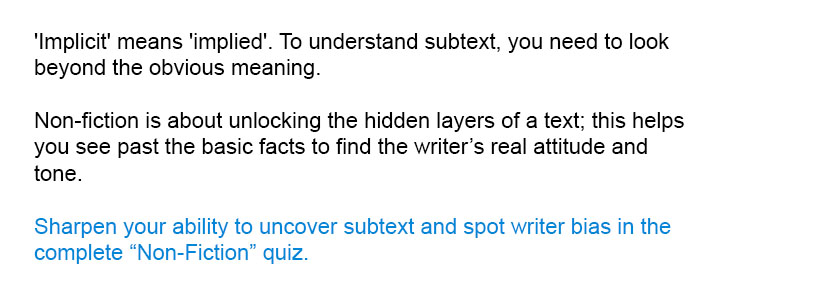
'Implicit' means 'implied'. To understand subtext, you need to look beyond the obvious meaning.

Sharpen your ability to uncover subtext and spot writer bias in the complete Non-Fiction quiz.

Non-fiction is about unlocking the hidden layers of a text; this helps you see past the basic facts to find the writer’s real attitude and tone.
6 .
It won't be ...... on this ...... to make a formal report.
neccessary, occasion
necessary, occasion
necessary, ocassion
nessessary, occasion
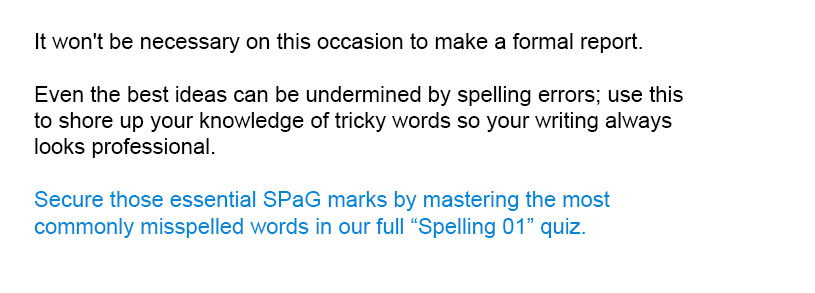
It won't be necessary on this occasion to make a formal report.

Secure those essential SPaG marks by mastering the most commonly misspelled words in our full Spelling 01 quiz.

Even the best ideas can be undermined by spelling errors; use this to shore up your knowledge of tricky words so your writing always looks professional.
7 .
Find the example of personification in the following quotation.
From To Kill a Mockingbird, by Harper Lee:
'Suddenly I noticed that the men were backing away from Miss Maudie's house.'
'The fire...had eaten its way to the roof.'
'Smoke was rolling off our house...like fog off a riverbank.'
'Another fire truck appeared and stopped in front of Miss Stephanie Crawford's.'
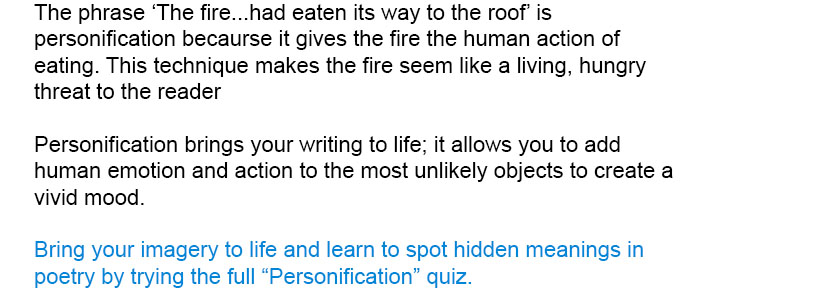
Bring your imagery to life and learn to spot hidden meanings in poetry by trying the full Personification quiz.

Personification brings your writing to life; it allows you to add human emotion and action to the most unlikely objects to create a vivid mood.
8 .
Which of the following best describes the style of a review?
Extremely formal
Quite formal and distant
Somewhat informal, but authoritative
Completely informal, novice-like
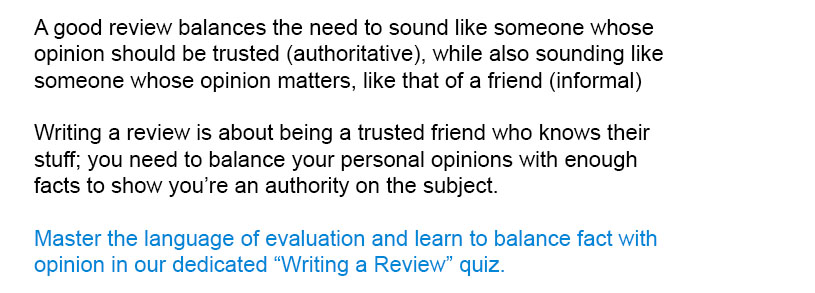
A good review balances the need to sound like someone whose opinion should be trusted (authoritative), while also sounding like someone whose opinion matters, like that of a friend (informal)

Master the language of evaluation and learn to balance fact with opinion in our dedicated Writing a Review quiz.

Writing a review is about being a trusted friend who knows their stuff; you need to balance your personal opinions with enough facts to show you’re an authority on the subject.
9 .
Which would be the modern equivalent of 'thine'?
You
You're
Your
Yours
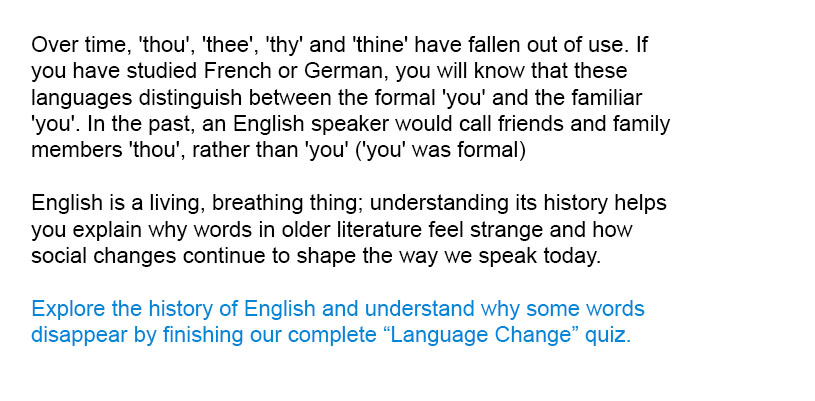
Over time, 'thou', 'thee', 'thy' and 'thine' have fallen out of use. If you have studied French or German, you will know that these languages distinguish between the formal 'you' and the familiar 'you'. In the past, an English speaker would call friends and family members 'thou', rather than 'you' ('you' was formal)

Explore the history of English and understand why some words disappear by finishing our complete Language Change quiz.

English is a living, breathing thing; understanding its history helps you explain why words in older literature feel strange and how social changes continue to shape the way we speak today.
10 .
You have been asked to write a guide to starting high school / secondary school. Who is your audience?
Secondary school teachers
Primary school teachers
Pupils who are at the end of Year 6
Pupils who are at the end of Year 11
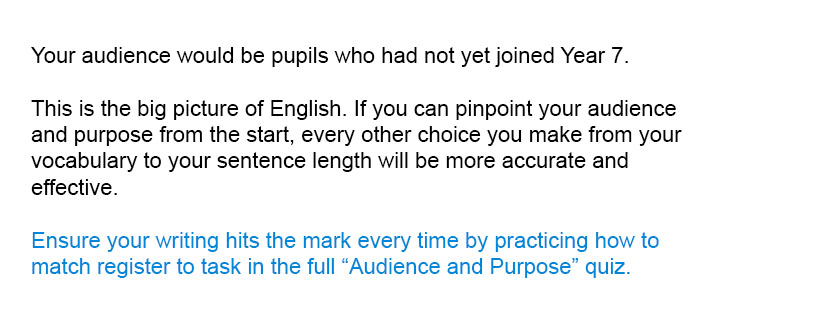
Your audience would be pupils who had not yet joined Year 7.

Ensure your writing hits the mark every time by practicing how to match register to task in the full Audience and Purpose quiz.

This is the big picture of English. If you can pinpoint your audience and purpose from the start, every other choice you make from your vocabulary to your sentence length will be more accurate and effective.
Author:  Tara Kemp

© Copyright 2016-2026 - Education Quizzes
Work Innovate Ltd - Design | Development | Marketing