




Ask the AI Tutor
Need help with Electricity - Electrical Circuits 01? Ask our AI Tutor!
AI Tutor - Lucy
Connecting with Tutor...
Please wait while we establish connection
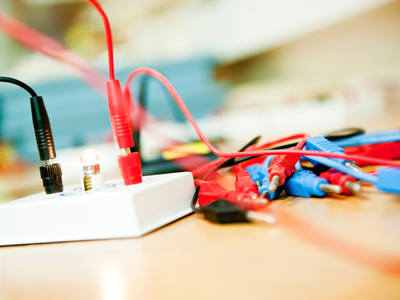
The unit of current is Amperes.
Electricity - Electrical Circuits 01
Build confidence with GCSE electric circuits by exploring components, circuit diagrams, energy transfers and how series and parallel circuits behave in real exam style questions.
1 .
What is the size of the current in a circuit if the charge, Q, is 100 C and lasts for 25 seconds?
1A
2A
3A
4A
Remember the definition - current is a measure of how much charge flows past a given point in one second. This should help you to get the right answer even if you can't recall the equation
2 .
What is electrical current?
Flow of electric charge
Flow of protons
Flow of neutrons
Flow of water
Current is the flow of electric charge around a circuit. The charge is carried by electrons which are emitted by the negative electrode of the cell and travel to the positive electrode of the cell through the circuit
3 .
What is the formula for potential difference?
V = W⁄Q
V = W⁄2Q
V = 3W⁄2Q
V = 5W⁄3Q
V is in volts when W is in joules and Q is in coulombs
4 .
Which formula calculates the size of the current?
I = Q x t
I = Q⁄t
I = t⁄Q
Q = I⁄t
If you didn't remember the equation, you can work it out. Whenever you need to calculate the rate of something in physics, it is expressed as something per second. To get the 'per second' bit, you know that you need to divide by time. That eliminates two of the alternative answers so the one that works out the current must be the correct one
5 .
What is the work done in a circuit if the voltage is 10 V, the current is 4 A and the circuit is on for 25 seconds?
200J
500J
800J
1000J
You need to rearrange the equation V = W?Q and work out the charge. Remember that one coulomb is one amp flowing for one second so if you have four amps flowing for 25 seconds, how many coulombs is that?
6 .
What is the unit of current?
Volts
Ohms
Amperes
Joules
Amperes or Amps for short is the unit of current. It is usually denoted with an A after a value of current
7 .
What does the size of the electric current depend on?
The rate of flow of electric charge
The rate of flow of protons
The rate of flow of neutrons
All of the above
High currents = bigger flow rates
8 .
What can be calculated from current-potential difference graphs?
Resistivity
Magnetism
Resistance
None of the above
The gradient gives the resistance
9 .
What is potential difference?
Work done per coulomb of charge that passes between two points
Kinetic energy per coulomb of charge that passes between two points
Work done per coulomb of charge that passes between three points
Work done per ampere of current that passes between two points
Strictly speaking, it should really be called electrical potential difference but at GCSE, potential difference is acceptable, when used in the correct context
10 .
What is the unit of charge?
Volts
Ohms
Coulombs
Amperes
The coulomb is the unit of charge. It is denoted by a C after a value of charge and is named for the French scientist Charles-Augustin de Coulomb who carried out a lot of pioneering work on electrical charge and magnetism



**Unlimited Quizzes Await You! 🚀**
Hey there, quiz champ! 🌟 You've already tackled today's free questions.
Ready for more?
Ready for more?
🔓 Unlock UNLIMITED Quizzes and challenge yourself every day. But that's
not all...
not all...
🔥 As a Subscriber you can join our thrilling "Daily Streak" against other
quizzers. Try to win a coveted spot on our Hall of Fame Page.
quizzers. Try to win a coveted spot on our Hall of Fame Page.
Don't miss out! Join us now and keep the fun rolling. 🎉
**Unlimited Quizzes Await You! 🚀**
Hey there, quiz champ! 🌟 You've already tackled today's free questions. Ready for more?
🔓 Unlock UNLIMITED Quizzes and challenge yourself every day. But that's not all...
🔥 As a Subscriber you can join our thrilling "Daily Streak" against other quizzers. Try to win a coveted spot on our Hall of Fame Page.
Don't miss out! Join us now and keep the fun rolling. 🎉




© Copyright 2016-2026 - Education Quizzes
Work Innovate Ltd - Design | Development |
Marketing
