




Ask the AI Tutor
Need help with Electricity - The National Grid? Ask our AI Tutor!
AI Tutor - Lucy
Connecting with Tutor...
Please wait while we establish connection
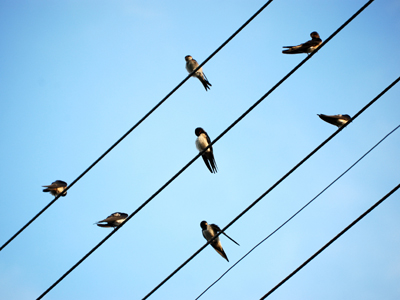
Birds don't get electrocuted when they stand on pylon wires - why not?
Electricity - The National Grid
How does electricity travel from power stations to your home safely and efficiently? This GCSE Physics quiz explores the National Grid and transformer voltage changes.
1 .
What is transferred through the National Grid?
Coal
Petrol
Gas
Electricity
The highest voltage cables are made from aluminium which is light, strong and a good electrical conductor
2 .
What voltage is used to transfer electricity through the National Grid?
Up to 300,000 V
Up to 400,000 V
Up to 500,000 V
Up to 600,000 V
There are 132 kV, 275 kV and 400 kV circuits that make up the grid
3 .
How is such a high voltage produced?
By using step-up transformers
By using step-down transformers
By using a Darlington pair
None of the above
Step-up transformers can be used to increase voltage whilst decreasing current, conserving the total amount of energy
4 .
Why is a high voltage used?
It increases the amount of energy wasted in cables
It reduces the amount of energy wasted in cables
The cables cannot transfer low voltage electricity
So they can transfer the electricity at a high current
Some electricity used in homes and businesses on the south coast could have been generated in Scotland so keeping energy losses down to the minimum possible is really important
5 .
What is the mains voltage in homes in the UK?
120 V
170 V
230 V
270 V
Whilst in the UK the voltage is 230 V, in other countries this can vary, for example, in the USA it is 110 V
6 .
How is voltage from the National Grid changed into 230 V for home use?
Step-up transformer
A thin cable
A thick cable
Step-down transformer
Step-down refers to the voltage
7 .
Electricity is sent through the National Grid using which type of electrical current?
Alternating current
Direct current
Alternating and direct current
Neither alternating nor direct current
If it was sent using DC, it would not be possible to use transformers so a lot more energy would be wasted (or we would need to use extremely high and therefore more dangerous voltages)
8 .
What voltage is produced in power stations?
15,000 V
20,000 V
25,000 V
30,000 V
This then needs to be increased for distribution via the National Grid
9 .
Why don't birds get electrocuted when they stand on pylon wires?
As they are not connected to any grounded point, the electricity will not flow through the bird and will continue through the cables
They do get electrocuted
Birds do not conduct electricity
None of the above
Electricity will always try to make its way back to the Earth by finding the most efficient path. Air is actually a good electrical insulator and high voltages are required for electricity to be able to pass through it. The birds are not earthed and surrounded by air, so the electricity follows the line of least resistance - the wire
10 .
Why does reducing the current and increasing the voltage mean less energy is lost?
A high voltage means they can transfer the electricity at a high current, transferring it at a high current means fewer electrons travelling through the cables which reduces the amount of collisions between electrons and the cables, thus wasting less energy as heat
A high voltage means they can transfer the electricity at a low current, transferring it at a low current means fewer electrons travelling through the cables which reduces the amount of collisions between electrons and the cables, thus wasting less energy as heat
A high voltage means they can transfer the electricity at a low current, transferring it at a low current means more electrons travelling through the cables which reduces the amount of collisions between electrons and the cables, thus wasting less energy as heat
A high voltage means they can transfer the electricity at a low current, transferring it at a low current means fewer electrons travelling through the cables which increases the amount of collisions between electrons and the cables, thus wasting less energy as heat
The heating effect of an electric current increases in direct proportion to the square of the current, so keeping the current as low as possible saves energy losses
You can find more about this topic by visiting BBC Bitesize - The National Grid and mains electricity



**Unlimited Quizzes Await You! 🚀**
Hey there, quiz champ! 🌟 You've already tackled today's free questions.
Ready for more?
Ready for more?
🔓 Unlock UNLIMITED Quizzes and challenge yourself every day. But that's
not all...
not all...
🔥 As a Subscriber you can join our thrilling "Daily Streak" against other
quizzers. Try to win a coveted spot on our Hall of Fame Page.
quizzers. Try to win a coveted spot on our Hall of Fame Page.
Don't miss out! Join us now and keep the fun rolling. 🎉
**Unlimited Quizzes Await You! 🚀**
Hey there, quiz champ! 🌟 You've already tackled today's free questions. Ready for more?
🔓 Unlock UNLIMITED Quizzes and challenge yourself every day. But that's not all...
🔥 As a Subscriber you can join our thrilling "Daily Streak" against other quizzers. Try to win a coveted spot on our Hall of Fame Page.
Don't miss out! Join us now and keep the fun rolling. 🎉




© Copyright 2016-2026 - Education Quizzes
Work Innovate Ltd - Design | Development |
Marketing
