




Ask the AI Tutor
Need help with Electricity - Transferring Electrical Energy? Ask our AI Tutor!
AI Tutor - Lucy
Connecting with Tutor...
Please wait while we establish connection
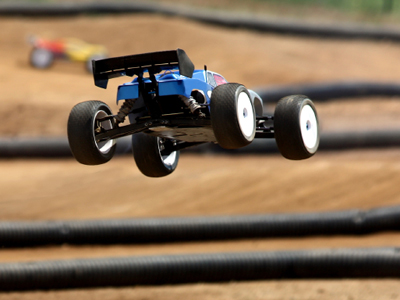
A radio-controlled car turns electrical energy into kinetic energy.
Electricity - Transferring Electrical Energy
Electrical devices transfer energy from batteries or the mains. This quiz checks if you can link power, time and energy when working with everyday circuits and appliances.
1 .
What is the useful form of energy produced by a kettle?
Sound
Heat
Microwaves
Light
Sound is the main non-useful type of energy
2 .
What is the useful form of energy produced by a radio-controlled car?
Kinetic energy
Radio
Sound
Heat
Heat is waste energy as is sound, although you could argue that without the sound, the car wouldn't be as much fun, so perhaps the sound is also a useful energy - what do you think?
3 .
Which equation can be used to calculate the amount of energy transferred from a mains supply?
E = P x t
E = t⁄P
E = P⁄t
P = E x t
The amount of energy transferred is equal to the power consumed by the device multiplied by the time period in which the appliance is using that power
4 .
If a kettle uses 3 kW of power when it is switched on and is on for 2 minutes, how much energy is transferred during the period?
0.1 kWh
0.2 kWh
0.5 kWh
1 kWh
Always make sure the values given in the question are in the right form. In this case power needs to be in kW and time needs to be in hours since the answer options have units of kWh
5 .
An electric cooker heating element converts electricity to heat, but what else is also produced in this process?
Sound
Light
Kinetic energy
Radio waves
They glow a dull red colour when they are fully on
6 .
What is the power of an appliance that uses 5 kWh in 15 minutes?
20kW
10kW
5kW
1.25kW
Since the question involves the units of kWh, the time needs to be in hours. 15 minutes is 0.25 hours. Power is the rate at which energy is used, in other words, divide the energy used by the time in hours and you have the answer
7 .
If 1 kWh of energy costs 15 pence and an appliance with a power rating of 10 kW is switched on for 20 minutes, how much will the appliance cost to run for this amount of time?
25p
35p
50p
75p
These kinds of questions are common in many exams. Ensure you are able to rearrange equations and use simple ratios to calculate relevant answers. For this answer, you need to first work out how many units (kWh) are consumed by the appliance in the time given and then convert that to a cost using the price of the electricity. 20 minutes is one third of an hour, so it will transfer one third of 10 kW in that time i.e. 3.3 kWh. Multiply that by 15 pence and the closest of the answers is 50p
8 .
On what does the amount of energy an appliance transfers rely?
Time, current and voltage
Power and resistance
Time, voltage and power
Resistance and power
Sometimes, the examiners will slip in a question where you need to work out the energy transferred by an appliance but only give you the current and voltage. This is to test if you know that the power of an electrical device is given by the current in amps multiplied by the potential difference in volts
9 .
Two appliances are switched on at the same time; one appliance uses twice as much power as the other but is on for half the amount of time. Which appliance uses more energy?
The appliance which is switched on for the longer period of time
The appliance which is switched on for the shorter period of time
They use the same amount of power
It's impossible to tell
Logic gives you the answer here, or you can make up some actual figures and do two calculations to arrive at the same conclusion
10 .
An iron, a kettle and a computer all produce what type of energy?
Elastic potential
Radio waves
Kinetic energy
Heat
A simple question to finish with, finding the energy transfer that several appliances have in common



**Unlimited Quizzes Await You! 🚀**
Hey there, quiz champ! 🌟 You've already tackled today's free questions.
Ready for more?
Ready for more?
🔓 Unlock UNLIMITED Quizzes and challenge yourself every day. But that's
not all...
not all...
🔥 As a Subscriber you can join our thrilling "Daily Streak" against other
quizzers. Try to win a coveted spot on our Hall of Fame Page.
quizzers. Try to win a coveted spot on our Hall of Fame Page.
Don't miss out! Join us now and keep the fun rolling. 🎉
**Unlimited Quizzes Await You! 🚀**
Hey there, quiz champ! 🌟 You've already tackled today's free questions. Ready for more?
🔓 Unlock UNLIMITED Quizzes and challenge yourself every day. But that's not all...
🔥 As a Subscriber you can join our thrilling "Daily Streak" against other quizzers. Try to win a coveted spot on our Hall of Fame Page.
Don't miss out! Join us now and keep the fun rolling. 🎉




© Copyright 2016-2026 - Education Quizzes
Work Innovate Ltd - Design | Development |
Marketing
