




Ask the AI Tutor
Need help with Forces - Forces and Motion? Ask our AI Tutor!
AI Tutor - Lucy
Connecting with Tutor...
Please wait while we establish connection
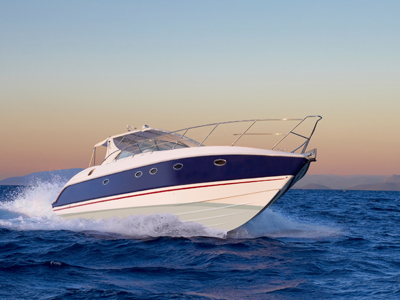
If a boat of mass 500kg is accelerating at 1m/s, the resultant force is 500N.
Forces - Forces and Motion
Explore GCSE Physics forces and motion, from resultant forces and acceleration to how mass affects motion in real situations like cars, trolleys and everyday moving objects.
1 .
What is the equation to find the acceleration of an object, knowing its initial and final velocities and the time taken?
a = (u - t)⁄v
v = (a - u)⁄t
u = (a - v)⁄t
a = (v - u)⁄t
It is always the final velocity minus the initial velocity divided by time. A negative value from the calculation means there was a deceleration
2 .
What does the gradient of a distance-time graph represent?
Speed
Distance
Time
Resistance
The gradient of a graph is calculated by dividing the y value by the x value. In this case, you are dividing metres by seconds (or kilometres by hours and so on) so the units will be metres per second (or kilometres per hour etc) which you should recognise as being the units of speed
3 .
If a boat of mass 500 kg is accelerating at 1 m/s2, what is the resultant force?
250 N
500 N
750 N
1,000 N
Only unbalanced forces produce an acceleration
4 .
What is the acceleration of an object dependent on?
Mass
Resultant force
Neither mass nor resultant force
Both mass and resultant force
Changing either mass or resultant force will change the acceleration of an object
5 .
What is the correct formula which links force, mass and acceleration?
F = m x a
m = F x a
a = F x m
C = m x a
This is the equation of Newton's second law of motion
6 .
What is the unit used to measure force?
The pascal
The kilogram
The newton
The metre
Named after Isaac Newton since he carried out the key work that lead to an understanding of forces, although Galileo had already worked out the first law many years before Newton was born
7 .
What is the acceleration of a ball whose initial velocity is 0 m/s and final velocity is 10 m/s if the ball takes 5 seconds to get to this speed?
1 m/s2
2 m/s2
3 m/s2
2 m/s
Remember that acceleration is the rate of change of velocity and its units are m/s2
8 .
What does the gradient of a velocity-time graph represent?
Acceleration
Velocity
Time
Distance
The gradient of a velocity-time graph measures the change in velocity per second, in other words, exactly the definition of acceleration
9 .
What is velocity?
Speed in a given direction
Direction of an object
Speed of an object
Acceleration
Velocity is a vector quantity and has both magnitude (size) and direction. The magnitude represents how fast the object is moving and the direction represents in which direction it is going
10 .
What is the mass of a person who is accelerated at a rate of 2 m/s2 when a resultant force of 130 N is applied?
55Kg
65Kg
75Kg
85Kg
Using the equation F = m x a, you can calculate the force required to accelerate an object, the mass of it or the acceleration of it when given two of the three values



**Unlimited Quizzes Await You! 🚀**
Hey there, quiz champ! 🌟 You've already tackled today's free questions.
Ready for more?
Ready for more?
🔓 Unlock UNLIMITED Quizzes and challenge yourself every day. But that's
not all...
not all...
🔥 As a Subscriber you can join our thrilling "Daily Streak" against other
quizzers. Try to win a coveted spot on our Hall of Fame Page.
quizzers. Try to win a coveted spot on our Hall of Fame Page.
Don't miss out! Join us now and keep the fun rolling. 🎉
**Unlimited Quizzes Await You! 🚀**
Hey there, quiz champ! 🌟 You've already tackled today's free questions. Ready for more?
🔓 Unlock UNLIMITED Quizzes and challenge yourself every day. But that's not all...
🔥 As a Subscriber you can join our thrilling "Daily Streak" against other quizzers. Try to win a coveted spot on our Hall of Fame Page.
Don't miss out! Join us now and keep the fun rolling. 🎉




© Copyright 2016-2026 - Education Quizzes
Work Innovate Ltd - Design | Development |
Marketing
