




Ask the AI Tutor
Need help with Forces - Forces and Terminal Velocity? Ask our AI Tutor!
AI Tutor - Lucy
Connecting with Tutor...
Please wait while we establish connection
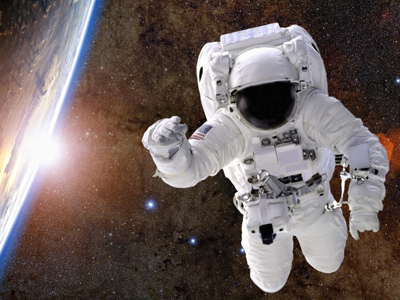
An astronaut travels to another planet. Travel through this quiz for more information!
Forces - Forces and Terminal Velocity
Discover how forces, weight and air resistance balance to create terminal velocity, and what happens when a skydiver opens a parachute to change their motion.
1 .
An astronaut travels to another planet. On this planet she records that she has a weight of 400 N. She knows from measurements back at the space centre that she has a mass of 72 kg. What is the strength of gravity on this new planet?
3.3 N/kg
5.56 N/kg
7.89 N/kg
12.23 N/kg
Rearranging the equation to g = W/m and substituting with the figures gives you the correct answer
2 .
The gravity on the moon is 1/6 of the force due to gravity on the Earth. What is the weight of a person on the moon who has a mass of 65 kg?
6.5 N
25 N
65 N
108 N
The mass of a person remains the same no matter where they are in the universe. The weight of an object is created by the force of gravity acting on its mass
3 .
What is the speed of an object known as when the force due to gravity and the frictional forces acting on the object are equal?
Initial velocity
Terminal velocity
Final velocity
Light speed
All objects travelling through a fluid have a terminal velocity
4 .
What is the weight of a person on Earth if their mass is 65 kg?
500 N
650 N
750 N
850 N
Unless you are told otherwise, assuming that the Earth's gravitational field strength is 10 N/kg is acceptable for the GCSE. In everyday language, people often refer to their weight in kilograms - in science, that is incorrect, the SI unit for weight is the newton
5 .
What could a horizontal line on a velocity-time graph indicate?
An object has reached terminal velocity
An object is accelerating
An object is decelerating
An object has changed direction
A velocity time graph can show you when an object is at rest, whether it is accelerating or if it is travelling at a constant speed. The gradient gives you the acceleration - a horizontal line has zero gradient which means zero acceleration. An object travelling at terminal velocity is no longer accelerating through the fluid. The area underneath a velocity-time graph will tell you the distance travelled by an object
6 .
Which formula correctly relates the weight of an object and the force exerted on it by gravity?
W = 2 x m x g
W = m x g
W = 2g
G = W x m
This is a variation of the equation from Newton's second law
7 .
If an object is placed into a fluid and released on Earth, what will initially happen to the object?
Accelerate
Decelerate
Move at a constant velocity
None of the above
Initially, the force of gravity is greater than the resistance force from the fluid
8 .
What is weight measured in?
Kilograms
Newtons
Grams
Metres
Weight is measured in newtons, whilst mass is measured in kilograms
9 .
Why does a parachute reduce a parachutist's terminal velocity?
It decreases the force of gravity exerted on the parachutist and hence reduces the parachutist's terminal velocity
It decreases the amount of air resistance exerted on the parachutist and hence reduces the parachutist's terminal velocity
It increases the amount of air resistance exerted on the parachutist and hence reduces the parachutist's terminal velocity
It increases the force of gravity exerted on the parachutist and hence reduces the parachutist's terminal velocity
This is achieved by increasing the surface area of the parachutist
10 .
Which statement is true for an object which is travelling through a fluid?
The slower an object moves, the greater the frictional force that acts upon it
The frictional force on an object moving through a fluid remains constant regardless of the speed at which the object moves through the fluid
The faster an object moves, the greater the frictional force that acts upon it
After an object reaches a certain speed, whilst travelling through a liquid, the frictional force acting upon it becomes zero
Fluids are liquids and gases
Our Social Circles




**Unlimited Quizzes Await You! 🚀**
Hey there, quiz champ! 🌟 You've already tackled today's free questions.
Ready for more?
Ready for more?
🔓 Unlock UNLIMITED Quizzes and challenge yourself every day. But that's
not all...
not all...
🔥 As a Subscriber you can join our thrilling "Daily Streak" against other
quizzers. Try to win a coveted spot on our Hall of Fame Page.
quizzers. Try to win a coveted spot on our Hall of Fame Page.
Don't miss out! Join us now and keep the fun rolling. 🎉
**Unlimited Quizzes Await You! 🚀**
Hey there, quiz champ! 🌟 You've already tackled today's free questions. Ready for more?
🔓 Unlock UNLIMITED Quizzes and challenge yourself every day. But that's not all...
🔥 As a Subscriber you can join our thrilling "Daily Streak" against other quizzers. Try to win a coveted spot on our Hall of Fame Page.
Don't miss out! Join us now and keep the fun rolling. 🎉
© Copyright 2016-2026 - Education Quizzes
Work Innovate Ltd - Design | Development |
Marketing
