




Ask the AI Tutor
Need help with Forces - Moments? Ask our AI Tutor!
AI Tutor - Lucy
Connecting with Tutor...
Please wait while we establish connection
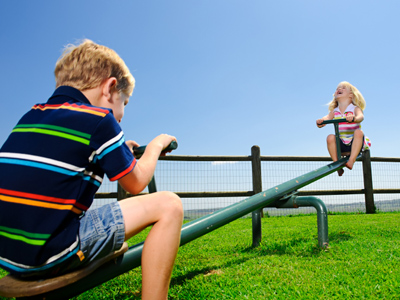
A see-saw is a good example of how the principles of moments can be utilised.
Forces - Moments
Explore moments and turning forces in GCSE Physics, learning how clockwise and anticlockwise moments balance to keep objects steady and how to calculate unknown forces in everyday systems.
1 .
What is a moment?
A turning effect of a force
The mass of an object at a point
The distance of a mass from a pivot
When a system is in equilibrium
Moments can be used to your advantage when using a lever
2 .
What is the formula for the size of a moment?
M = F x d
F = M x d
M = F⁄d
d = M x F
This is a direct proportionality so if the force is greater, the moment is larger. If the distance is longer, the moment will be larger too. The opposite is true for smaller values of both terms of the equation
3 .
What does d in the above equation stand for?
Parallel distance from line of action to the pivot
Perpendicular distance from line of action to the pivot
Distance of the plane
Distance between two masses
This is the shortest distance between the point at which the force is acting and the point around which an object pivots
4 .
If an object is not turning, the total clockwise moment, compared to the total anti-clockwise moment about any pivot, must be what?
Clockwise moment is twice as large as anti-clockwise moment
Clockwise moment is three times as large as anti-clockwise moment
Clockwise moment is half as large as anti-clockwise moment
Clockwise moment is exactly equal in magnitude to the anti-clockwise moment
For an object to be at rest on a pivot, all the forces acting on it must be in equilibrium
5 .
What is the size of a moment if F = 10 N and d = 125 cm?
10.125 N m
1250 N m
12.5 N m
1.25 N m
Did you remember to convert 125 cm into metres?
6 .
A see-saw is balanced on a pivot with two children on it. One child is sitting 1.5 m to the left of the pivot and has a mass of 50 kg. Another child of mass 30 kg is sitting on the right hand side of the pivot. What distance away from the pivot is the child on the right of the pivot?
30 cm
1.5 m
2.5 m
Impossible to say without knowing the length of the see-saw
The key word in the question is balanced so the principle of moments calculation can be applied
7 .
What is the force that creates a moment of 10 N m when it is applied 0.25 m from the pivot?
30 N
40 N
50 N
60 N
Rearrangement of the equation for calculating the size of a moment
8 .
If the point of application of the force was moved further away from the pivot, what would be the effect on the moment?
The moment would be greater because the distance is greater
The moment would remain the same because the force hasn't changed
The moment would be smaller because it is further away and therefore has less effect on the pivot
More information is needed to be able to answer this question
Changing either (or both) of the force and distance will alter the moment. An example of this would be using a spanner to turn a nut. A longer spanner enables you to apply the force from a greater distance, increasing the moment and magnifying the force that your muscles can apply
9 .
A plank of wood is balanced on a pivot. One mass of 10 kg is then placed 1 m to the left of the pivot on the wood. What weight needs to be placed 0.5 m to the right of the pivot for the wood to still be balanced?
10 kg
20 kg
10 N
200 N
Did you spot that the question asked for the weight? The weight of an object is the mass multiplied by the strength of the gravitational field - 10 N/kg is an acceptable approximation for the gravitational field strength at the surface of the Earth
10 .
Which of the following is an example of the principle of moments being utilised?
Lifting a book
A rock falling
A crowbar being used to lift a drain cover
A USB stick
The crowbar is being used as a lever. Levers are a favourite of the examiners for testing your knowledge of moments



**Unlimited Quizzes Await You! 🚀**
Hey there, quiz champ! 🌟 You've already tackled today's free questions.
Ready for more?
Ready for more?
🔓 Unlock UNLIMITED Quizzes and challenge yourself every day. But that's
not all...
not all...
🔥 As a Subscriber you can join our thrilling "Daily Streak" against other
quizzers. Try to win a coveted spot on our Hall of Fame Page.
quizzers. Try to win a coveted spot on our Hall of Fame Page.
Don't miss out! Join us now and keep the fun rolling. 🎉
**Unlimited Quizzes Await You! 🚀**
Hey there, quiz champ! 🌟 You've already tackled today's free questions. Ready for more?
🔓 Unlock UNLIMITED Quizzes and challenge yourself every day. But that's not all...
🔥 As a Subscriber you can join our thrilling "Daily Streak" against other quizzers. Try to win a coveted spot on our Hall of Fame Page.
Don't miss out! Join us now and keep the fun rolling. 🎉




© Copyright 2016-2026 - Education Quizzes
Work Innovate Ltd - Design | Development |
Marketing
