




Ask the AI Tutor
Need help with Radioactivity - Atomic Structure? Ask our AI Tutor!
AI Tutor - Lucy
Connecting with Tutor...
Please wait while we establish connection
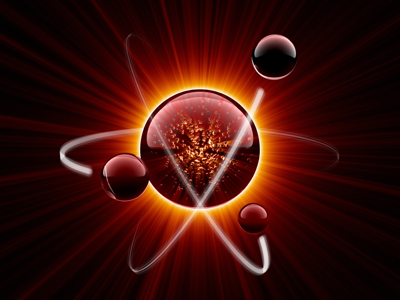
An atom which has lost an electron is called an ion.
Radioactivity - Atomic Structure
In GCSE Physics you explore atomic structure, learning how protons, neutrons and electrons are arranged and how this links to elements and radiation.
1 .
What is an atom?
An atom is made up of an electron
An atom is a particle consisting of a small central nucleus containing protons and neutrons surrounded by electrons
An atom is made up of molecules such as H2O
An atom is a particle consisting of a small central nucleus containing neutrons and electrons surrounded by protons
The numbers of the protons and electrons are exactly equal in an atom
2 .
What is the relative charge of a proton?
+1
-1
0
+10
One way of remembering this is to think about the first letter of proton - p for positive
3 .
What is the relative charge of a neutron?
+1
-1
0
-10
Neutrons are neutral particles
4 .
What is the relative mass of a proton?
+1
-1
0
+10
Whilst the mass of a proton is not actually +1, it is helpful for calculating relative masses when dealing with atomic physics
5 .
What is the relative mass of an electron?
+1
-1
0
+10
OK, that's not strictly true but you would need nearly 2,000 electrons to equal the mass of one proton or one neutron. The element with the highest number of electrons is element 118. Its atoms contain only 118 electrons which contribute so little to the mass of an atom, their mass can be ignored
6 .
A neutral atom has five protons. How many electrons does it contain if it is not an ion?
4
5
10
1
An atom will always have the same number of electrons as it does protons
7 .
What is an atom called which has lost an electron?
Ion
Baryon
Quark
Oxygen
Ions can be formed when atoms gain electrons as well
8 .
What does an atom's atomic number represent?
The number of particles within an atom in its nucleus
The number of protons in an atom in its nucleus
The number of neutrons in an atom in its nucleus
The number of electrons in an atom in its nucleus
Make sure that you know how to work out the number of particles in an atom from its atomic number and mass number, it is an easy way to gain marks
9 .
Atoms of an element always have the same number of protons but can have a different number of what?
Atomic numbers
Electron masses
Proton masses
Neutrons
An element is recognised for having a specific fixed number of protons in every atom, the number of neutrons is variable. Atoms of a particular element which contain different numbers of neutrons are described as isotopes
10 .
If an atom has 3 electrons, how many protons does it contain?
1
2
3
4
Remember, in an atom, the number of electrons is equal to the number of protons



**Unlimited Quizzes Await You! 🚀**
Hey there, quiz champ! 🌟 You've already tackled today's free questions.
Ready for more?
Ready for more?
🔓 Unlock UNLIMITED Quizzes and challenge yourself every day. But that's
not all...
not all...
🔥 As a Subscriber you can join our thrilling "Daily Streak" against other
quizzers. Try to win a coveted spot on our Hall of Fame Page.
quizzers. Try to win a coveted spot on our Hall of Fame Page.
Don't miss out! Join us now and keep the fun rolling. 🎉
**Unlimited Quizzes Await You! 🚀**
Hey there, quiz champ! 🌟 You've already tackled today's free questions. Ready for more?
🔓 Unlock UNLIMITED Quizzes and challenge yourself every day. But that's not all...
🔥 As a Subscriber you can join our thrilling "Daily Streak" against other quizzers. Try to win a coveted spot on our Hall of Fame Page.
Don't miss out! Join us now and keep the fun rolling. 🎉




© Copyright 2016-2026 - Education Quizzes
Work Innovate Ltd - Design | Development |
Marketing
