




Ask the AI Tutor
Need help with Radioactivity - Nuclear Fission? Ask our AI Tutor!
AI Tutor - Lucy
Connecting with Tutor...
Please wait while we establish connection
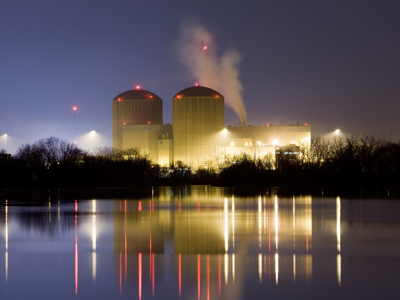
Nuclear power stations generate power through fission.
Radioactivity - Nuclear Fission
In GCSE Physics you investigate nuclear fission, where heavy nuclei split into smaller parts, releasing energy that can be used in nuclear power stations.
1 .
In nuclear power stations, a chain reaction is required. What is a chain reaction?
Reactions in which one reaction causes further reactions, which cause further reactions etc.
Reactions in which when the first reaction has occurred others are prevented
Reactions in which when a certain number of reactions have occurred others are prevented
Reactions which will never stop
It keeps going without the need for any extra help
2 .
What happens to the atom after it absorbs a neutron?
The atom becomes unstable and decays into two smaller atoms releasing more neutrons and energy
It loses an electron
It loses a proton
The neutron is ejected
The neutrons released start a chain reaction
3 .
What must a nucleus absorb for fission to occur?
Proton
Neutron
Electron
Heat
For fission to occur, neutrons are fired at the atomic nucleus
4 .
If Uranium-235 and one neutron are collided together they can create one Kr92 and 1 Ba142. In this circumstance, how many free neutrons are released in this reaction?
1
2
3
4
This question required you to balance the chemical equation in terms of the number of nuclear particles. There are 236 particles to begin with, so there must be 236 after the fission. Always remember that you will always have the same amount of particles on either side of the reaction. What goes in must always come out!
5 .
What happens to the excess neutrons?
They decay into protons and electrons
They decay into electrons
They are absorbed by other atoms creating more atoms to split into smaller atoms
They bond with other free neutrons to create a large neutron mass
As more neutrons are created by the fission reaction, more atoms absorb the now-free neutrons creating an avalanche effect until all of the fissionable material is used
6 .
What is a disadvantage of nuclear fission?
It creates radioactive waste
A large amount of fissionable material is needed
It produces vast amounts of energy
Nuclear power plants are cheap to build
The waste produced by nuclear fission can stay radioactive for centuries and as such can be costly to dispose of
7 .
In a nuclear reactor, water is used as a moderator. What is a moderator?
A substance which speeds up a nuclear reaction
A substance which slows down the fission neutrons
A substance which slows down the production of electricity
A substance that absorbs surplus neutrons
If the neutrons are moving too quickly, fission will not occur
8 .
Which two fissionable substances are commonly used in nuclear reactors?
Uranium and plutonium
Carbon and oxygen
Neon and lithium
Boron and hydrogen
Not all isotopes of these two elements are fissionable
9 .
What is nuclear fission?
It is the process by which stars generate light and heat
Fission is the splitting of an atomic nucleus creating two smaller atomic nuclei
Fission is the fusion of two atoms to create a heavier atom
Fission is the process by which electrons are removed from an element
The smaller nuclei are called daughter nucleides
10 .
What is an advantage of nuclear fission?
It creates radioactive material
A low percentage of energy is output compared to energy input into the process
A large amount of fissionable material is needed
A small amount of fissionable material is needed
When compared with the amount of fossil fuel needed to release the same amount of energy, it is a tiny fraction



**Unlimited Quizzes Await You! 🚀**
Hey there, quiz champ! 🌟 You've already tackled today's free questions.
Ready for more?
Ready for more?
🔓 Unlock UNLIMITED Quizzes and challenge yourself every day. But that's
not all...
not all...
🔥 As a Subscriber you can join our thrilling "Daily Streak" against other
quizzers. Try to win a coveted spot on our Hall of Fame Page.
quizzers. Try to win a coveted spot on our Hall of Fame Page.
Don't miss out! Join us now and keep the fun rolling. 🎉
**Unlimited Quizzes Await You! 🚀**
Hey there, quiz champ! 🌟 You've already tackled today's free questions. Ready for more?
🔓 Unlock UNLIMITED Quizzes and challenge yourself every day. But that's not all...
🔥 As a Subscriber you can join our thrilling "Daily Streak" against other quizzers. Try to win a coveted spot on our Hall of Fame Page.
Don't miss out! Join us now and keep the fun rolling. 🎉




© Copyright 2016-2026 - Education Quizzes
Work Innovate Ltd - Design | Development |
Marketing
