




Ask the AI Tutor
Need help with Waves - Reflection and Refraction? Ask our AI Tutor!
AI Tutor - Lucy
Connecting with Tutor...
Please wait while we establish connection
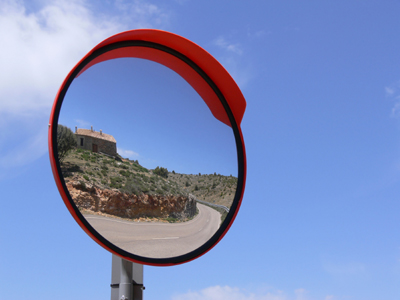
Mirrors reflect light.
Waves - Reflection and Refraction
In this GCSE Physics quiz, you’ll practise reflection diagrams, measure angles accurately, and check you really understand what happens when light hits smooth and rough surfaces.
1 .
A light ray is reflected off the surface of a plane mirror at 40o to the normal. What is the angle of reflection of the reflected ray?
30o
40o
50o
60o
The angle of reflection is always equal to the angle of incidence. This is known as Snell's Law or the law of reflection
2 .
What determines how fast light travels in a medium?
Size of the medium
Shape of the medium
Refractive index of the medium
Colour of the medium
The higher the refractive index, the slower the wave travels and the more it will bend on entering the medium
3 .
What equation can be used to calculate the refractive index of a substance?
Refractive index = 1 x sin c
Refractive index = 1 / sin c
Refractive index = 1 – sin c
Refractive index = 2 / sin c
Using two different types of glass that have different refractive indices to make compound lenses for optical instruments avoids the defect of chromatic aberration
4 .
The critical angle of diamond is 24 degrees. What is its refractive index?
0.6
4.9
2.4
0.4
Diamond has a small critical angle which means a lot of light is totally internally reflected - this is why diamonds are so sparkly
5 .
Another equation for calculating the refractive index of a substance is ...
Refractive index = sin i x sin r
Refractive index = sin r / sin i
Refractive index = sin c / sin r
Refractive index = sin i / sin r
Whichever way that you work it out, the refractive index has no units
6 .
If light enters a medium with an angle of incidence of 23 degrees and has an angle of refraction of 18 degrees, what is the refractive index of the medium?
0.12
1.3
0.8
0.7
Simple substitution into the equation
7 .
If a shiny surface is not smooth, what will happen to light rays incident upon it?
They will be reflected in numerous directions
They will be reflected towards one point
They will pass straight through the material
The light will be absorbed by the material
Each tiny section of the surface still follows Snell's law
8 .
When a light ray travels from air into glass, what can you say about the size of the angle of refraction compared to the angle of incidence?
It is bigger
It is the same
It is smaller
It is zero
Glass is a more dense medium than air therefore the light refracts towards the normal
9 .
What direction does the incident ray bend when travelling from glass to air?
Towards the normal
Towards the glass
Towards the sea
Away from the normal
This is exactly the opposite to the case in the previous question because the light is travelling from a more dense medium into a less dense medium
10 .
Which of the following can reflect light?
Mirror
Water
Glass
All of the above
Light can be reflected by most surfaces. The above are examples of a few which can be regularly observed in our daily lives. It does not just have to be a mirror which reflects light



**Unlimited Quizzes Await You! 🚀**
Hey there, quiz champ! 🌟 You've already tackled today's free questions.
Ready for more?
Ready for more?
🔓 Unlock UNLIMITED Quizzes and challenge yourself every day. But that's
not all...
not all...
🔥 As a Subscriber you can join our thrilling "Daily Streak" against other
quizzers. Try to win a coveted spot on our Hall of Fame Page.
quizzers. Try to win a coveted spot on our Hall of Fame Page.
Don't miss out! Join us now and keep the fun rolling. 🎉
**Unlimited Quizzes Await You! 🚀**
Hey there, quiz champ! 🌟 You've already tackled today's free questions. Ready for more?
🔓 Unlock UNLIMITED Quizzes and challenge yourself every day. But that's not all...
🔥 As a Subscriber you can join our thrilling "Daily Streak" against other quizzers. Try to win a coveted spot on our Hall of Fame Page.
Don't miss out! Join us now and keep the fun rolling. 🎉




© Copyright 2016-2026 - Education Quizzes
Work Innovate Ltd - Design | Development |
Marketing
