




Ask the AI Tutor
Need help with Catholicism - Creative Heritage? Ask our AI Tutor!
AI Tutor - Lucy
Connecting with Tutor...
Please wait while we establish connection
Learn about Catholic creative heritage in this informative and interesting quiz.
Catholicism - Creative Heritage
Explore Catholic creative heritage, from church design and sacred objects to music and symbolism. See how art supports worship, teaching, and identity.
1 .
Many practising Catholics regard it as part of their life's duty to take, and express, a clear moral stance on a range of issues such as public and private ethics. The Hays Code, which dominated Hollywood film-making during its formative years (1930-66 usually being quoted), was principally the outworking of concerns from which pressure group?
Father Daniel Lord SJ and the Catholic/National Legion of Decency
The Catholic Daughters of America
Joseph I Breen and the Production Code Administration
The (Catholic) Crusaders for Clean Cinema
There is quite a history to this, which you might be interested to investigate (carefully) since this was such a culturally influential measure in remarkably volatile times. The Hays Code's list of 'Dont's or Be Careful's' may seem almost comically quaint in itself, getting on for a century later; but one is bound to ask, from the point of view of traditionalists concerned with family values: at what such point might the rot set in? Breen and the PCA (the follow-up administrators; Answer 3) certainly had a tough time of it, but they might be shuddering in their beyond to see and hear what comes through people's screens in these early years of the 21st century
2 .
To complement the visual arts, the Church has a magnificent repertoire of music to enrich worship and encourage religious contemplation. All the following composers wrote settings of the Mass, but we have intercalated one Protestant (Lutheran) composer among the Catholics. Who was this odd one out?
Franz Joseph Haydn
Wolfgang Amadeus Mozart
Johann Sebastian Bach
Franz Schubert
Bach is famous (among much else) for his towering B Minor Mass, two surviving settings of the Passion story (in the St Mark and St John versions) and enough church cantatas to provide at least one each Sunday over the whole liturgical year. His work is often texturally and symbolically rich (he was, after all, writing in the Baroque period and style) ... but he wasn't a Catholic (nor indeed was Handel, who wrote 'The Messiah' ~ the world's first oratorio, which your present writer fairly recently had the experience of directing in a major Catholic church in Oxford)!
3 .
Europe's largest Gothic cathedral is at Ulm in Germany: built in 1890 (with the benefit of what we might call Victorian technology: steam-cranes, rail freighting of stone etc.) but by the Protestants. Its spire deliberately surpasses that of the world's tallest Catholic cathedral, also in Germany and built just 10 years earlier. In which city does this second cathedral stand?
Berlin
Cologne
Augsburg
Munich
The Kölner Dom is, by any reckoning, a most remarkable architectural achievement
4 .
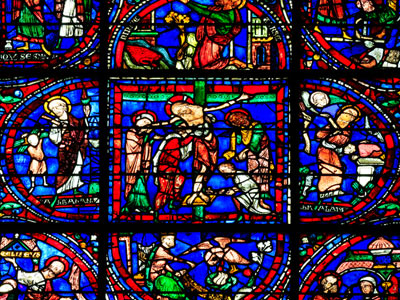
How did the mediaeval craftsmen at Chartres Cathedral (in France) achieve the spectacular blue tint in their stained-glass which is known as 'bleu de Chartres'?
They followed a recipe from the Roman archives that had previously been on the same site
They relied on prayer and heavenly guidance
They used vegetable dyes to replicate a blue tint associated with relics of the cloak of the Virgin Mary
Nobody knows: there is no other glass quite like it, no chemical explanation nor process to explain its composition, and one theory has it that airborne pollution within the past century may have contributed in some subtle way
Colour photography does not range back reliably far enough for even this theory to be proved. It may seem surprising that anything so emblematic can remain inscrutable to modern science; but there it stands!
5 .
Probably the most famous single example of Renaissance religious art is the painted ceiling of the Sistine Chapel in the Vatican ... done by whom?
Michaelangelo
Leonardo da Vinci
Donatello
Piranesi
The chapel's name derives from Pope Sixtus who commissioned the work, most famous among which is Michaelangelo's 'Last Judgment', though some years passed before the whole project was complete. The chapel remains significant in the Church's life since this is where the cardinals go into conclave to elect each new Pope
6 .
For non-Catholic British people, the 'nearest English-speaking Catholics' (apart from those living amongst them) are probably the Irish, some of whom have certainly had cultural influence through the world of entertainment. Which of the following popular series tells of the activities of a trio of disgraced priests and their housekeeper?
All Gas and Gaiters
Holy Smoke!
Father Ted
Mrs Brown's Boys
Probably not very representative of more than a 'splinter' of the Catholic community, but this show does seem to have a strong following!
7 .
What artist from the Low Countries, who died in 1516, remains deservedly famous for his extraordinary pictures such as the triptych altarpieces on 'The Last Judgment' and 'The Garden of Earthly Delights', that feature proto-surrealist and deformed people and animals?
Hieronymus Bosch
Giovanni Battista Piranesi
Rembrandt van Rijn
Moritz Escher
There is nothing else quite like the extraordinary visions of Bosch, which in their way reference Mediaeval ideas about the meaning and nature of life and divine judgment. Piranesi (Ans.2) was fairly obviously an Italian rather than from the Low Countries, but who specialised in dystopias of his own, usually involving fathomless prisons. Escher (Ans.4) was a much later Dutchman whose experiments with tricks of perspective were perhaps equally graphically astonishing, but in different (and generally less distressing) ways
8 .
In which part of a traditional monastery would the beautiful hand-written copies of books be made, before the days of movable-type printing (which came in as powerful 'new technology' around the same time as the Reformation, and indeed was instrumental in spreading its ideas)?
The dormitories
The scriptorium
The chapel
The refectory
The 'scriptorium' was the place set aside for writing
9 .
To evoke the setting of a monastery (or similar institution) onscreen, it seems almost obligatory to play the sound of monks chanting in Plainsong as they have done since time almost immemorial. Another more formal label for this simple style of music comes from the name of the Pope under whom it was (supposedly) codified: who was he?
Saint Francis
Saint Benedict
Pope Saint Gregory
Saint Cecilia
Gregory (whence the label 'Gregorian chant') was active around AD 600, though subsequent scholarship suggests the style was not in fact codified directly under him nor even during his lifetime. Francis and Benedict were each founders of monastic orders, but St Cecilia (patroness of Music though she was and is), by virtue of having been female, could unfortunately never have been a Pope
10 .
An easy enough, but hopefully thought-provoking question: which of the following mechanical aids were available to the builders of mediaeval abbeys and cathedrals?
Diesel-engined heavy haulage trucks
Gantry cranes to 25m and above
CAD software
None of the above
All such great works were translated from paper (or parchment) designs into what we might now call 'concrete' reality thanks to the work of master masons and their assistants, and a host of other craftsmen, and using nothing but human and animal muscle-power to assemble precise yet bulky components at great heights. Not infrequently, such people worked and died without seeing their project through to completion. As exercises in faith and devotion and perseverance, this alone must count for something!



**Unlimited Quizzes Await You! 🚀**
Hey there, quiz champ! 🌟 You've already tackled today's free questions.
Ready for more?
Ready for more?
🔓 Unlock UNLIMITED Quizzes and challenge yourself every day. But that's
not all...
not all...
🔥 As a Subscriber you can join our thrilling "Daily Streak" against other
quizzers. Try to win a coveted spot on our Hall of Fame Page.
quizzers. Try to win a coveted spot on our Hall of Fame Page.
Don't miss out! Join us now and keep the fun rolling. 🎉
**Unlimited Quizzes Await You! 🚀**
Hey there, quiz champ! 🌟 You've already tackled today's free questions. Ready for more?
🔓 Unlock UNLIMITED Quizzes and challenge yourself every day. But that's not all...
🔥 As a Subscriber you can join our thrilling "Daily Streak" against other quizzers. Try to win a coveted spot on our Hall of Fame Page.
Don't miss out! Join us now and keep the fun rolling. 🎉




© Copyright 2016-2026 - Education Quizzes
Work Innovate Ltd - Design | Development |
Marketing
