




Ask the AI Tutor
Need help with Catholicism - Pilgrimage? Ask our AI Tutor!
AI Tutor - Lucy
Connecting with Tutor...
Please wait while we establish connection
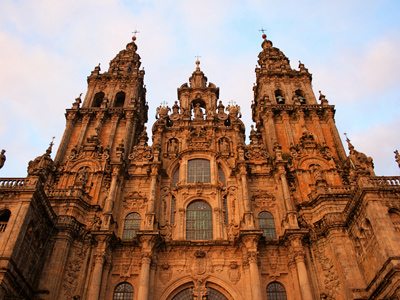
Compostela Cathedral.
Catholicism - Pilgrimage
Pilgrimage is a journey with a purpose. In this quiz you will explore why Catholics travel to holy places, what they do there, and what it means.
1 .
Not far from Compostela (in global-location terms) is the French-Pyrenean commune of Lourdes, probably the most famous pilgrimage site of them all. To whom, and when, were some 18 visions of Mary of the Immaculate Conception granted, and who subsequently became a Saint?
Bernadette Soubirous, 1858
Marie-Therese Martin, 1894
Dominique d'Angers, 1881
Elisabeth Moulins, 1876
Almost countless numbers of pilgrims (reportedly nowadays up to 5 million a year) have been to the grotto at Lourdes in the hope of healing through the spring waters
2 .
There would be huge significance in definitively identifying the remains of the actual Cross of Calvary 'on which the Prince of Glory died', as the Anglican hymnodist put it in 1707. (After all, in earthly demographic terms, Jesus Himself was a carpenter by trade, so His execution on a wooden gibbet added a further element of irony to an already epic occasion.) Which Saint went to the Holy Land in the late 320s AD and discovered the True Cross?
St Helen
St Constantina
St Boniface
St Agrippina
Helen (or Helena) was the mother of the Emperor Constantine who Christianised the Roman Empire; she was reportedly around 80 years old by the time she returned from Palestine ~ a remarkable achievement by any standards, let alone back then in such relatively primitive times (as regards travel, food, health and medicine etc.), so one suspects she must indeed have enjoyed at least some particular blessing in her endeavours
3 .
There have been pilgrim routes through and beyond France for centuries, not least to Solesmes (the mother-abbey of the Benedictine order). But the country's biggest 20th-century church building honours the memory of a young woman of Normandy: where?
Mont St-Michel
Arromanches
Lisieux
Caen
The Mont St-Michel (its name openly connoting the Archangel) has been a sacred and pilgrimage site since far longer back ~ it is held to be one of the Seven Wonders of the Mediaeval World; Arromanches and Caen were key sites in the D-Day Landings and subsequent campaign, and receive many visitors who come to honour, research and visualise those grim and crucial events. But Lisieux ~ probably the least-known of the places we offered you ~ was the almost-lifelong home of St Therese Martin, 'The Little Flower (of Jesus)' who died in 1897 at the age of just 24, leaving behind many fond memories and a significant corpus of devotional writing. Construction of the Basilica was delayed during wartime but once resumed and concluded, has yielded a magnificent structure that commands the local landscape, and draws the eye ... and the pilgrims who come to see the relics and venerate the saint
4 .
In July 1949 a young woman was killed in a stampede of pilgrims at a cathedral city in Poland (then newly under an atheistic [i.e. anti-religious] communist regime) ~ where six other blind pilgrims had had their sight restored after praying in front of a portrait of the Virgin, which itself had reportedly 'wept'. Which was this city?
Warsaw
Gdansk (a.k.a. Danzig)
Bialystok
Lublin
Lublin had suffered much in then-recent times, with the Majdanek concentration/extermination camp having been operating just up the hill a few years previously, and the Weeping Virgin was eagerly seen (as one can fairly imagine) by faithful Catholics as an indicator of the Church's sorrow at finding the area under unsympathetic oppression once again and so soon. Your author visited Lublin Cathedral in the late 1980s as communism was on almost its last legs (not least thanks to feisty resistance by hardy and dedicated Catholic Poles, chief among them Pope John Paul II who was Polish himself) ~ but the picture was not seen weeping on that occasion
5 .
Which Saint is patron of the cathedral at Compostela in Spain, a longtime pilgrimage destination?
St Mark
St James (Iago)
St Luke
St John
This cathedral in Galicia (northwestern Spain), with the world's most gigantic incense burner suspended from its ceiling, has been a pilgrimage destination for many centuries, though apparently the Vatican has not definitively ruled as to whether the relics there are indeed genuinely those of St James the Greater. Pilgrims from further afield, coming along the northern Spanish coastal road, would traditionally pick up scallop shells as souvenirs of their own journey along the 'camino' ~ and the converging lines within the shell make a reminder of how that pilgrimage draws diverse souls together (the geometry of this itself, perhaps, also echoing Christ's words: 'I, when I am raised, will draw all men unto me' [Jn.12:32])
6 .
Special pilgrimages were laid on over a couple of months in 2015 to an Italian city, whose cathedral houses a very special relic that can only be exhibited for short periods of time due to its fragile (if in other ways, almost inextricably resilient) nature. As what is this relic usually known, in English?
The Shroud of Turin
The Toile of Veronica of Verona
The Cremona Crucifix
The Sacred Nail of Rome
Some readers (and, to be honest, this writer) may be sceptical of some of the range of relics claimed for veneration: it has been suggested, for instance, that if all the reputed fragments of the True Cross were reunited, one might have rather more wood than would have been practically necessary for the job at hand. The famous cathedral of Notre-Dame in Paris alone contains a number of such pieces*. But the Turin Shroud is undeniably intriguing in ways, and at levels, that probably no other item of such a broad kind could rival. Over decades as a churchgoer and many years as a classroom RE teacher I have followed technical and devotional arguments on each 'side', but remain fascinated ~ one might almost say 'haunted' ~ by its image, and how that appears to have come to be. Further, but careful, research is warmly encouraged.
* He does, however, vividly remember an 'Alpha'-type course at a young people's holiday houseparty many years ago, where a talk about the Cross was given by a colleague with interests in archaeology. While he spoke, a small metal artefact was passed around for us to handle and consider: this was a 'standard Roman army six-inch [15cm] nail' that had recently been unearthed from the site of an abandoned Roman fort. Unremarkable in itself, you might think ... except that if this was a typical all-purpose large wood-nail from that particular, proto-global organisation, it brought one an alarming step closer to appreciating what would have been hammered into the beams at a typical crucifixion, let alone that most infamous one of all on 'Good Friday'
* He does, however, vividly remember an 'Alpha'-type course at a young people's holiday houseparty many years ago, where a talk about the Cross was given by a colleague with interests in archaeology. While he spoke, a small metal artefact was passed around for us to handle and consider: this was a 'standard Roman army six-inch [15cm] nail' that had recently been unearthed from the site of an abandoned Roman fort. Unremarkable in itself, you might think ... except that if this was a typical all-purpose large wood-nail from that particular, proto-global organisation, it brought one an alarming step closer to appreciating what would have been hammered into the beams at a typical crucifixion, let alone that most infamous one of all on 'Good Friday'
7 .
In due pilgrim spirit, let's take a moment's break from more modern sites and consider how the Virgin Mary and Her Son Jesus were themselves pilgrims, within their own Jewish tradition. Where did they go, and what age was He on that occasion?
To the ruins of King David's palace, when He was in his early teens
To the Temple at Jerusalem, when He was rising 13
To Mount Sinai (site of the giving of the Ten Commandments), while He was of primary-school age
To the Jordan River for His baptism when He was very small
The famous Gospel story recounts how He lingered behind to discuss religious and scriptural matters, as though on equal terms, with the mostly elderly priests, while the rest of His (earthly) family assumed he was somewhere among the group heading home to Nazareth. Hardly quite your usual pilgrim, though it shows He too had the impulse and respect for tradition. Answer 1 is certainly not factual, 3 is extremely unlikely (and has no direct biblical grounding) and 4 is plain wrong, since He was baptised much later, as a young adult, by St John (the Baptist, as we now know him) who was Jesus' own cousin and only a few months older than Himself
8 .
Which two Saints were the focus for the Canterbury pilgrimage?
Aldhelm and Wulfric
Athelstan and Nigel
Augustine and Thomas Becket
Anastasius and Ethelwald
Augustine had been the Pope's first missionary to Britain, and Archbishop Thomas Becket was famously murdered in the cathedral (seemingly on the orders of the king) in December 1170. Some of the 'distractors' in the wrong answers here refer to genuine ~ if here irrelevant ~ saints, but there appears to be no actual St Nigel
9 .
One might be forgiven for assuming that all the significant pilgrimage routes and destinations would be in the northern hemisphere, in the heartlands of the Judaeo-Christian heritage; or at least that, south of the Equator, there might only be a few in (perhaps) mainly-Catholic Latin America &/or parts of Africa formerly under French colonial influence. However, as of 2016 a new route is being established in Tasmania (a substantial island off the south coast of Australia). Fairly clearly, Tasmania will not (as least, yet!) have a ready-made series of wayside shrines or other significant religious staging-points. But the priest who is developing the route has recommended all pilgrims to carry with them a shell and one other associated symbolic object: what is this?
A palm-leaf (as a gesture of homage, referencing the Triumphal Entry on the original Palm Sunday)
A small stone, symbolising the burdens we each carry through life and long to lay down
A small phial of water from the River Jordan, in which Jesus was baptised by His cousin John
A medallion with the ICHTHUS 'fish' symbol on one side, and on the other a Dove of Peace
One of the essentials of a pilgrim journey is that if travelling 'light, and under one's own steam', one will not wish to carry any more along with one than possible: a few changes of washable walking-clothes, overnight kit and a spongebag, and possibly a select few devotional texts (not too hefty ... basically just a Bible and a map, and, these days, any essential paperwork such as travel insurance). It is an important aspect of the experience that one should not 'burden oneself' physically nor metaphorically, but more or less 'come as you are' ~ or as near so as practicable: deliberately laying aside all the everyday mundungus of one's ordinary life is a way of opening oneself up to God and one's fellow-pilgrims, a physical part of the exercise along with determining to make the actual journey in the first place. And for many, as the years go by, such trips can indeed prove a life-changing experience
10 .
Not all pilgrim shrines are on the European mainland: the one at Walsingham is perennially popular with British pilgrims (by no means only Catholics). This was all-but done-away-with in the Reformation of the 1530s, but the place's special significance could somehow not be wholly extinguished, and it has been devotedly revived during the 20th century. In which English county is Walsingham?
Suffolk
Norfolk
Essex
Hertfordshire
In general geographical terms it is in a similar part of the country to Sandringham, whose near-rhyming name you may more familiarly recognise as being the British monarch's East-Anglian country retreat. Walsingham is now a site for ecumenical pilgrimages, and originally was a Catholic shrine before the Reformation brought Protestantism into being. It also offered a pilgrimage route for those who could not manage a trip to the continent (where wars were sometimes an added deterrent), and its more modern popularity increased with the accessibility brought by the railways ~ surprisingly many other such sites experienced similar traffic growth around the year 1900, e.g. Lourdes. Walsingham had its branch-line axed after the Beeching Report (1960s) but a narrow-gauge light railway has since been installed, whose locomotive is proudly pictured on the website in its 'Marian' blue paintwork
Our Social Circles




**Unlimited Quizzes Await You! 🚀**
Hey there, quiz champ! 🌟 You've already tackled today's free questions.
Ready for more?
Ready for more?
🔓 Unlock UNLIMITED Quizzes and challenge yourself every day. But that's
not all...
not all...
🔥 As a Subscriber you can join our thrilling "Daily Streak" against other
quizzers. Try to win a coveted spot on our Hall of Fame Page.
quizzers. Try to win a coveted spot on our Hall of Fame Page.
Don't miss out! Join us now and keep the fun rolling. 🎉
**Unlimited Quizzes Await You! 🚀**
Hey there, quiz champ! 🌟 You've already tackled today's free questions. Ready for more?
🔓 Unlock UNLIMITED Quizzes and challenge yourself every day. But that's not all...
🔥 As a Subscriber you can join our thrilling "Daily Streak" against other quizzers. Try to win a coveted spot on our Hall of Fame Page.
Don't miss out! Join us now and keep the fun rolling. 🎉
© Copyright 2016-2026 - Education Quizzes
Work Innovate Ltd - Design | Development |
Marketing
