




Ask the AI Tutor
Need help with Catholicism - Rites and Sacraments? Ask our AI Tutor!
AI Tutor - Lucy
Connecting with Tutor...
Please wait while we establish connection
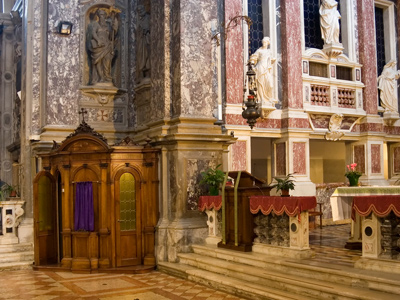
How many Catholic rites are you aware of?
Catholicism - Rites and Sacraments
Rites and sacraments are central to Catholic life. This quiz explores how Catholics use worship, symbols, and ceremonies to express faith, mark key moments, and receive grace.
1 .
Among non-Catholics there is a fair (or maybe unfair?) amount of misunderstanding regarding the Sacrament of Penance at the confessional. All but ONE of the following are at least broadly true: which is NOT?
When someone has confessed their sin/s, the priest will pronounce a formal prayer of Absolution and set a Penance (recommendation of good deeds to be done to confirm an improved attitude; or at least, several further prayers to be repeated)
Confession is permissible in three ways: privately (probably weekly, soon before Mass); occasionally at Parish Penance Services, such as during the penitential seasons of Advent and Lent; and rarely, through General Confession and Absolution in circumstances where individual penance is impracticable (e.g. during a major public emergency)
Confession of mortal sin is essential, and of venial (somewhat less serious) sins is encouraged; 'imperfect contrition' is when the sinner confesses out of fear of God's punishment, rather than from shame. It entails total secrecy: the priest who hears the confession, even of mortal sin, is bound never to divulge what he has heard, even to (for instance) the police who may be following up a serious crime
(Choose this Answer if you believe all the other three are true)
Confession is a complex matter of faith and psychology, which you may wish to explore carefully through your own research and perhaps by gently asking practising Catholics that you know, to explain and discuss it with you
2 .
Quite apart from the 'rites' such as baptism, the Catholic Church also distinguishes Rites in the sense of different liturgical traditions, often which have developed along geographical lines. Which of these is NOT such a Rite?
Western
Eastern
Armenian
American
There are of course plenty of Catholics in both North and (particularly) South America, but there is no American Rite as such. If you have heritage or other cultural interests in Rites from further afield, we encourage you to conduct your own careful research
3 .
Most of the Sacraments can be administered by priests, but for Confirmation (as is also true in many Protestant churches) the authority has to be higher: how high?
A bishop
An archbishop
The Pope
A cardinal
A bishop will do this duty. His characteristic hat ('mitre') represents the flames alighting on the heads of the Apostles at Pentecost, the 'birthday of the Church' when ~ led by Peter ~ its missionary work first began
4 .
Holy Orders (the Priesthood: as deacon, priest or bishop) are collectively another form of Sacrament, conferring as they do the Church's authority to administer other sacraments such as marriage and confession. Which of the following is NOT a mandatory prerequisite for an aspirant Catholic priest arriving at the seminary to train?
He must be male
He must himself have been baptised
He must be 'professional grade' in the sense of already holding a university degree, though not necessarily in Divinity
He must have done penance with a bishop
For the foreseeable future the Catholic priesthood is only open to male candidates, for a range of unalterable doctrinal reasons whose details need not detain us here, but which to Christians from more liberal traditions can seem increasingly hardline and even self-defeating ~ in an age when fewer ordinands are coming forward from among only 50% of the population who happen to be male.
The baptism stipulation (Ans.2) is genuine but not exclusive, in that baptism into several other churches is acceptable: within the past 20 years or so, several alienated ex-Anglican priests (for instance) have converted en-bloc to Rome by special dispensation ~ sometimes bringing entire congregations across with them ~ after differing with the 'C of E' over gender issues such as women priests or the sanctioning of marriage between same-sex couples, divorcees or whatever.
Further to Ans.3, a first degree is a marker that someone has a trained and capable mind, potentially able to assimilate all the complex information needed for priestly ministry; but the seminary will then provide not only that information, but also the crucial 'soft' pastoral skills of dealing with everyone from committees to the sick and those in all manner of need
The baptism stipulation (Ans.2) is genuine but not exclusive, in that baptism into several other churches is acceptable: within the past 20 years or so, several alienated ex-Anglican priests (for instance) have converted en-bloc to Rome by special dispensation ~ sometimes bringing entire congregations across with them ~ after differing with the 'C of E' over gender issues such as women priests or the sanctioning of marriage between same-sex couples, divorcees or whatever.
Further to Ans.3, a first degree is a marker that someone has a trained and capable mind, potentially able to assimilate all the complex information needed for priestly ministry; but the seminary will then provide not only that information, but also the crucial 'soft' pastoral skills of dealing with everyone from committees to the sick and those in all manner of need
5 .
Which of the following would NOT normally form a part of the Last Rites?
The giving of Communion, provided the recipient is still capable to swallow
Anointing on the head and palms, as practical in the circumstances
Confession
Lighting of symbolic candles, unless in a hyper-oxygenated medical context
The dying person might well not be capable of sustained thought or speech, in which case insistence on Confession would seem rather harsh, though, if still practicable, it could be done. These Last Rites are also known as Anointing of the Sick, or Extreme Unction
6 .
The Sacrament of Anointing is administered to people in what sort of needy circumstance?
They have confessed their sins
They are at a significant marital point, such as approaching marriage or giving thanks for the safe birth of a child
They are ill
They are dying
Depending on the nature of the illness, since quite ancient times people have been encouraged to 'put something on it' ~ certain such things being more effective than others down the ages. But anointing with holy oil is potently symbolic, and while it does not replace nor supplant formal medication, it can certainly bring an additional measure of hope
7 .
The Sacrament of Marriage is a key and happy occasion in the Catholic Church. Which ONE of the following would you NOT be at all likely to experience while present at such a service?
Nuptial Mass, i.e. segue-ing from the marriage into a Eucharist / Communion so as to auspiciously combine two Sacraments on the same occasion
The singing of a Psalm, and readings from the Old and New Testaments plus a Gospel
The reading of texts, poems etc. from outside the Scriptures and approved Order of Service
The offering of flowers by the couple before a statue of the Blessed Virgin Mary
Nuptial Mass (Ans.1) is the assumed custom when the wedding is between two Catholics, and a full complement of Scripture readings (Ans.2) leaves little room for external material. On this point at least, your lifelong Anglican author is happy to concur, having (in his role as an organist) sat through any number of mawkish light-verse and folk wisdom read by well-intentioned ~ but often self-conscious if not downright giggly ~ family members at weddings and indeed also funerals. Last weekend at time of writing, he played out a couple to the strains of 'I'm forever blowing bubbles', as a requested reference to the groom's football allegiance. 'Why not?', you may fairly ask ... well, just consider for a few moments ... a happy occasion is one thing, but where on earth is the sanctity or dignity in that? Meanwhile the floral offering (Ans.4) refers to Mary as the instigator of Jesus' first public miracle (water into wine) at the Wedding at Cana in Galilee ~ itself usually alluded-to in the preamble to the heart of the wedding service
8 .
A valid Catholic marriage requires three sincere intentions on the part of those committing to it. Which is the 'non-essential' among this list of four?
It must be intended to be permanent, i.e. until 'first death' among the couple
It must be faithful, i.e. avoiding intention or committal of adultery
It must be fruitful, i.e. open to the begetting of children should that be God's will ~ and certainly not exercising any form of human 'family-planning'
It can only be contracted between two baptised Catholics of complementary sexes
Catholic marriage can only ever be heterosexual (i.e. one each of male and female) but only one of these need be a baptised Catholic. The other may have been baptised in any of a range of different but compatible traditions, provided they can prove so with a certificate, else a bishop's dispensation is required
9 .
After Baptism, Catholic belief and practice identify six further Sacraments (totalling seven: a deeply holy and symbolic tally, like the seven days in the week or the Seven Joys and Sorrows of Mary). Probably the most obvious and regular one for most observant Catholics is the Holy Eucharist (the taking of communion in the context of the Mass); but nobody may approach that without first engaging with another of the seven. Which is this?
Confirmation
Penance
Holy Orders
Anointing
You need not have been Confirmed (Ans.1) to receive First ~ or subsequent ~ Communion; you could not offer Mass to others unless you were Ordained (Ans.3); Anointing is not a prerequisite. But Confession (Penance) is most definitely a precondition, because you cannot approach God in the Mass while still knowingly encumbered with sin and guilt
10 .
Catholics accept Baptism 'in good faith' from other traditions, provided water was used and the name/s of the Trinity invoked. This means that you would not need to be re-baptised from scratch if you were converting to Rome from many other mainstream Christian denominations. However, baptism into ONE church or group in this list is NOT acceptable as a genuine sacrament to Catholics: which one?
Anglican, Presbyterian and Lutheran
Quakers (the Society of Friends)
Methodist and Baptist
Seventh Day Adventist
It may seem a shame that there can be key differences of interpretation even in so initial a common cause. But clearly it would be wrong to seek to blame any sincere party for that state of affairs



**Unlimited Quizzes Await You! 🚀**
Hey there, quiz champ! 🌟 You've already tackled today's free questions.
Ready for more?
Ready for more?
🔓 Unlock UNLIMITED Quizzes and challenge yourself every day. But that's
not all...
not all...
🔥 As a Subscriber you can join our thrilling "Daily Streak" against other
quizzers. Try to win a coveted spot on our Hall of Fame Page.
quizzers. Try to win a coveted spot on our Hall of Fame Page.
Don't miss out! Join us now and keep the fun rolling. 🎉
**Unlimited Quizzes Await You! 🚀**
Hey there, quiz champ! 🌟 You've already tackled today's free questions. Ready for more?
🔓 Unlock UNLIMITED Quizzes and challenge yourself every day. But that's not all...
🔥 As a Subscriber you can join our thrilling "Daily Streak" against other quizzers. Try to win a coveted spot on our Hall of Fame Page.
Don't miss out! Join us now and keep the fun rolling. 🎉




© Copyright 2016-2026 - Education Quizzes
Work Innovate Ltd - Design | Development |
Marketing
