




Ask the AI Tutor
Need help with Olympic Games? Ask our AI Tutor!
AI Tutor - Lucy
Connecting with Tutor...
Please wait while we establish connection
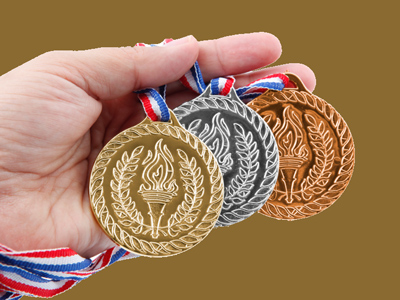
The Olympics have taken place for many years and have endured as a celebration of human achievement and athleticism.
Olympic Games
The Olympic Games bring athletes together from many countries. In this quiz, explore how the Games began, changed over time, and became a worldwide sporting celebration.
1 .
What did Sir Ludwig Guttmann introduce in 1948?
A brand new sport no one had tried before
A new kind of medal
The first Paralympics
A different way of scoring the athletes
The 'Parallel Olympics' were designed for athletes with disabilities
2 .
Where is the Olympic flame always lit?
In Buckingham Palace by the King
In the capital of the host country
In Olympia, Greece
At the North Pole
A female performer, acting as a priestess, ignites a torch by placing it inside a special mirror which focuses the sun's rays
3 .
The Olympic motto is 'Citius, Altius, Fortius'. What does this mean?
Faster, Higher, Stronger
Bigger, Better, Winner
Training, Diet, Attitude
Athletes, Audience, Entertainment
This has been the official motto since 1924
4 .
What prevented the Olympics from happening three times?
An argument between the organisers
Two World Wars
No suitable venue for the games
Very bad weather
The games are all numbered and these three games were still numbered, even though they did not take place
5 .
What happened for the first time at the Paris games in 1924?
There weren't enough medals for everyone
The athletes refused to take part
Everyone who was invited managed to come
There was a closing ceremony
The Winter Games also had its debut that year
6 .
What is the official symbol of the modern games?
Five wide bands of colour
A red cross on a white background
Five interlocking coloured rings
Five children holding hands
The rings represent the continents of North and South America, Asia, Africa, Europe and Australia
7 .
How often do the main Olympic Games take place?
Every 4 years
Every 6 months
Every 8 years
Every 16 years
The winter Olympics alternate with the main Olympic games every 2 years
8 .
The 1936 Summer Olympics in Berlin were the first Games to be what?
Restarted
Sabotaged
Abandoned
Televised
This was only to local audiences - now the Games are televised around the world
9 .
Where did the Olympic Games originally start?
Ancient Rome
Ancient Greece
Ancient Egypt
Ancient Britain
The original, ancient games were a sporting festival and started more than 3,000 years ago
10 .
When and where were the first modern Olympics held?
1989 in Rome
1927 in Stockholm
1888 in Spain
1896 in Athens
In the opening ceremony, King Georgios I and a crowd of 60,000 spectators welcomed 280 male-only participants from 13 nations



**Unlimited Quizzes Await You! 🚀**
Hey there, quiz champ! 🌟 You've already tackled today's free questions.
Ready for more?
Ready for more?
🔓 Unlock UNLIMITED Quizzes and challenge yourself every day. But that's
not all...
not all...
🔥 As a Subscriber you can join our thrilling "Daily Streak" against other
quizzers. Try to win a coveted spot on our Hall of Fame Page.
quizzers. Try to win a coveted spot on our Hall of Fame Page.
Don't miss out! Join us now and keep the fun rolling. 🎉
**Unlimited Quizzes Await You! 🚀**
Hey there, quiz champ! 🌟 You've already tackled today's free questions. Ready for more?
🔓 Unlock UNLIMITED Quizzes and challenge yourself every day. But that's not all...
🔥 As a Subscriber you can join our thrilling "Daily Streak" against other quizzers. Try to win a coveted spot on our Hall of Fame Page.
Don't miss out! Join us now and keep the fun rolling. 🎉




© Copyright 2016-2026 - Education Quizzes
Work Innovate Ltd - Design | Development |
Marketing
