




Ask the AI Tutor
Need help with Ten Pieces - Horn Concerto No. 4 (3rd Movement)? Ask our AI Tutor!
AI Tutor - Lucy
Connecting with Tutor...
Please wait while we establish connection
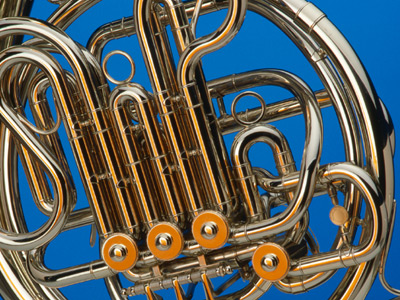
Find out more about the French horn in this quiz.
Ten Pieces - Horn Concerto No. 4 (3rd Movement)
Listen to Mozart’s Horn Concerto No. 4, third movement. Spot the main tune, notice the tempo and dynamics, and hear how the soloist leads the sound.
1 .
This piece is marked to be played Allegro Vivace. Which of the following does this mean ~ as though you probably couldn't have guessed?
At a steady medium speed
Bright and lively
Full blast all the way through
Standing up and leaning forward
Vivace is related to 'vivid', i.e. with plenty of life to it. It's hard to hear this piece and not buck up and smile!
2 .
What is the technical term for what happens around 3 minutes into our recording ~ when the orchestra 'pulls up' and the horn plays entirely alone, in flexible time, for a while before everyone returns to the main tune?
The solo
The soliloquy
The cadenza
The grand pause
'Cadence' means the musical feature where one chord leads into another as the harmonies move on through a piece, and at the end. If you stop a moment to consider what goes on in Happy Birthday to You, each time you sing 'to you' you can probably hear others singing or playing along with you, and together they reach ~ as it were ~ the end of a musical phrase or sentence (or idea). The first 'to you' sounds and feels different from the second and final ones (which should sound alike): and 'where the music's going' at these points is, basically, a matter of cadences. In a concerto movement, what one might expect to be a final cadence is suspended in mid-air while the soloist goes off on a (usually fairly wild and virtuosic) flight of musical fancy all on their own
3 .
There is a famous and much-loved song version of this piece, supposedly telling the story of someone who learnt the horn precisely so as to be able to play this (cheerful but tricky) movement ~ and then whose instrument was stolen. What were the names of the duo who wrote and popularised this version in the 1950s?
Abbott and Costello
Flanagan and Allen
Gilbert and Sullivan
Flanders and Swann
Gilbert & Sullivan (Ans.3) were each dead by 50-odd years when this version was written. Flanders & Swann entitled their song Ill Wind and it should be readily available online / by CD etc
4 .
The horn is a notoriously difficult instrument to make sound steady and attractive (even more so than the dear violin; or than the keyboards, where at least the notes are 'already there' and one merely has to hit them in the right order). In common with other brass instruments and also the flute, it needs very special techniques in the actual blowing, quite apart from any fingering issues. What is the correct musical term for 'applying one's mouth and blowing'?
Mouthing
Blowing
Blasting
Embouchure
This is originally a French term (from their root-word bouche = 'mouth')
5 .
The whole sound and rhythm of this piece is powerfully evocative of which activity, that was probably done a great deal more in Mozart's day?
Riding
Shooting
Fishing
Hunting
The horn (and its single-tube cousins, the bugle and post-horn) were originally used as outdoor signals over long distances. It was Papa Haydn who had the master idea of bringing the horns into his developing orchestra on the Esterhazy estate, and nowadays the symphony orchestra would be the poorer without the warmth of a group of them in the middle register of the brass section
6 .
The rhythm of the piece is technically known as 'compound duple time' (i.e. two main beats, each subdivided into 3 rather than 2 or 4; 'gallopy-gallopy', etc.). In simple terms, how does this appear as a time-signature on the score and parts?
3 / 4
6 / 8
6 / 4
2 / 3
This time pattern is associated with riding, galloping, cavalry marches (like Sousa's Liberty Bell and many others) and the old 'jig' dance ~ to which one could, at very least, easily skip (think of BBC Radio 4's Archers signature tune, which began life in the style of a maypole dance)
7 .
How many times does the main theme ('tune') come round within this movement?
Twice
Three times
Four times
Four main repeats plus the coda (playout/conclusion)
We hear plenty of the tune as it goes away and comes back again every couple of minutes. It would be a shame to waste such a good one!
8 .
How many valves are there on a 'modern' French horn?
Four
Three
Two
One
These enable the player to switch-in extra lengths of tubing so that all the notes can be played. Previously, the single un-valved tube could only produce notes within its harmonic series (not the same thing as a full scale; please look up this technicality elsewhere if interested, since it's important)
9 .
This movement is scored for solo horn (obviously enough) plus two 'chorus' horns in the orchestra; what other wind instrument/s, if any (i.e. brass or woodwind) are required?
A pair of flutes
A clarinet and bassoon
Two oboes
None
If you listen carefully you will still fail to hear any flutes, clarinets or trumpets at any point
10 .
The horn generally sits well against, or near, the human body. What total length of tubing is contained within the instrument?
6 metres
4 metres
9 metres
3 metres
Including all the 'diversions' this is the correct length. Answer 3 refers to the typical total length of the digestive tract within a fullgrown human body ~ not to the tubing in a horn!
You can find more about this topic by visiting BBC - KS2: Wolfgang Amadeus Mozart - Horn Concerto No. 4 (3rd movement)



**Unlimited Quizzes Await You! 🚀**
Hey there, quiz champ! 🌟 You've already tackled today's free questions.
Ready for more?
Ready for more?
🔓 Unlock UNLIMITED Quizzes and challenge yourself every day. But that's
not all...
not all...
🔥 As a Subscriber you can join our thrilling "Daily Streak" against other
quizzers. Try to win a coveted spot on our Hall of Fame Page.
quizzers. Try to win a coveted spot on our Hall of Fame Page.
Don't miss out! Join us now and keep the fun rolling. 🎉
**Unlimited Quizzes Await You! 🚀**
Hey there, quiz champ! 🌟 You've already tackled today's free questions. Ready for more?
🔓 Unlock UNLIMITED Quizzes and challenge yourself every day. But that's not all...
🔥 As a Subscriber you can join our thrilling "Daily Streak" against other quizzers. Try to win a coveted spot on our Hall of Fame Page.
Don't miss out! Join us now and keep the fun rolling. 🎉




© Copyright 2016-2026 - Education Quizzes
Work Innovate Ltd - Design | Development |
Marketing
