




Ask the AI Tutor
Need help with Ten Pieces - The Firebird Suite - Finale? Ask our AI Tutor!
AI Tutor - Lucy
Connecting with Tutor...
Please wait while we establish connection
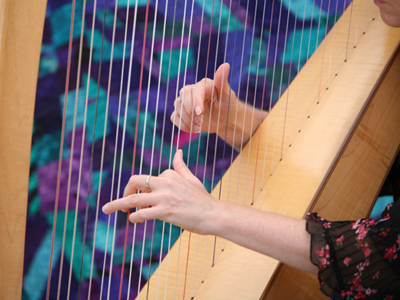
How many harp parts are in this piece of music? Find out in this quiz!
Ten Pieces - The Firebird Suite - Finale
The Firebird Finale builds from quiet to huge. Hear new instruments join, rhythms steady, and the melody return brighter. Can you follow the music as it grows?
1 .
How many separate harp parts are going on within all this, in the original version?
Just one
A couple
Three
Four
There is also a piano part, though it's not perhaps as obvious or distinctive. Stravinsky was clearly taking no chances!
2 .
At around 1'45" the tune is 'thrown around' more boldly between some more noble and assertive instruments: which are they?
Bassoon and cymbals
Trumpets and kettledrums
Horns and castanets
Guitars and drums
A careful listen should establish this very clearly. There are no guitars in this piece usually, and the percussionists will be too busy with other things to play any castanets (though these are very distinctive ~ the instant sound-clue to Spanish music ~ even their insistent clicking would be drowned by all the other noise)!
3 .
Which is the correct order in which these instruments are significantly heard in the first minute of the piece?
Flute, harp, strings (violins), horn
Harp, horn, violins, flute
Horn, harp, violins, flute
Violins, flute, horn, harp
Listen carefully and all should be clear. The opening tune finds the horn sounding far mellower and calmer than it did in our Mozart concerto movement!
4 .
Sometimes in music a pattern 'gets stuck' (like the repeated rhythm in Holst's Mars); sometimes one note or pitch clings on while the rest of the music rises or drops against it. In the Firebird Finale there is a lowish drone early on, but the last-but-one chord (just before the 3-minute mark) arrives while the trumpets have been hanging onto one note against all opposition. What is the technical term for such a musical device?
Ostinato
Pedal
Tenuto
Crescendo
'Pedal' alludes originally to organists who can park their foot on a single pedal key and hold that note (usually in the bass) for as long as they want, while other, upper parts in their music may be moving around. (Not the same thing as the 'sustain' pedal on a piano, which holds on any notes played ~ until they either die of their own accord, or the pedal is released.) Stravinsky does a similar trick with the long low drone during the first minute or so while the music is 'waking up'; and then the trumpets cling onto a note ahead of the finish while everyone else gets there, even creating discords during the struggle
5 .
During the long opening buildup of this piece, many of the instruments play not just 'straight' notes, but with a quivering texture according to their technique (jiggling their bows, fluttering their tongues or whatever). This helps create a sense of excitement and tension, perhaps even of the sight of the Firebird rising amid flickering flame. What is the technical musical term for such a manner of playing?
Trill
Tremolando
Aquiver
Shaken
Many of the others are close alternatives but this is the usual technical term. The violins in particular do it a lot in this piece, both in the first section and suddenly, louder and more insistently, after the change of mood at around 1'40''
6 .
What was the name of the Russian ballet boss who commissioned Stravinsky to write Firebird, which in turn was the composer's 'breakthrough' piece into the musical world of Paris and beyond?
Artur Rubinstein
Sergei Diaghilev
Pablo Picasso
Anatoly Nikinsky
His troupe was called the Ballets Russes (pronounced 'ballay-rooss')
7 .
The piece was originally the last section within a longer work: what kind of work?
Opera
Oratorio
Symphony
Ballet
Ballet is the creation and performance of an 'abstract spectacle' in which groups and individual dancers make moving shapes to the sound of music. Since long before the age of screen-based graphics (film, computers etc) this has been one of the creative glories of human culture
8 .
What is the technical term for the 'glide' (usually upwards) played by a harpist ~ as, here, 30-and-a-few seconds into the performance?
Crescendo
Glissando
Sforzando
Rallentando
The terms may have baffled you ~ but the correct answer is related to our word 'glide', perhaps unsurprisingly. When any other instrument tries to create the same effect (e.g. the piano) based on an actual chord, rather than a scale, this in turn is known as arpeggio ('harp-like playing'). The effect has become aural shorthand for someone going into, or perhaps emerging from, a dream in films etc
9 .
Appropriately, this music was used to accompany the lighting of the torch at a recent Olympiad ... in which year and city?
Beijing 2008
Vancouver 2010 (winter)
London 2012
Sochi 2014 (winter)
Bear in mind that the Russians were hosting these, and Stravinsky was of that nationality by birth (though he later changed citizenship not once, but twice: see our companion quiz on him)
10 .
The underlying rhythm in the early stages of this piece is steady but very relaxed. How many beats are there to the bar?
Two
Three
Four
Six
Three slow beats (try counting them: a similar pace to a very broad rendering of the British National Anthem). The marking is Lento maestoso which means 'Slow and majestic', so this is a surprisingly appropriate off-the-cuff comparison!
You can find more about this topic by visiting BBC - KS2: Igor Stravinsky - The Firebird — suite (1911) (Finale)



**Unlimited Quizzes Await You! 🚀**
Hey there, quiz champ! 🌟 You've already tackled today's free questions.
Ready for more?
Ready for more?
🔓 Unlock UNLIMITED Quizzes and challenge yourself every day. But that's
not all...
not all...
🔥 As a Subscriber you can join our thrilling "Daily Streak" against other
quizzers. Try to win a coveted spot on our Hall of Fame Page.
quizzers. Try to win a coveted spot on our Hall of Fame Page.
Don't miss out! Join us now and keep the fun rolling. 🎉
**Unlimited Quizzes Await You! 🚀**
Hey there, quiz champ! 🌟 You've already tackled today's free questions. Ready for more?
🔓 Unlock UNLIMITED Quizzes and challenge yourself every day. But that's not all...
🔥 As a Subscriber you can join our thrilling "Daily Streak" against other quizzers. Try to win a coveted spot on our Hall of Fame Page.
Don't miss out! Join us now and keep the fun rolling. 🎉




© Copyright 2016-2026 - Education Quizzes
Work Innovate Ltd - Design | Development |
Marketing
