




Ask the AI Tutor
Need help with KS3 Science Gap-Finder Quiz? Ask our AI Tutor!
AI Tutor - Lucy
Connecting with Tutor...
Please wait while we establish connection
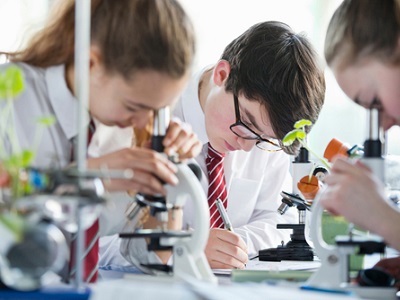
Ever wonder which science topics you've actually mastered? Use our Gap-Finder to find out.
KS3 Science Gap-Finder Quiz
Use this KS3 Science Gap-Finder to check what you know, spot gaps, and decide what to practise next across Biology, Chemistry, and Physics topics.
1 .
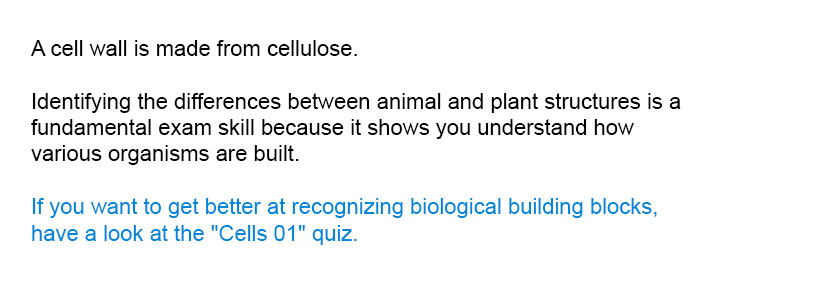
Which of the following is NOT present in an animal cell?
Cell membrane
Cell wall
Cytoplasm
Nucleus
2 .
What is listed in the Periodic Table?
Only compounds
Only elements
Only gases
Only metals

3 .
Which of the following is NOT a force?
Gravity
Pull
Mass
Weight

4 .
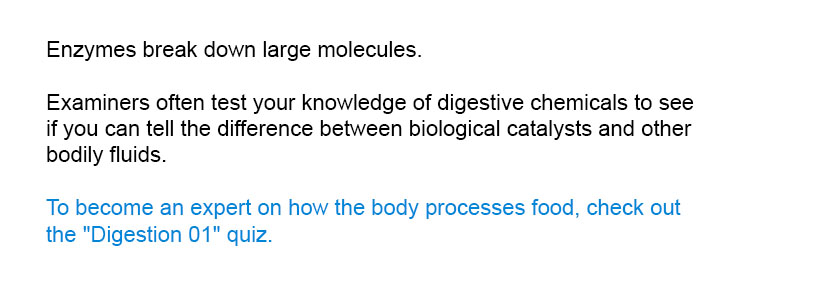
Which of the following is NOT an enzyme?
Carbohydrase
Lipase
Protease
Bile
5 .
Which of the following pH numbers indicates a neutral substance?
1
5
7
14

6 .
Which is the MAIN energy transfer taking place when a candle burns?
Chemical → light
Chemical → sound
Light → chemical
Thermal → chemical

7 .
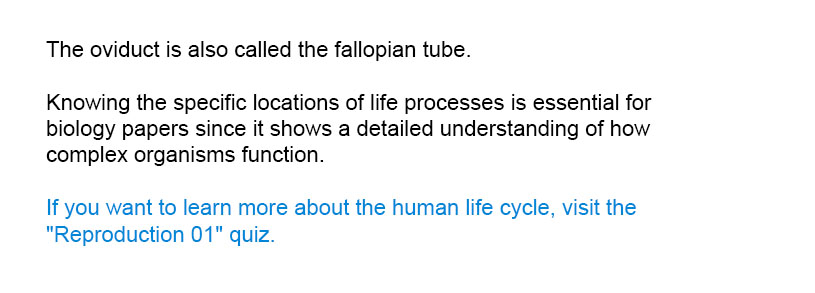
Fertilisation of an egg occurs in:
the ovary
the oviduct
the uterus
the vagina
8 .
Which of these statements about solids is true?
They can be compressed easily
They have no definite volume
They take the shape of their container
They do not flow

9 .
In order to measure the current flowing through a bulb in a circuit, the ammeter is connected in:
Not connected in the circuit
parallel with the battery
parallel with the bulb
series with the bulb

10 .
Which one of the following shows continuous variation?
Height
Blood group
Gender
Tongue rolling




**Unlimited Quizzes Await You! 🚀**
Hey there, quiz champ! 🌟 You've already tackled today's free questions.
Ready for more?
Ready for more?
🔓 Unlock UNLIMITED Quizzes and challenge yourself every day. But that's
not all...
not all...
🔥 As a Subscriber you can join our thrilling "Daily Streak" against other
quizzers. Try to win a coveted spot on our Hall of Fame Page.
quizzers. Try to win a coveted spot on our Hall of Fame Page.
Don't miss out! Join us now and keep the fun rolling. 🎉
**Unlimited Quizzes Await You! 🚀**
Hey there, quiz champ! 🌟 You've already tackled today's free questions. Ready for more?
🔓 Unlock UNLIMITED Quizzes and challenge yourself every day. But that's not all...
🔥 As a Subscriber you can join our thrilling "Daily Streak" against other quizzers. Try to win a coveted spot on our Hall of Fame Page.
Don't miss out! Join us now and keep the fun rolling. 🎉




© Copyright 2016-2026 - Education Quizzes
Work Innovate Ltd - Design | Development |
Marketing
