




Ask the AI Tutor
Need help with Jewish Practices and Customs? Ask our AI Tutor!
AI Tutor - Lucy
Connecting with Tutor...
Please wait while we establish connection
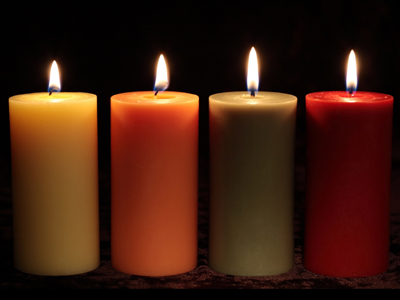
Candles are often lit in Jewish homes.
Jewish Practices and Customs
Jewish practices and customs shape daily life, worship, and community, helping people express belief through prayer, festivals, home traditions, and shared responsibilities.
1 .
Although it occurs every week, the Jewish Sabbath (“Shabbat” - translation is “rest”) on a Saturday is an important holy day for Jews. It traditionally lasts ....
midnight Friday to midnight Saturday
evening Friday to sunset Saturday
dawn Saturday to dawn Sunday
dawn Saturday to sunset Saturday
The Torah (Book of Jewish Law) describes creation as "And there was evening, and there was morning, one day." So according to Judaism, a new day begins in the evening, at sunset. Therefore the Jewish Sabbath, like all days as far as Judaism is concerned, begins at sunset the previous evening. The Sabbath ends at nightfall, when three stars are visible, some 40 minutes after sunset
2 .
Can non-Jews participate in a Jewish funeral?
Only if they are related through inter-marriage
It is considered somewhat of an honour by the grieving family if they do
With the Rabbi’s permission
Provided they recite the Jewish burial prayer in English
While non-Jewish participation in a Jewish funeral is usually limited to either serving as a pall bearer or, if especially close to the deceased, reading a tribute, in Jewish tradition, the burial of the dead is sometimes referred to as an act of true loving kindness because the dead can’t repay for the act of helping them to rest in peace
3 .
In order to maintain a "kosher" kitchen and prevent the "cooking of a goat in its mother's milk" (which is the basis of Jewish kosher laws where meals prepared with dairy products are separated from meals made with meat), Orthodox Jews will ....
not bring meat into the kitchen
not bring dairy products into the kitchen
use separate cooking and food utensils for meat and dairy dishes
be strictly vegetarian
Orthodox Jewish homes normally have separate drawers and cupboards for dairy and meat cooking and eating 'equipment'. Depending on the level of Orthodoxy, this may extend to a dual kitchen, where there will be two of everything (cutlery, pots and pans, crockery, cooker, microwave and dishwasher). The ultra-observant Orthodox will sometimes extend this as far as having two kitchens, one for the preparation of meat meals and one for the preparation of dairy product meals
4 .
On the eve of the Sabbath it is customary in a Jewish home to light ....
a candle
two candles
two or more candles
no candles
Each Friday in a Jewish home, shortly before sunset (no later than 18 minutes before) the lady of the house lights at least two candles, which usher in peace and blessing to their homes and to the world. At least two are lit to signify the two commandments to “remember” the Sabbath and to “keep” the Sabbath day holy
5 .
It is customary for Jewish people to give money to charity ....
at Saturday (Sabbath) morning services
before the beginning of each Sabbath
during the synagogue service on the Sabbath day
before Sabbath on at least one occasion a year
In traditional Jewish homes there will nearly always be at least one charity box for the needy. Jewish tradition encourages charity to be put aside just prior to lighting the Sabbath candles on a Friday night (because money should not be handled on a Sabbath) or a special occasion so as to remember and do something concrete for those who are less fortunate. Jewish custom states a person should give at least a tenth of their wealth to the poor, although it warns that giving beyond one’s means is counter-productive because if it makes them poor they would be unable to help others
6 .
A Jewish man and wife can divorce....
never
if the husband and wife mutually agree
if granted by the husband
if a civil divorce has been granted
There is nothing in Jewish Law that states marriage is a union for life, as it recognises that marriages can fail. While a Jewish divorce is a consensual document, it may only be granted by the husband for the wife to accept. A civil divorce also has to be granted. However, without the Jewish divorce, neither of the parties would be otherwise free to remarry in a Jewish ceremony
7 .
When naming a child, Jewish parents ...
are forbidden from naming them after themselves, that is, the father David cannot call his son David
name them with one, single first name only
use a name chosen from a specific list provided by the Rabbi
use a name chosen by a grandparent, or handed down should the grandparent be deceased at the time of birth
Jewish Law forbids the naming of children after their own living parents, that is, if the father's name is 'David', it is not permitted for any of his sons to be named 'David'. Jewish children are usually given
at least two names, one being a full secular name and the other a full Hebrew name. The full secular name is the one used in daily life, as seen on passports, in addresses and by friends, etc. The Hebrew name, used for ceremonies in the synagogue, is one usually based on (but not named after) the parent. For example, Harry Michael Taylor's son David would be referred to, if being called to make a reading in the synagogue on the Sabbath, as, "David, son of Harry Michael" (this would be translated and called out in Hebrew as "Dovid, ben [son of] Hersh Michel")
8 .
The abstinence from work on the Jewish Sabbath (Saturday) and High Holy days means ....
not going to work
not driving
not watching television
all three and more besides
In the book of Deuteronomy, the fifth Book of Moses and the Old Testament, (5:12-15) the commandment to "observe" the Sabbath is to ensure that no creature, not even animals, will work without respite. In the modern world, very religious Orthodox Jews have interpreted this to include the using of any appliance or piece of equipment that requires 'energy' that has been generated in order to function - lighting a fire, cutting paper with scissors, switching on the radio, going shopping or even writing. As a result, in strictly observant homes, meals for the Sabbath or High Holy Day will have been pre-prepared, and if needed to be served hot, will be placed on a low cooker light the previous evening. Also, to make hot drinks during the Holy Day, a "Sabbath kettle" will be boiled prior to the Sabbath or High Holy Day and left undisturbed on a low light for the duration of the day
9 .
The small metal cylinder that can be seen on the doorpost of Jewish homes, the 'Mezuzah', is ....
for decoration
traditionally made from solid silver
to assist the Rabbi with identifying his congregants' homes
contains a small house blessing
A mezuzah is a piece of parchment, contained in a decorative case, and is inscribed with specified Hebrew verses from the Torah (Old Testament, Deuteronomy, the fifth Book of Moses, 6:4-9 and 11:13-21). These verses comprise the Jewish prayer "Shema Yisrael", beginning with the phrase: "Hear, O Israel, the Lord our God, the Lord is One". The parchment is written by a qualified scribe, in black indelible ink with a special quill pen, rolled up, and placed inside the case
10 .
If passing, for example, a broken-down motorist on the motorway, some Jewish people will say "nebach". This is an adverb of Yiddish origin ....
to empathise with an unlucky person
and an exclamation of relief that it is not them
to apologise that they could not stop to assist
and is a good luck statement to ward of the possibility of it happening to them
According to Babylonian experts, "nebach" translates as an unlucky or unfortunate person, but it also means "It's a pity." It is often apologetically used in situations where to demonstrate the user is unable to help but wants to offer their condolences



**Unlimited Quizzes Await You! 🚀**
Hey there, quiz champ! 🌟 You've already tackled today's free questions.
Ready for more?
Ready for more?
🔓 Unlock UNLIMITED Quizzes and challenge yourself every day. But that's
not all...
not all...
🔥 As a Subscriber you can join our thrilling "Daily Streak" against other
quizzers. Try to win a coveted spot on our Hall of Fame Page.
quizzers. Try to win a coveted spot on our Hall of Fame Page.
Don't miss out! Join us now and keep the fun rolling. 🎉
**Unlimited Quizzes Await You! 🚀**
Hey there, quiz champ! 🌟 You've already tackled today's free questions. Ready for more?
🔓 Unlock UNLIMITED Quizzes and challenge yourself every day. But that's not all...
🔥 As a Subscriber you can join our thrilling "Daily Streak" against other quizzers. Try to win a coveted spot on our Hall of Fame Page.
Don't miss out! Join us now and keep the fun rolling. 🎉




© Copyright 2016-2026 - Education Quizzes
Work Innovate Ltd - Design | Development |
Marketing
