




Ask the AI Tutor
Need help with Between the Devil and the Deep Blue Sea? Ask our AI Tutor!
AI Tutor - Lucy
Connecting with Tutor...
Please wait while we establish connection
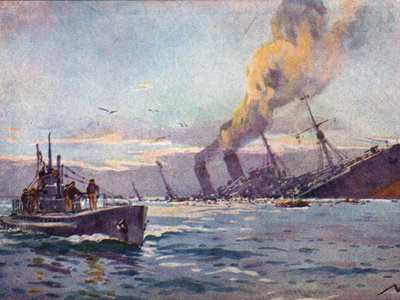
The above painting is by Willy Stöwer, depicted on a postcard sent in 1917.
Between the Devil and the Deep Blue Sea
Explore naval danger in World War 1, looking at submarines, sea routes and how conflict affected ships, trade and civilians.
1 .
On 26th February 1918, HMHS Glenart Castle was sunk by a German U-boat. What did the initials 'HMHS' stand for?
His Majesty's Hospital Ship
His Majesty's Heavy Ship
His Majesty's Helicopter Ship
His Majesty's Homeland Ship
In total 23 hospital ships were sunk during the war. Four were sunk by the Allies, 17 by the Germans and Austrians and two by accident
2 .
On 16th December 1914 the German Navy conducted a raid on which British ports?
Dover, Portsmouth and Southampton
Aberdeen, Newcastle and Hull
Liverpool, Swansea and Glasgow
Hartlepool, Scarborough and Whitby
729 people were killed or injured in the raid and many of them were civilians. The British public became angry at Germany for attacking civilians but also at the Royal Navy for allowing the Germans to get so close
3 .
In the Allied raid on Zeebrugge in 1918, what was the British plan?
To sink Dutch ships
To sink Belgian ships
To sink British ships
To sink German ships
It was planned to sink old British ships in the port entrance to stop German ships from leaving. However, the ships were sunk in the wrong place and the German submarines were still able to leave the port at high tide
4 .
The largest naval battle of the war, the Battle of Jutland, took place between 31st May and 1st June 1916. How many warships took part?
250 warships
200 warships
150 warships
100 warships
The British, Canadians and Australians brought 151 warships to battle. The Germans brought 99. Of these, the Allies lost 14 ships and 6,094 men, whilst the Germans lost 11 ships and 2,551 men. Both sides claimed to have been victorious!
5 .
The Germans conducted a further raid on Dover Strait in April 1917, during which German and British crews engaged in which old-fashioned act of naval warfare?
Powered their ships with oars
Used cannonballs
Fought hand to hand
Made their enemies walk the plank
The British destroyer, HMS Broke, rammed a German torpedo boat. German sailors tried to board Broke and the two sets of crews fought hand to hand before the German boat finally sank
6 .
In October 1916 the Germans won a victory when a force of torpedo boats launched an attack on which stretch of water?
The Bristol Channel
Straits of Dover
The Thames Estuary
The Straits of Orkney
A German force of 23 small torpedo boats took on a British force of seven destroyers, and 30 other Royal Navy boats. They sank one destroyer and six boats and lost none of their own
7 .
The German U-boat campaign, against Allied merchant ships in the Atlantic, sunk how many tons of shipping?
Eighty million tons
Eight million tons
Eight hundred thousand tons
Eighty thousand tons
Almost half the supply vessels heading for Great Britain were sunk, but despite this supplies were not cut off. 178 German U-boats were lost in the action and it is considered a victory for the Allies
8 .
After the Armistice of November 1918, 74 German ships were sent to Scapa Flow in the Scottish Orkneys to await Germany's surrender. How did their German commander react?
He had his men abandon their ships
He ordered his ships back to Germany
He resisted the British and continued to fight
He sunk all his ships
On 21st June 1919, Admiral von Reuter gave his men the order to sink their ships so that the British would not get to use them
9 .
The first naval battle of the war took place on 28th August 1914 and was a victory for the British. Where did the battle take place?
Off the coast of Britain
In the mid-Atlantic
Off the coast of Germany
In the south-Pacific
The battle was fought at Heligoland Bight, a bay at the mouth of the river Elbe, in Germany. 35 British men were killed and no British ships were lost, whereas 712 German men were killed, 336 were captured and six German vessels were sunk
10 .
In November 1914 Britain suffered its first naval defeat of the war. How many years was it since their last defeat at sea?
22 years
52 years
82 years
102 years
In the battle of Coronel, fought off the coast of Chile, Britain lost two ships and 1,570 men. It was the Royal Navy's first defeat since the Battle of Lake Champlain in 1812
Our Social Circles




**Unlimited Quizzes Await You! 🚀**
Hey there, quiz champ! 🌟 You've already tackled today's free questions.
Ready for more?
Ready for more?
🔓 Unlock UNLIMITED Quizzes and challenge yourself every day. But that's
not all...
not all...
🔥 As a Subscriber you can join our thrilling "Daily Streak" against other
quizzers. Try to win a coveted spot on our Hall of Fame Page.
quizzers. Try to win a coveted spot on our Hall of Fame Page.
Don't miss out! Join us now and keep the fun rolling. 🎉
**Unlimited Quizzes Await You! 🚀**
Hey there, quiz champ! 🌟 You've already tackled today's free questions. Ready for more?
🔓 Unlock UNLIMITED Quizzes and challenge yourself every day. But that's not all...
🔥 As a Subscriber you can join our thrilling "Daily Streak" against other quizzers. Try to win a coveted spot on our Hall of Fame Page.
Don't miss out! Join us now and keep the fun rolling. 🎉
© Copyright 2016-2026 - Education Quizzes
Work Innovate Ltd - Design | Development |
Marketing
