UKUK USUSIndiaIndia
Progress you can see
Join Us
Lucy
Ask the AI Tutor
Need help with 11 Plus English Gap-Finder? Ask our AI Tutor!
Lucy AI Tutor - Lucy
Connecting with Tutor...
Please wait while we establish connection
Lucy
Hi! I'm Lucy, your AI tutor. How can I help you with 11 Plus English Gap-Finder today?
now
Close-up of open book pages with a vibrant background representing 11+ English diagnostic triage.
Take the 10-question challenge now to pinpoint your English gaps and fast-track your 11+ success.

11 Plus English Gap-Finder

Use this 11 Plus English Gap-Finder to spot strengths, find gaps, and choose what to practise next, from vocabulary and spelling to grammar and reading skills.

Explore the Topic →
(quiz starts below)

Fascinating Fact:

Vocabulary grows best when you meet words repeatedly in different texts. Seeing a word in stories, articles, and questions helps it stick.

In 11 Plus English, students practise the skills needed for entrance exam style questions, including grammar knowledge, precise word choices, and clear understanding of what a text is saying. A gap-finder quiz helps you see which building blocks need more practice before tackling timed papers.

  • Adjective: A describing word that tells you more about a noun, such as “bright”, “careful”, or “noisy”.
  • Alphabetising: Putting words in order using the alphabet, comparing letter by letter when needed.
  • Antonym: A word with the opposite meaning of another word, such as “early” and “late”.
What should I revise for the 11 Plus English exam?

Revise vocabulary and spelling, word classes like adjectives and adverbs, punctuation, and reading skills such as finding information and choosing the best meaning from the context.

How can I improve my vocabulary for 11 Plus English?

Read a range of books and short articles, collect new words with meanings, and practise using them in your own sentences so you remember them and recognise them in questions.

How do I get quicker at 11 Plus English questions?

Practise little and often, learn common grammar terms, and use timed mini quizzes so you build speed while still checking accuracy, especially for spellings and word meanings.

1 .
What is the antonym of the word below?
Tranquil (adjective)
Calm
Cool
Agitated
Relaxed
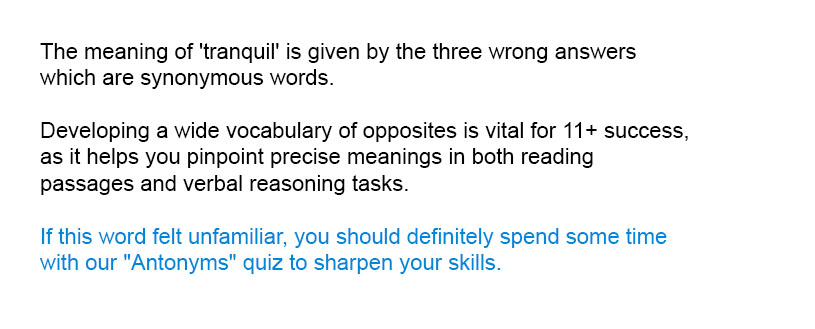
The meaning of 'tranquil' is given by the three wrong answers which are synonymous words.
Developing a wide vocabulary of opposites is vital for 11+ success, as it helps you pinpoint precise meanings in both reading passages and verbal reasoning tasks.
If this word felt unfamiliar, you should definitely spend some time with our "Antonyms" quiz to sharpen your skills.
2 .
Which of the following sentences is a complex sentence?
The bell rang, and the children ran out of the classroom.
When the bell rang, the children ran out of the classroom.
The children ran out of the classroom. The bell rang.
The children ran out of the classroom.
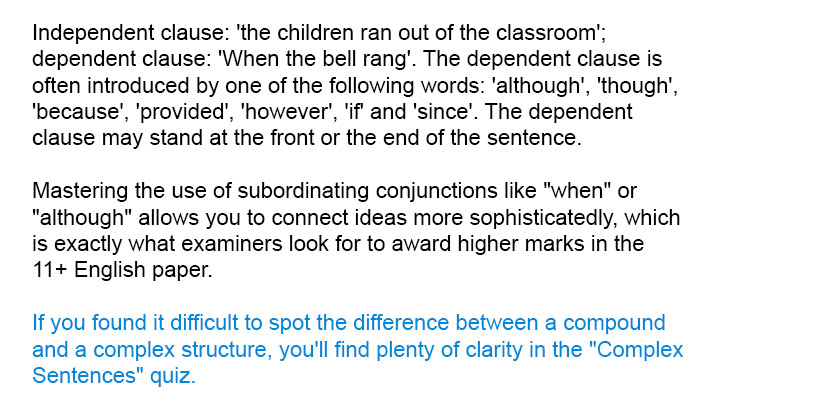
Independent clause: 'the children ran out of the classroom'; dependent clause: 'When the bell rang'. The dependent clause is  often introduced by one of the following words: 'although', 'though', 'because', 'provided', 'however', 'if' and 'since'. The dependent clause may stand at the front or the end of the sentence.

Mastering the use of subordinating conjunctions like "when" or "although" allows you to connect ideas more sophisticatedly, which is exactly what examiners look for to award higher marks in the 11+ English paper.

If you found it difficult to spot the difference between a compound and a complex structure, you'll find plenty of clarity in the "Complex Sentences" quiz.
3 .
In the sentence below, which words are adverbs?
He is often late for work, and she is never on time.
There are no adverbs in this sentence
often
often, never
never
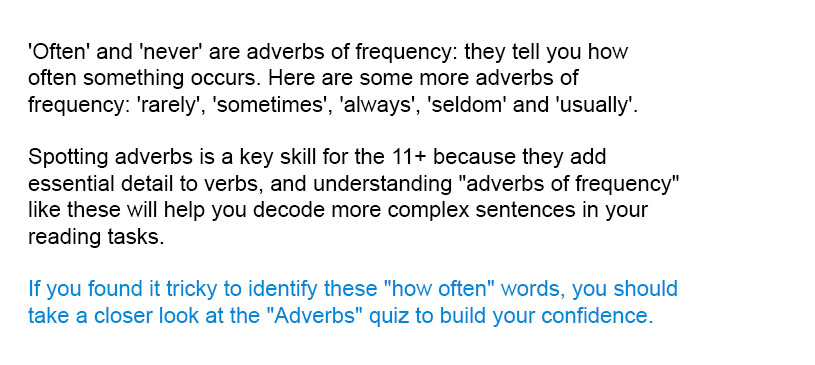
'Often' and 'never' are adverbs of frequency: they tell you how often something occurs. Here are some more adverbs of frequency: 'rarely', 'sometimes', 'always', 'seldom' and 'usually'.

Spotting adverbs is a key skill for the 11+ because they add essential detail to verbs, and understanding "adverbs of frequency" like these will help you decode more complex sentences in your reading tasks.

If you found it tricky to identify these "how often" words, you should take a closer look at the "Adverbs" quiz to build your confidence.
4 .
Choose the best explanation for the simile.
The teacher's explanation was as clear as mud.
The teacher's explanation was very clear
The teacher's explanation was not at all clear
The teacher's explanation was quite clear
The teacher's explanation was covered in mud
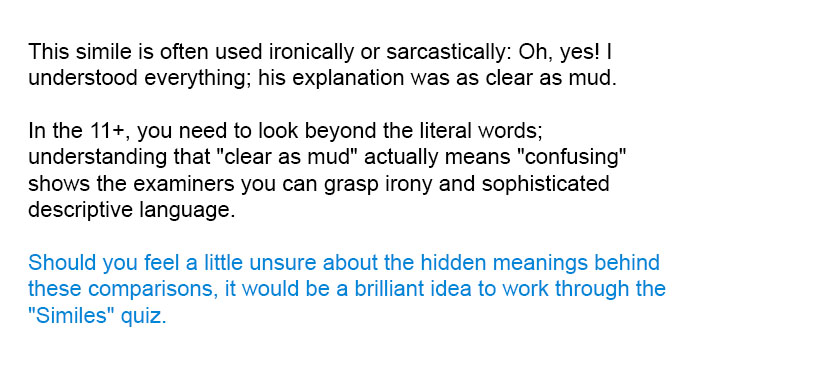
This simile is often used ironically or sarcastically: Oh, yes! I understood everything; his explanation was as clear as mud.

In the 11+, you need to look beyond the literal words; understanding that "clear as mud" actually means "confusing" shows the examiners you can grasp irony and sophisticated descriptive language.

Should you feel a little unsure about the hidden meanings behind these comparisons, it would be a brilliant idea to work through the "Similes" quiz.
5 .
Complete the sentence below with the correct possessive forms.
The ... showers were not working.
girls'
girlz'
girls's
girlses
To form the plural possessive you add -s' to the end of the word, for example: professor - professors' (more than one professor). In the case of words like 'baby', the plural is 'babies': the possessive form of the plural would then be babies' NOT babys' - be on the look out for nouns ending in a 'consonant and -y' because the -y changes to -ies in the plural form. For example: fairy - fairies (plural) - fairies' (possessive).

Accurate punctuation is a non-negotiable for the 11+; showing that you know exactly where to place an apostrophe when there is more than one owner proves you have the precision required for top-tier schools.

If the rules for plural owners feel a bit foggy, you will find it incredibly helpful to master the "Apostrophes to Mark Possession" quiz.
6 .
What is the synonym of the word given?
peril (noun)
danger
safety
shelter
security
Use the synonymous word as a guide to one of  the meanings of 'peril'.

Expanding your knowledge of synonyms is one of the most effective ways to boost your score, as 11+ papers frequently test your ability to recognise words with similar meanings to see if you can handle more sophisticated vocabulary.

If you want to strengthen your word bank and become more confident with complex vocabulary, it would be a fantastic idea to spend some time on the "Synonyms" quiz.
7 .
In which of the following sentences has a comma been wrongly used or omitted?
The headmaster, the mayor, and the school governors were at the meeting.
The headmaster, the mayor and the school governors were at the meeting.
It was a long, hard, tiring journey.
He left the scene of the crime, and tried to forget that it had happened.
This breaks Rule 2. 'tried to forget that it had happened' is NOT an independent clause: there is no subject, so you don't need the comma. On the other hand, 'He left the scene of the crime, and HE tried to forget that it had happened' has two independent clauses.

Commas are essential for guiding the reader through your sentences. Knowing when not to use one, especially before a joining word like 'and' when the second part is not a full sentence, marks you out as a high-level writer.

If you found it tricky to spot the misplaced pause in these sentences, it would be a great idea to dive into the "Commas" quiz to sharpen your punctuation.
8 .
Choose which word(s) are in non-standard English.
That's the swing she swinged on.
That's
swinged
swing
on
It should be 'swung'. It's an irregular verb: 'swing-swung-swung' (principal parts).

Using correct verb forms is a major part of the 11+ English criteria. Examiners look for your ability to use irregular past tense verbs accurately to show you have a high command of the language.

In case you found it tricky to spot the incorrect verb form here, you might enjoy the challenge of the "Standard English" quiz.
9 .
What is the meaning of the given prefix?
Anti-
in favour of
against
undecided
before
For example: antidote; anticlockwise; anti-abortion. 'Contr(a)' and 'Counter' also mean against: contradiction; counter-revolution. LEARN these prepositions and their uses.

Prefixes are like secret codes that help you unlock the meaning of difficult words you might not have seen before. Being able to recognize that "ante" means "before" will give you a significant advantage when you encounter complex vocabulary in your exam papers.

If you found it difficult to recall what these specific letter groups mean, it would be a smart move to try out the "Prefixes" quiz to boost your word power.
10 .
What subscription would you use to end your letter to Mrs. Mary Jones?
Yours Sincerely,
Yours Faithfully,
Yours faithfully,
Yours sincerely,
This would be followed directly underneath by your signature, and underneath that: your name enclosed in brackets. DON'T spell 'sincerely' wrongly! If you didn't know the person's name, you would write 'Yours faithfully'.

First impressions are everything in a writing task. Correctly matching your sign-off to your greeting shows the examiner that you understand the formal etiquette required for professional correspondence.

If you found it difficult to remember whether to use "faithfully" or "sincerely," you will find plenty of helpful tips in the "Writing Letters" quiz.
Author:  Tara Kemp

© Copyright 2016-2026 - Education Quizzes
Work Innovate Ltd - Design | Development | Marketing