UKUK USUSIndiaIndia
Progress you can see
Join Us
Lucy
Ask the AI Tutor
Need help with 11 Plus Maths Gap-Finder? Ask our AI Tutor!
Lucy AI Tutor - Lucy
Connecting with Tutor...
Please wait while we establish connection

Lucy
Hi! I'm Lucy, your AI tutor. How can I help you with 11 Plus Maths Gap-Finder today?
now
Close-up of professional technical blueprints with a calculator and drawing compass for 11 plus Maths diagnostic testing.
Map out your 11+ Maths strengths and find every calculation gap with our 10-question diagnostic challenge.

11 Plus Maths Gap-Finder

Use this 11 Plus Maths Gap-Finder to find strengths, spot gaps, and choose what to practise next, from number skills to problem solving with time, ratio, and sequences.

Explore the Topic →
(quiz starts below)

Fascinating Fact:

Angles on a straight line add to 180°, and angles around a point add to 360°. These two facts solve loads of tricky angle puzzles.

In 11 Plus Maths, students build fast, accurate methods and learn to apply them in unfamiliar questions. A gap-finder quiz helps you identify which foundations need attention, such as calculation accuracy, patterns, and multi-step reasoning with real-world maths.

  • Number sequence: A list of numbers that follows a rule or pattern, such as adding the same amount each time.
  • Ratio: A way of comparing amounts, showing how many parts of each quantity there are.
  • Elapsed time: The amount of time that passes between a start and finish time.
What should I revise for the 11 Plus maths exam?

Revise the four operations, fractions and decimals, time and measures, ratio, and number patterns, then practise word problems that need more than one step.

How can I get faster at 11 Plus maths without making mistakes?

Use short daily practice, learn efficient methods, write working clearly, and check answers quickly with estimation or inverse operations, like subtraction to check addition.

How do I approach tricky 11 Plus maths word problems?

Underline key information, decide the steps before calculating, use a small diagram or table if helpful, and keep units consistent, especially for time, money, and measures.

1 .
123 + 56 + 684 - 3 = ?
870
880
860
890
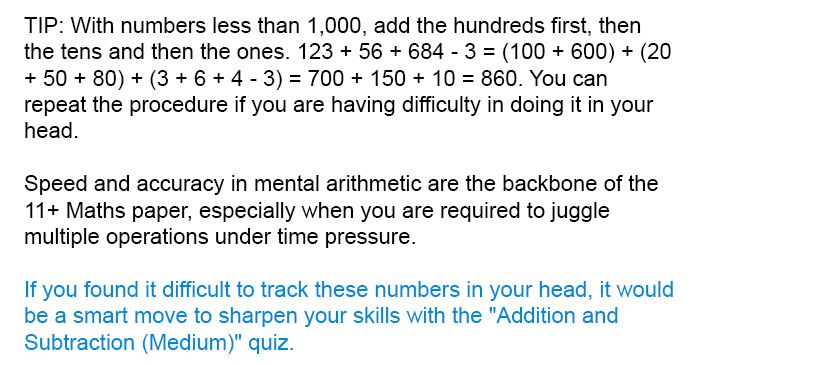
TIP: With numbers less than 1,000, add the hundreds first, then the tens and then the ones. 123 + 56 + 684 - 3 = (100 + 600) + (20 + 50 + 80) + (3 + 6 + 4 - 3) = 700 + 150 + 10 = 860. You can repeat the procedure if you are having difficulty in doing it in your head.

Speed and accuracy in mental arithmetic are the backbone of the 11+ Maths paper, especially when you are required to juggle multiple operations under time pressure.

If you found it difficult to track these numbers in your head, it would be a smart move to sharpen your skills with the "Addition and Subtraction (Medium)" quiz.
2 .
Using the tip, what is the correct answer to the given calculation?
TIP: To multiply a number by 9: first multiply the number by 10, then subtract the original number from it.
47 × 9 = ?
432
423
342
324
47 × 9 = (47 × 10) - 47 = 423

Developing "number sense" through shortcuts, like multiplying by 10 and then subtracting the original number, is a powerful way to increase your speed and reduce errors during the 11+ exam.

If you had to write this down to solve it, it is definitely worth spending time with the "Multiplication and Division (Medium)" quiz to learn these essential mental tricks.
3 .
What is 25 + 410 + 1215?
1615
263
85
1810
<sup>2</sup>?<sub>5</sub> + <sup>4</sup>?<sub>10</sub> + <sup>12</sup>?<sub>15</sub> = <sup>2</sup>?<sub>5</sub> + <sup>2</sup>?<sub>5</sub> + <sup>4</sup>?<sub>5</sub> = <sup>8</sup>?<sub>5</sub>.

This type of question tests your ability to simplify fractions and find a common denominator. In the 11 plus, being able to quickly spot that <sup>4</sup>?<sub>10</sub> and <sup>12</sup>?<sub>15</sub> can be reduced makes the addition much faster and less prone to mistakes.

In case you found it tricky to find a common ground for these different fractions, it would be a brilliant idea to work through the "Fractions (Medium)" quiz.
4 .
What is 'one eighth' as a decimal?
0.135
0.145
0.125
0.165
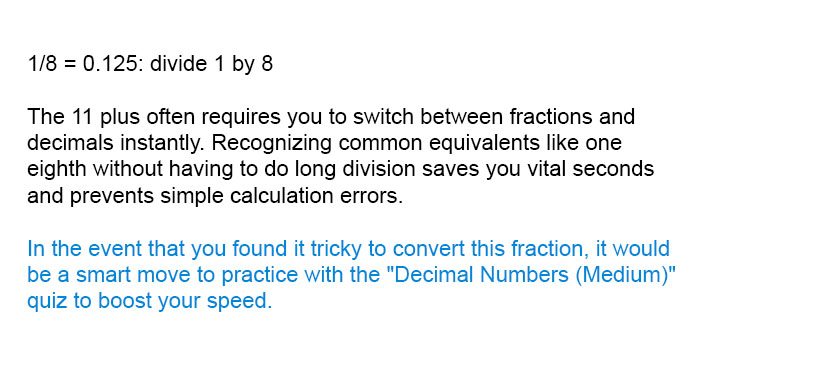
1/8 = 0.125: divide 1 by 8

The 11 plus often requires you to switch between fractions and decimals instantly. Recognizing common equivalents like one eighth without having to do long division saves you vital seconds and prevents simple calculation errors.

In the event that you found it tricky to convert this fraction, it would be a smart move to practice with the "Decimal Numbers (Medium)" quiz to boost your speed.
5 .
What is 20% of 20% of 500?
100
20
200
2
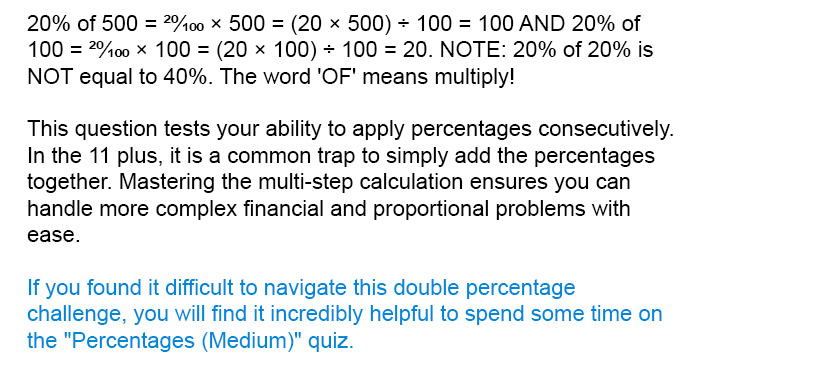
20% of 500 = <sup>20</sup>?<sub>100</sub> × 500 = (20 × 500) ÷ 100 = 100 AND 20% of 100 = <sup>20</sup>?<sub>100</sub> × 100 = (20 × 100) ÷ 100 = 20. NOTE: 20% of 20% is NOT equal to 40%. The word 'OF' means multiply!

This question tests your ability to apply percentages consecutively. In the 11 plus, it is a common trap to simply add the percentages together. Mastering the multi-step calculation ensures you can handle more complex financial and proportional problems with ease.

If you found it difficult to navigate this double percentage challenge, you will find it incredibly helpful to spend some time on the "Percentages (Medium)" quiz.
6 .
Which sequence can be formed from the given rule for the nth term?
nth term = 2n + 3
1, 7, 9, 13, ...
1, 5, 7, 9, ...
2, 5, 7, 9, ...
5, 7, 9, 11, ...
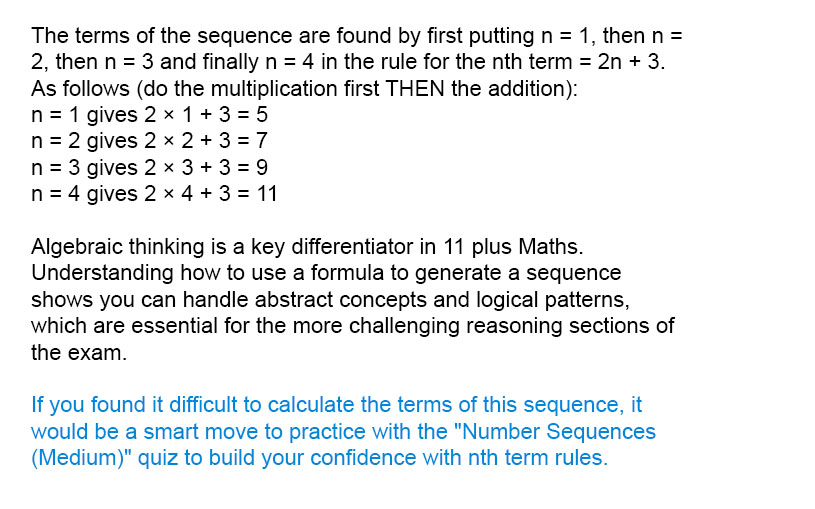
The terms of the sequence are found by first putting n = 1, then n = 2, then n = 3 and finally n = 4 in the rule for the n<sup>th</sup> term = 2n + 3. As follows (do the multiplication first THEN the addition):<br />n = 1 gives 2 × 1 + 3 = 5<br />n = 2 gives 2 × 2 + 3 = 7<br />n = 3 gives 2 × 3 + 3 = 9<br />n = 4 gives 2 × 4 + 3 = 11

Algebraic thinking is a key differentiator in 11 plus Maths. Understanding how to use a formula to generate a sequence shows you can handle abstract concepts and logical patterns, which are essential for the more challenging reasoning sections of the exam.

If you found it difficult to calculate the terms of this sequence, it would be a smart move to practice with the "Number Sequences (Medium)" quiz to build your confidence with nth term rules.
7 .
What is the surface area of a cube of side length 10 mm?
600 cm2
60 mm2
600 mm2
60 cm2
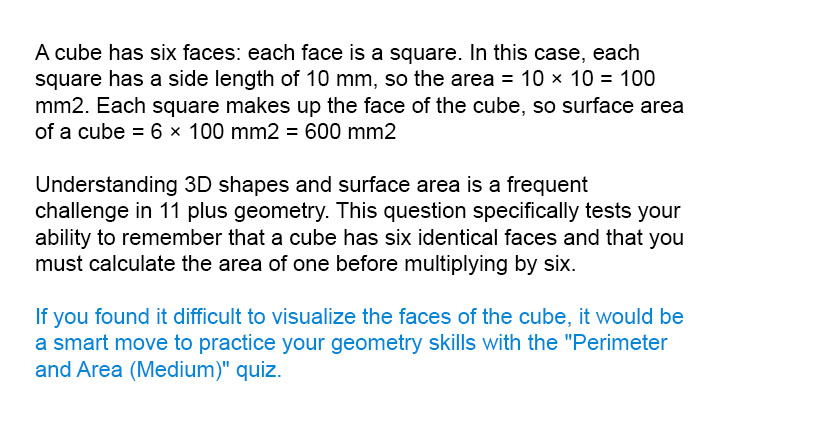
A cube has six faces: each face is a square. In this case, each square has a side length of 10 mm, so the area = 10 × 10 = 100 mm<sup>2</sup>. Each square makes up the face of the cube, so surface area of a cube = 6 × 100 mm<sup>2</sup> = 600 mm<sup>2</sup>

Understanding 3D shapes and surface area is a frequent challenge in 11 plus geometry. This question specifically tests your ability to remember that a cube has six identical faces and that you must calculate the area of one before multiplying by six.

If you found it difficult to visualize the faces of the cube, it would be a smart move to practice your geometry skills with the "Perimeter and Area (Medium)" quiz.
8 .
What is the digit in the ten thousandths' place in 44.0105?
1
5
4
0
Reading from left to right immediately after the decimal point: 5 is in the ten thousandths' place. Precision with place value is what separates a good score from a great one. Recognizing exactly which digit represents the ten thousandths, especially with zeros involved, demonstrates the high-level accuracy required for the 11 plus. If you found it tricky to pinpoint the correct digit after the decimal point, it would be a smart move to practice with the "Place Value (Difficult)" quiz.
9 .
Last month, The 'TOYS' toy shop sold 210 teddy bears. Using a pictogram, if 1 teddy bear head represents 20 teddy bears, how many teddy bear heads would you use to show this information?
10
21
20
10.5
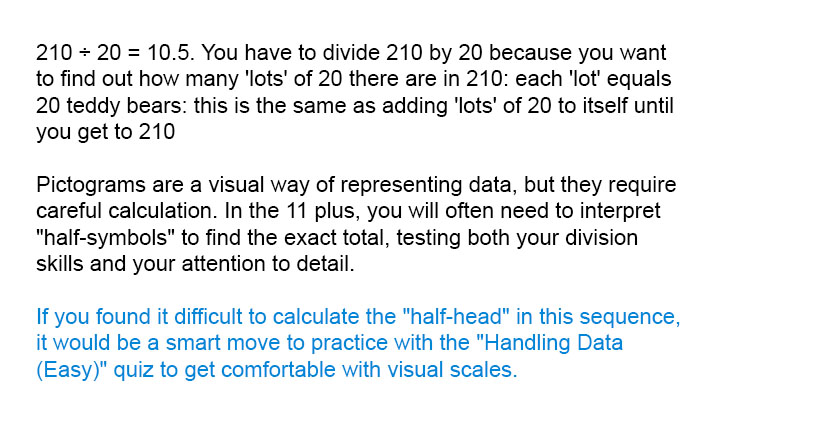
210 ÷ 20 = 10.5. You have to divide 210 by 20 because you want to find out how many 'lots' of 20 there are in 210: each 'lot' equals 20 teddy bears: this is the same as adding 'lots' of 20 to itself until you get to 210

Pictograms are a visual way of representing data, but they require careful calculation. In the 11 plus, you will often need to interpret "half-symbols" to find the exact total, testing both your division skills and your attention to detail.

If you found it difficult to calculate the "half-head" in this sequence, it would be a smart move to practice with the "Handling Data (Easy)" quiz to get comfortable with visual scales.
10 .
The ratio of green bottles to white bottles is 3:4. What fraction of the bottles is white?
37
34
43
47
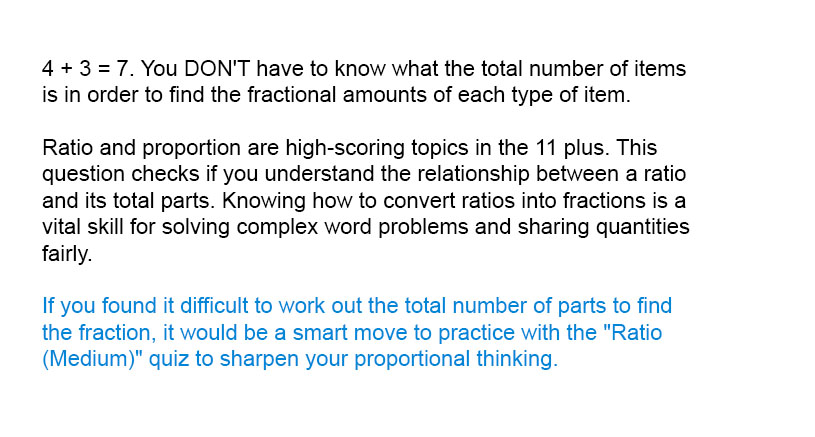
4 + 3 = 7. You DON'T have to know what the total number of items is in order to find the fractional amounts of each type of item.

Ratio and proportion are high-scoring topics in the 11 plus. This question checks if you understand the relationship between a ratio and its total parts. Knowing how to convert ratios into fractions is a vital skill for solving complex word problems and sharing quantities fairly.

If you found it difficult to work out the total number of parts to find the fraction, it would be a smart move to practice with the "Ratio (Medium)" quiz to sharpen your proportional thinking.
Author:  Tara Kemp

© Copyright 2016-2026 - Education Quizzes
Work Innovate Ltd - Design | Development | Marketing