




Ask the AI Tutor
Need help with A Time and a Place - Prepositions? Ask our AI Tutor!
AI Tutor - Lucy
Connecting with Tutor...
Please wait while we establish connection
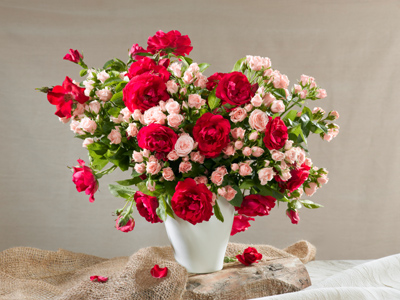
What a beautiful vase of flowers!
A Time and a Place - Prepositions
Learn simple time and place words in English. Practise “in”, “on”, and “at” with everyday examples, so your sentences sound natural and clear.
1 .
Pick the best word (or words) to fit into the gap.
Who is the girl standing ... those two strange men?
Who is the girl standing ... those two strange men?
... among ...
... between ...
... against ...
... along ...
We wouldn't say 'among' unless there were more than two men ('a house built among [several] trees'). It would be hard to stand 'against' more than one other person at a time, except perhaps in a political sense ('She stood against five men and won the election').
2 .
Pick the best word (or words) to fit into the gap.
What were you looking ... ?
What were you looking ... ?
... to?
... in?
... by?
... at?
We 'look at' things (such as pictures) in English; we also 'look for' them if we've lost them.
3 .
Pick the best word (or words) to fit into the gap.
They always used to send me a card ... ... my birthday.
They always used to send me a card ... ... my birthday.
... on ...
... of ...
... for ...
... at ...
'On' in its primary sense means 'physically on top of' (as in 'on horseback' / 'on the river'), but for some reason English uses it to say 'on what day/date' something happens. Answer 3 ('for') is possible but unlikely; people might send you presents FOR your birthday, but a card ON it; perhaps because a present is a bigger thing that is sent 'for the sake of' the birthday, which has a wider sense to it than just the mathematical mark of one date on the calendar.
4 .
Pick the best word (or words) to fit into the gap.
Your documents should be available to collect ... ... the weekend.
Your documents should be available to collect ... ... the weekend.
... in ...
... before ...
... while ...
... behind ...
This clearly needs to be an expression of time rather than place. Answer 4 may have looked tempting, but proper English would say 'after the weekend', rather than 'behind' it.
5 .
Pick the best word (or words) to fit into the gap.
She went ... ... a special program on her computer and translated the information ... ... Spanish.
She went ... ... a special program on her computer and translated the information ... ... Spanish.
... on ... / ... to ...
... in ... / ... for ...
... into ... / ... in ...
... into ... / ... into ...
'Into' is right in both parts of this sentence.
6 .
Pick the best word (or words) to fit into the gap.
I'm afraid I was always pretty hopeless ... ... foreign languages when I was at school.
I'm afraid I was always pretty hopeless ... ... foreign languages when I was at school.
... at ...
... with ...
... in ...
... on ...
In English we are usually good (or bad, etc.) 'at' doing things, such as playing sports or instruments. Sometimes you will hear expressions such as 'He's very good with children' or 'She's not confident with computers', but in those cases we are talking more about the things themselves, as such, rather than what we do with them (although that's fairly obviously what is really meant).
7 .
Pick the best word (or words) to fit into the gap.
There is a beautiful vase of flowers ... ... the dining-room table.
There is a beautiful vase of flowers ... ... the dining-room table.
... on ...
... in ...
... under ...
... behind ...
None of the other answers makes much sense. (Why have such a pretty thing in a place where nobody can see it?)
8 .
Pick the best word (or words) to fit into the gap.
Which letter comes ... ... Zeta in the Greek alphabet?
Which letter comes ... ... Zeta in the Greek alphabet?
... under ...
... after ...
... beyond ...
... behind ...
'After' is what we use to mark the next item in a sequence. ('I before E except after C', as the English spelling rule goes ...)
9 .
Pick the best word (or words) to fit into the gap.
I wonder who has moved into the house ... ... , ... ... the street?
I wonder who has moved into the house ... ... , ... ... the street?
... facing, over ...
... over, opposite ...
... opposite, across ...
... across, facing ...
These two expressions are simple enough, but easily confused.
10 .
Pick the best word (or words) to fit into the gap.
I've never quite mastered the art of eating 'bitty' Eastern food ... ... chopsticks.
I've never quite mastered the art of eating 'bitty' Eastern food ... ... chopsticks.
... with ...
... by ...
... off ...
... from ...
We use 'with' to show that we are using a tool to do a job ('Cut it neatly with the scissors, instead of tearing it with your hands!'). All the other answers feel sensible, but only No.1 is completely right.



**Unlimited Quizzes Await You! 🚀**
Hey there, quiz champ! 🌟 You've already tackled today's free questions.
Ready for more?
Ready for more?
🔓 Unlock UNLIMITED Quizzes and challenge yourself every day. But that's
not all...
not all...
🔥 As a Subscriber you can join our thrilling "Daily Streak" against other
quizzers. Try to win a coveted spot on our Hall of Fame Page.
quizzers. Try to win a coveted spot on our Hall of Fame Page.
Don't miss out! Join us now and keep the fun rolling. 🎉
**Unlimited Quizzes Await You! 🚀**
Hey there, quiz champ! 🌟 You've already tackled today's free questions. Ready for more?
🔓 Unlock UNLIMITED Quizzes and challenge yourself every day. But that's not all...
🔥 As a Subscriber you can join our thrilling "Daily Streak" against other quizzers. Try to win a coveted spot on our Hall of Fame Page.
Don't miss out! Join us now and keep the fun rolling. 🎉




© Copyright 2016-2026 - Education Quizzes
Work Innovate Ltd - Design | Development |
Marketing
