




Ask the AI Tutor
Need help with Out and About - Direction Words and Terms? Ask our AI Tutor!
AI Tutor - Lucy
Connecting with Tutor...
Please wait while we establish connection
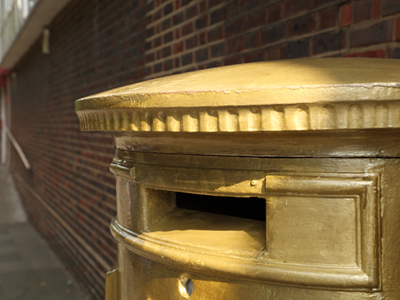
'The postbox has been painted gold instead of red, in honour of a 2012 Olympic champion who lived in our town.'
Out and About - Direction Words and Terms
Learn simple English for giving directions and talking about places. Practise useful words like opposite, next to, and near, so you can explain where things are.
1 .
Pick the best word (or words) to fit in the gap:
There is a small food store just ... ... the ... ... .
There is a small food store just ... ... the ... ... .
... beyond ... / ... bus halt.
... beyond ... / ... bus stop.
... after ... / ... bus place.
... behind ... / ... bus halt.
'Beyond' = 'on the far side of'. We might say 'after' here, meaning 'after you have reached the bus stop and gone past it'.
2 .
Pick the best word (or words) to fit in the gap:
'Go ... ... the bridge and you will see ... ... cathedral nearby on the other side.'
'Go ... ... the bridge and you will see ... ... cathedral nearby on the other side.'
... across ... / ... a ...
... across ... / ... the ...
... among ... / ... the ...
... between ... / ... a ...
Most cities only have one Cathedral, so it would be 'the cathedral' and not just 'a cathedral'. (Some major cities have more than one, like London, Dublin and Liverpool; we don't believe any city has more than two!)
We can go 'over' or 'across' (the top of) a bridge, or 'under' it (or possibly 'underneath', particularly if we then stay there to visit a shop or something inside the archway), or maybe 'through' it. No other preposition would make good sense here.
We can go 'over' or 'across' (the top of) a bridge, or 'under' it (or possibly 'underneath', particularly if we then stay there to visit a shop or something inside the archway), or maybe 'through' it. No other preposition would make good sense here.
3 .
Pick the best word (or words) to fit in the gap:
'Go down the road, and the cinema is ... '
'Go down the road, and the cinema is ... '
... at your left.'
... by your left.'
... on your left.'
... to your left.'
Answer 3 is best, but 'to your left (or right)' is also possible. Things are usually 'on' one side or the other in English.
4 .
Pick the best word (or words) to fit in the gap:
' ... ... the third street on your left, and the post office is ... ... the supermarket.'
' ... ... the third street on your left, and the post office is ... ... the supermarket.'
Go ... / ... opposite ...
Take ... / ... opposite ...
Use ... / ... against ...
Turn ... / ... against ...
Answer 2 is right in each case.
You can't 'turn a street' (Answer 4) in English, but you can 'turn into a street'.
If two buildings are facing each other with a road in between them, we say they are 'opposite' each other. 'Against' would suggest that there is nothing else in between them. ('He sat against the wall.') ... in which case, how could anyone squeeze in between to get there?
You can't 'turn a street' (Answer 4) in English, but you can 'turn into a street'.
If two buildings are facing each other with a road in between them, we say they are 'opposite' each other. 'Against' would suggest that there is nothing else in between them. ('He sat against the wall.') ... in which case, how could anyone squeeze in between to get there?
5 .
Pick the best word (or words) to fit in the gap:
'If the weather is fine, you might like to walk ... ... the churchyard and ... ... the canal.'
'If the weather is fine, you might like to walk ... ... the churchyard and ... ... the canal.'
... across ... / ... along ...
... among ... / ... along ...
... through ... / ... along beside ...
... under ... / ... into ...
Answer 3 is best, because you would walk 'among the graves' but 'through the churchyard', and 'along beside' makes it clear that you would be going parallel with the canal, but without getting your feet wet by trying to walk on the water!
Answer 4 is obviously silly.
You could go 'across' the churchyard, but 'through' carries a stronger suggestion that you might find it interesting to look around you while you are there (e.g. observing the styles and ages of some of the graves: the names, dates and stories ~ as a matter of human and cultural interest ~ instead of going quickly past).
Answer 4 is obviously silly.
You could go 'across' the churchyard, but 'through' carries a stronger suggestion that you might find it interesting to look around you while you are there (e.g. observing the styles and ages of some of the graves: the names, dates and stories ~ as a matter of human and cultural interest ~ instead of going quickly past).
6 .
Pick the best word (or words) to fit in the gap:
' ... ... this road ... ... you come to the railway station.'
' ... ... this road ... ... you come to the railway station.'
Continue ... / ... unless ...
Continue ... / ... until ...
Follow ... / ... until ...
Follow ... / ... unless ...
We can't 'continue a road', although we might 'continue along it' (or up, or down it).
'Unless' would mean that if we did come to the station, we would be on the wrong road anyway and have to change onto another one. That doesn't really sound right!
'Unless' would mean that if we did come to the station, we would be on the wrong road anyway and have to change onto another one. That doesn't really sound right!
7 .
Pick the best word (or words) to fit in the gap:
'When you reach the station, walk ... ... the stairs and you will see the ticket office ... ... you.'
'When you reach the station, walk ... ... the stairs and you will see the ticket office ... ... you.'
... along ... / ... just behind ...
... across ... / ... ahead of ...
... down ... / ... before ...
... up ... / ... straight in front of ...
It does not make much sense to walk 'across' a staircase (Answer 2), and you can't very easily go 'along' it (Answer 1) unless it is more or less flat (like the water in a canal) ... and a flat staircase wouldn't be very helpful, would it?
If the ticket-window were 'behind you' (Answer 1) it would be hard for you to see; '(straight) ahead of you' is possible (Answer 2), but 'across' made no sense.
So Answer 4 is the only one that fits sensibly in both places.
If the ticket-window were 'behind you' (Answer 1) it would be hard for you to see; '(straight) ahead of you' is possible (Answer 2), but 'across' made no sense.
So Answer 4 is the only one that fits sensibly in both places.
8 .
Pick the best word (or words) to fit in the gap:
'The ... ... has been painted ... ... instead of red, in honour of a 2012 Olympic champion who lived in our town.'
'The ... ... has been painted ... ... instead of red, in honour of a 2012 Olympic champion who lived in our town.'
... postbox ... / ... gold ...
... mail box ... / ... green ...
... mail case... / ... blue ...
... letter chest ... / ... silver ...
Perhaps if you are in Britain you may see one of these. There are over 100 of them around the country!
9 .
Pick the best word (or words) to fit in the gap:
'The ... ... is just ... ... the next corner ~ I can smell it already!'
'The ... ... is just ... ... the next corner ~ I can smell it already!'
... fish-and-chip shop ... / ... round ...
... fish shop ... / ... at ...
... chippery ... / ... in ...
... chop-shop ... / ... on ...
'Round the corner' means that the shop is just on the far side ('beyond the corner', but you have to turn to find it).
British people sometimes say 'just round the corner' when a place is in fact a bit further away than the next street: their favourite pub, or the place where they meet their friends for worship (church / synagogue / mosque / temple etc.), which might be about a kilometre away and take ten minutes or more to reach on foot. We also say '(just) down the road' ~ as in 'We still get Christmas cards from that couple who used to live down the road' ~ even if they were not quite in the actual same street. They might have been 'down the main road', in another town or village perhaps.
British people sometimes say 'just round the corner' when a place is in fact a bit further away than the next street: their favourite pub, or the place where they meet their friends for worship (church / synagogue / mosque / temple etc.), which might be about a kilometre away and take ten minutes or more to reach on foot. We also say '(just) down the road' ~ as in 'We still get Christmas cards from that couple who used to live down the road' ~ even if they were not quite in the actual same street. They might have been 'down the main road', in another town or village perhaps.
10 .
Pick the best word (or words) to fit in the gap:
' ... ... past the ... ... lights outside the sports centre.'
' ... ... past the ... ... lights outside the sports centre.'
Carry on ... / ... traffic ...
Pass on ... / ... red ...
Keep going ... / ... green ...
Pass on ... / ... blue ...
'Carry on' means 'keep going' (as in Answer 3). You may have seen mugs, posters and other souvenirs with the words 'KEEP CALM and CARRY ON' ~ a phrase from back during World War 2, when British people needed to go on with their normal lives as far as possible. even when circumstances were hard. In terms of street directions, 'carry on' means that you keep walking, unless or until you need to do anything else (such as turn into another road).
In Britain we tend to speak of 'traffic lights', or even just 'lights'; we don't usually call them 'red' or any other colour (even though they do seem to be at red, more often than not, when we come to them!).
In Britain we tend to speak of 'traffic lights', or even just 'lights'; we don't usually call them 'red' or any other colour (even though they do seem to be at red, more often than not, when we come to them!).



**Unlimited Quizzes Await You! 🚀**
Hey there, quiz champ! 🌟 You've already tackled today's free questions.
Ready for more?
Ready for more?
🔓 Unlock UNLIMITED Quizzes and challenge yourself every day. But that's
not all...
not all...
🔥 As a Subscriber you can join our thrilling "Daily Streak" against other
quizzers. Try to win a coveted spot on our Hall of Fame Page.
quizzers. Try to win a coveted spot on our Hall of Fame Page.
Don't miss out! Join us now and keep the fun rolling. 🎉
**Unlimited Quizzes Await You! 🚀**
Hey there, quiz champ! 🌟 You've already tackled today's free questions. Ready for more?
🔓 Unlock UNLIMITED Quizzes and challenge yourself every day. But that's not all...
🔥 As a Subscriber you can join our thrilling "Daily Streak" against other quizzers. Try to win a coveted spot on our Hall of Fame Page.
Don't miss out! Join us now and keep the fun rolling. 🎉




© Copyright 2016-2026 - Education Quizzes
Work Innovate Ltd - Design | Development |
Marketing
