




Ask the AI Tutor
Need help with Metals - Alloys? Ask our AI Tutor!
AI Tutor - Lucy
Connecting with Tutor...
Please wait while we establish connection
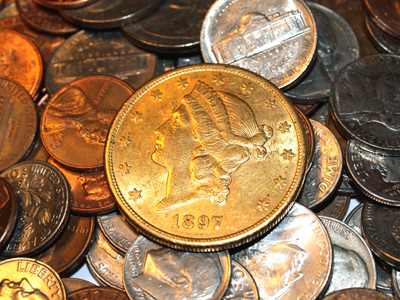
Bronze and cupronickel are both used to make coins. They are both examples of alloys.
Metals - Alloys
Metals are chosen for strength, conductivity, and cost, and alloys improve performance. This GCSE Chemistry quiz covers metals and alloys, including properties, uses, and why mixing metals changes behaviour.
1 .
Gold that is used to make jewellery is usually an alloy. It is mixed with copper and silver. Apart from making it harder, what other property is changed by mixing it with other metals?
Increases its density
Lowers its melting point
Colour
Decreases its hardness
The colour of gold is dependent on the metals it has been alloyed with. The amount of copper added to gold determines how 'red' the gold is
2 .
Which type of steel is likely to be used for cutlery?
High carbon steel
Low carbon steel
Stainless steel
Pure iron
Stainless steel is highly resistant to rusting so the cutlery will remain shiny and not corroded
3 .
Bronze and cupronickel are both used to make coins. They are both examples of...
compounds
alloys
elements
ores
These alloys are resistant to corrosion
4 .
Bronze is an alloy made from...
copper and tin
copper and brass
copper and zinc
copper and iron
Bronze can be used to make statues, musical instruments and medals
5 .
Metals are often mixed with other elements to make alloys. Which of the following is NOT a good reason for producing an alloy?
It can produce harder materials
It can produce different coloured materials
It can produce more malleable materials
It can produce more brittle materials
Alloys are produced to make the properties of the materials more beneficial
6 .
Some alloys have very special properties. They return to their original shape after becoming deformed. These alloys are called...
shape memory alloys
shape remembering alloys
bend memory alloys
bendy alloys
This can be very useful in things like spectacles. How many people break their spectacles by sitting on them?
7 .
Nitinol is a 'smart' alloy. Why can it be described as a 'smart' alloy?
It expands when it is heated
It is flexible
It is made by mixing two metals
It returns to its original shape when heated
The discovery that nitinol has this property was discovered by accident in 1961
8 .
Brass is an alloy made from...
copper and tin
copper and bronze
copper and zinc
copper and iron
Brass can be used to make doorknobs, ammunition and musical instruments
9 .
Iron is mixed with other elements including carbon, chrominium and nickel to make steel. The percentage of the elements added determine the type of steel and also the properties of the steel produced. Which type of steel is likely to be used to make cutting tools?
High carbon steel
Low carbon steel
Stainless steel
Pure iron
This is a hard wearing type of steel
10 .
Nitinol is an alloy made from...
copper and titanium
nickel and copper
neon and titanium
nickel and titanium
This alloy was developed in 1959 during research to produce better nose cones for military missiles



**Unlimited Quizzes Await You! 🚀**
Hey there, quiz champ! 🌟 You've already tackled today's free questions.
Ready for more?
Ready for more?
🔓 Unlock UNLIMITED Quizzes and challenge yourself every day. But that's
not all...
not all...
🔥 As a Subscriber you can join our thrilling "Daily Streak" against other
quizzers. Try to win a coveted spot on our Hall of Fame Page.
quizzers. Try to win a coveted spot on our Hall of Fame Page.
Don't miss out! Join us now and keep the fun rolling. 🎉
**Unlimited Quizzes Await You! 🚀**
Hey there, quiz champ! 🌟 You've already tackled today's free questions. Ready for more?
🔓 Unlock UNLIMITED Quizzes and challenge yourself every day. But that's not all...
🔥 As a Subscriber you can join our thrilling "Daily Streak" against other quizzers. Try to win a coveted spot on our Hall of Fame Page.
Don't miss out! Join us now and keep the fun rolling. 🎉




© Copyright 2016-2026 - Education Quizzes
Work Innovate Ltd - Design | Development |
Marketing
