




Ask the AI Tutor
Need help with Atlases, Ordnance Survey? Ask our AI Tutor!
AI Tutor - Lucy
Connecting with Tutor...
Please wait while we establish connection
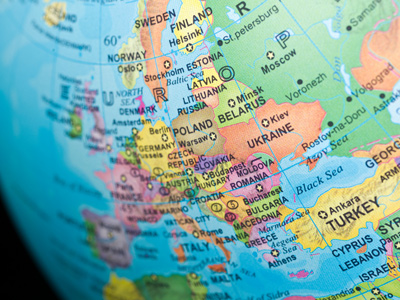
See if you can get 10 out of 10 in this quiz.
Atlases, Ordnance Survey
Atlases and Ordnance Survey maps are vital in GCSE Geography. This quiz helps you practise symbols, scale, and routes so real-world mapwork feels clearer and more confident.
1 .
On which of the following pages in an atlas might you find a hot desert marked?
North Africa, Middle East
Russia, Japan
Antarctica
Philippines and Indonesia
North Africa has the Sahara and the Middle East has the Arabian desert
2 .
One sort of Ordnance Survey map used by hikers for navigation has a scale of 1:50,000. This means:
only 50,000 copies have ever been printed
nothing, it is just something that has to be added to the map by law
there are 50,000 different features marked on the map
every 2 centimetres measured on the map corresponds to 1 kilometre on the area represented by the map
The scale of a map is the mathematical ratio showing how much smaller it is when compared with the area it represents. In this case, 1 centimetre on the map represents 50,000 centimetres (0.5 kilometres) on the ground
3 .
Ordnance Survey maps were first created for ...
military purposes
mountain rescue teams
people who go for country walks
car drivers
When the Ordnance Survey was started, there was a serious threat that Britain could have been invaded by the French forces of Napoleon I, so the Board of Ordnance (the equivalent of today's Ministry of Defence) needed better maps so that troops and equipment could be moved to invasion sites as efficiently as possible
4 .
What is 'Mercator's Projection'?
The method used by teachers to show a map to the whole class
A way of representing the curved surface of the Earth on a flat piece of paper
A piece of rock that is sticking out from a cliff face
A special instrument for drawing a map
Countries that are further from the equator appear proportionally larger than the equatorial countries
5 .
Ordnance Survey maps cover ...
England
the USA
the whole world
Britain
The Ordnance Survey produce several different series of maps at different scales
6 .
Which of the following most accurately describes a map?
An accurate representation of the world
A representation of part or all of the surface of the Earth
A drawing that is used only for navigation
A diagram that shows land use in Australia
Map-makers use a system of symbols to represent the features on the ground
7 .
Which of the following could be found in an atlas
The population of New York City
A list of the world's longest rivers
Land use in the UK
All of the above
An atlas is a very good source of geographical information
8 .
Which is the correct word to describe a person who is involved in preparing maps?
Mapper
Cartographer
Mapsmith
Mapographer
The word probably originates from the Latin word for 'chart'
9 .
Which of the following is not a reason for using an atlas?
To find out which countries have a border with Angola
To navigate your way in mountainous terrain
To discover which country in the world had the highest population density
To learn about how land is used in South America
The scale of the maps in an atlas is too small for navigation, a tiny error in working out the direction from a small scale map would create an error of many kilometres on the mountainous terrain. Only the largest features are shown so you would not know if there was a cliff or ravine etc. that might be blocking your way
10 .
Which of the following statements most accurately describes an atlas?
A collection of maps
A list of data about the countries of the world
A navigational aid
A book containing maps and other geographical data
Each map will have a title, scale and key



**Unlimited Quizzes Await You! 🚀**
Hey there, quiz champ! 🌟 You've already tackled today's free questions.
Ready for more?
Ready for more?
🔓 Unlock UNLIMITED Quizzes and challenge yourself every day. But that's
not all...
not all...
🔥 As a Subscriber you can join our thrilling "Daily Streak" against other
quizzers. Try to win a coveted spot on our Hall of Fame Page.
quizzers. Try to win a coveted spot on our Hall of Fame Page.
Don't miss out! Join us now and keep the fun rolling. 🎉
**Unlimited Quizzes Await You! 🚀**
Hey there, quiz champ! 🌟 You've already tackled today's free questions. Ready for more?
🔓 Unlock UNLIMITED Quizzes and challenge yourself every day. But that's not all...
🔥 As a Subscriber you can join our thrilling "Daily Streak" against other quizzers. Try to win a coveted spot on our Hall of Fame Page.
Don't miss out! Join us now and keep the fun rolling. 🎉




© Copyright 2016-2026 - Education Quizzes
Work Innovate Ltd - Design | Development |
Marketing
