




Ask the AI Tutor
Need help with Coastal Deposition? Ask our AI Tutor!
AI Tutor - Lucy
Connecting with Tutor...
Please wait while we establish connection
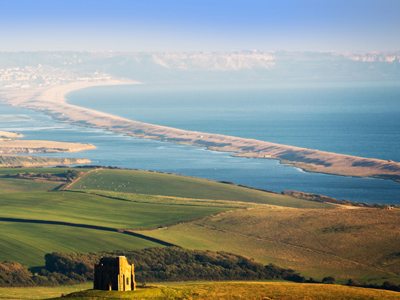
Chesil Beach, which connects the Isle of Portland to the Dorset coastline, is an example of a tombolo.
Coastal Deposition
Waves do not only wear coasts away, they also build them. This GCSE Geography quiz explores how coastal deposition creates beaches and other coastal landforms.
1 .
What is longshore drift?
The process where a reef is eroded on the upstream side and deposited on the downstream side, gradually moving it along the coast
The process that forms a high-tide line on a beach of flotsam and jetsam, as material is deposited by the movement of waves in and out
The transportation of sediments (clay, silt, sand and shingle) along a coast at an angle to the shoreline, in a zig-zag pattern
When a boat or other object comes to rest on a sandy shore material builds up downstream of the hull, and is eroded from upstream
On Holderness coast most of the eroded material is carred out to sea, but some is moved south via longshore drift to form Spurn Head
2 .
What sort of shape should a constructive wave have?
A steep crest with a short wavelength
A high wave in proportion to its length with a tall breaker
A low wave height and a long wavelength
A long wavelength and a steep breaker
These long low waves are created in calm weather and will deposit material on the coast
3 .
Spurn Head is a famous coastal spit across the mouth of the River Humber. The material that has built up the spit is the result of longshore drift. Why has this spit formed at this location?
The change in currents as the river enters the sea causes more energy to enter the system
The pollution coming down the river is deposited at this point. This allows the material moving down the coast to build up here
There is a natural reef at this point that material builds up on, aided by longshore drift
The energy in the waves and the river is reduced at this location causing the material to be deposited
A tip to remember is that material is deposited when energy levels drop, in this case because the coast in effect vanishes at the wide mouth of the Humber
4 .
Backwash is when a wave washes back down the beach. What do we call the opposite, when the wave washes up the beach?
Swash
Longshore drift
Deposition
Constructive
Swash is the period after the wave has broken and it washes up the beach. Swash normally acts at an angle to the beach rather than straight up and down. Swash and backwash are the noises you hear as the water runs up and down the beach
5 .
In terms of backwash and swash, when is deposition most likely to occur?
When backwash is equal to swash deposition is more likely to occur
When backwash is stronger than swash deposition is more likely to occur
Deposition occurs in neither swash nor backwash
When swash is stronger than backwash deposition is more likely to occur
When swash is stronger than backwash material is carried up the beach but not carried back down, leading to deposition
6 .
Which of the following is not a method of coastal transportation?
Erosion
Solution
Suspension
Traction
Both coastal and river transport methods are the same - Solution, Suspension, Saltation and Traction
7 .
Constructive waves are most likely to occur on which sort of beach?
A flat or shallow beach
A steep beach
A beach with sheer cliffs and a strong wave action
A beach that is heavily used for tourism
Constructive waves occur when the swash is stronger than the backwash. A steep beach will have a strong backwash as water runs faster down steeper slopes. Steep cliffs are normally exposed with little material to protect them
8 .
Depostion occurs when waves lose energy and deposit their load. Which of the following is not another reason that deposition is likely to occur?
Waves enter an area of shallow water
There is little or no wind
Waves enter a large open area, such as moving from a bay to the open sea
There is a large amount of material to be deposited
When waves enter a cove or bay they are more likely to slow in the shelter and drop their load rather than the other way round
9 .
Some beaches are protected by an offshore landform known as a reef. Which of the following is not a way reefs may form?
Sand banks build up as material is deposited away from the beach
Cliffs erode unevenly and leave behind land after arches collapse
Coral based creatures grow at the point of optimal light growth
Beach protection measures are artifically constructed to protect the land or provide leisure opportunities
After an arch collapses a stack is left behind. The formal definition of a reef is a ridge of rock, shingle or sand at or just below the surface of the water
10 .
What is a tombolo?
A spit connecting an island to the mainland
A beach with a lake behind it
A type of lagoon
A type of headland that terminates at a different type of rock
One of the key examples of a tombolo is Chesil Beach, connecting the Isle of Portland to the Dorset coastline



**Unlimited Quizzes Await You! 🚀**
Hey there, quiz champ! 🌟 You've already tackled today's free questions.
Ready for more?
Ready for more?
🔓 Unlock UNLIMITED Quizzes and challenge yourself every day. But that's
not all...
not all...
🔥 As a Subscriber you can join our thrilling "Daily Streak" against other
quizzers. Try to win a coveted spot on our Hall of Fame Page.
quizzers. Try to win a coveted spot on our Hall of Fame Page.
Don't miss out! Join us now and keep the fun rolling. 🎉
**Unlimited Quizzes Await You! 🚀**
Hey there, quiz champ! 🌟 You've already tackled today's free questions. Ready for more?
🔓 Unlock UNLIMITED Quizzes and challenge yourself every day. But that's not all...
🔥 As a Subscriber you can join our thrilling "Daily Streak" against other quizzers. Try to win a coveted spot on our Hall of Fame Page.
Don't miss out! Join us now and keep the fun rolling. 🎉




© Copyright 2016-2026 - Education Quizzes
Work Innovate Ltd - Design | Development |
Marketing
