




Ask the AI Tutor
Need help with Coastal Erosion? Ask our AI Tutor!
AI Tutor - Lucy
Connecting with Tutor...
Please wait while we establish connection
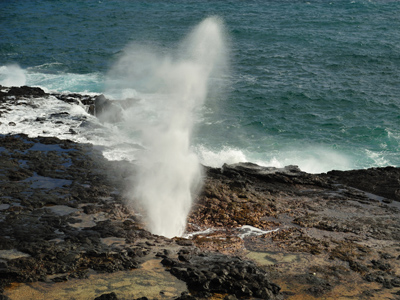
Blowholes can be a dramatic feature of a cliff structure.
Coastal Erosion
Cliffs, caves, arches and stacks are all linked to coastal erosion. This GCSE Geography quiz looks at how waves wear away rock and reshape the coastline.
1 .
As a wave undercuts a cliff the cliff retreats. What feature is left behind as the cliff retreats?
Beach
Headland
Blowhole
Wave cut platform
As the wave cut notch undercuts the cliffs the platforms form. These are flat features that are noticeable if they are raised, due to sea levels falling, into a raised beach
2 .
When the waves attack the base of the cliff they can undercut the overlying rock, forming what sort of feature?
Raised beach
Wave cut notch
Arch
Stack
As the notch increases in size the cliff face will collapse and retreat further
3 .
Which type of underlying geology is most likely to be formed into straight cliffs?
Soft rocks like mudstone and siltstone
Hard rocks including granite and basalt
Loose materials like soils and sands
Rocks that are partially soluble
The more resistant rocks will form straighter cliffs. Softer rocks will have a shallower cliff structure as material erodes and collapses faster
4 .
'Old Harry Rocks' in Dorset are examples of an erosional feature left behind after an arch collapses. These tall columns of rocks are known as what?
Stacks
Stumps
Columns
Megaliths
Stacks are commonly tall columns of rock, although some of them may be very large and on their way to being eroded to stumps
5 .
Why might a bay form?
On a discordant coastline the softer rock will be rapidly eroded away, leaving the harder rock to form headlands
On a concordant coastline weaknesses allow the water to work its way in and eventually erode a large area
A collapsed volcanic crater is flooded leaving a sheltered area
Former river valleys are flooded and form ports that gradually turn into bays
Discordant coastlines are the ones that form bays due to the different strength of the rocks. Concordant coastlines may have some small bays and headlands due to weakness in the rocks, but for the most part they are formed on discordant coastlines
6 .
How are stacks eroded to form stumps?
The rain and sea spray attack the stack from the top, gradually dissolving the rocks
The top-heavy nature of the stack, that may retain a lot of the material from the arch, will break off at the base far below sea level
The waves attack the base of the stack until it collapses under its own weight
Sediment washing along the coastline will build up and absorb the stack back into a larger landform
The stack is exposed on all sides and will be attacked by the waves. As the waves attack the base they can erode through it
7 .
An unusual geological feature forms when caves erode inland and, through hydraulic action, create gaps in the rock to the surface. As a wave pushes in the water is forced out of the top, often in a spout. What are these features known as?
Blowholes
Arches
Spots
Geysers
Blowholes can be a dramatic feature of a cliff structure. Eventually the cave roof will collapse and allow the sea further in
8 .
If a cave forms on a headland the waves may erode through to form what sort of feature?
Stack
Arch
Wave cut platform
Stump
Arches allow the waves to pass through and they in turn will further erode the material and increase the size of the arch
9 .
When waves hit the cliff face they force air deeper into the cracks in the cliff face, which can weaken and lead to the erosion of this material. This form of erosion is known as what?
Saltation
Abrasion
Attrition
Hydraulic action
Hydraulic action takes place on rivers as well, but when you are talking about the creation of caves and other similar features this is the main erosive process
10 .
Which of the following refers to a coastline made of bands of various types of geology, including hard and soft rock?
Discordant coastline
Concordant coastline
Uncordant coastline
Variable coastline
The layers of hard and soft rock allow bays and headlands to form as the softer rock is eroded away



**Unlimited Quizzes Await You! 🚀**
Hey there, quiz champ! 🌟 You've already tackled today's free questions.
Ready for more?
Ready for more?
🔓 Unlock UNLIMITED Quizzes and challenge yourself every day. But that's
not all...
not all...
🔥 As a Subscriber you can join our thrilling "Daily Streak" against other
quizzers. Try to win a coveted spot on our Hall of Fame Page.
quizzers. Try to win a coveted spot on our Hall of Fame Page.
Don't miss out! Join us now and keep the fun rolling. 🎉
**Unlimited Quizzes Await You! 🚀**
Hey there, quiz champ! 🌟 You've already tackled today's free questions. Ready for more?
🔓 Unlock UNLIMITED Quizzes and challenge yourself every day. But that's not all...
🔥 As a Subscriber you can join our thrilling "Daily Streak" against other quizzers. Try to win a coveted spot on our Hall of Fame Page.
Don't miss out! Join us now and keep the fun rolling. 🎉




© Copyright 2016-2026 - Education Quizzes
Work Innovate Ltd - Design | Development |
Marketing
