




Ask the AI Tutor
Need help with Erosion? Ask our AI Tutor!
AI Tutor - Lucy
Connecting with Tutor...
Please wait while we establish connection
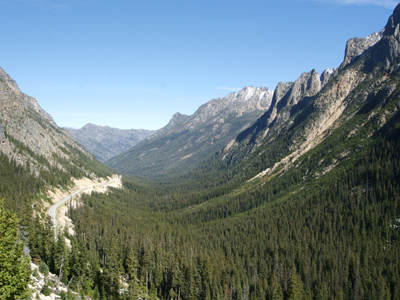
Glaciers smooth and round out V-shaped river valleys, leaving behind a rounded U-shaped valley floor.
Erosion
This GCSE Geography quiz explores erosion, looking at how rivers, coasts, glaciers and wind wear landscapes away and create dramatic landforms over time.
1 .
When river velocity slows the larger particles fall out of suspension. Which of these examples shows when velocity may drop leading to silting up of a part of the river?
The outside of a meander bend
Where a narrow river channel enters an open lake
When water runs over rapids
The entrance to an artificially straightened channel
When the river goes from a narrow channel to a wider channel, such as entering a lake or the sea, the velocity falls. It's the opposite of what happens when you put your thumb over the end of a garden hose
2 .
Which of the following is not a way that climate change will increase erosion?
Due to warmer conditions trees and other plants may be able to grow further north
Rising sea levels will allow waves to attack new areas of beaches and cliffs
Increased rainfall will lead to greater erosion by rivers
More extreme weather conditions, such as hurricanes, will lead to greater force of waves and wind on the coastal areas
Whilst trees and plants may increase weathering, in general they decrease erosion by holding material in situ
3 .
What type of coastal wave causes erosion?
Constructive
Destructive
Swash
Backwash
Waves can be either destructive or constructive. Destructive waves have a stronger backwash than swash and are normally created in storm conditions
4 .
South Stack in Anglesey is an example of a stack - a type of coastal erosional landform. What was this landform before it was eroded to form a stack?
A stump
An arch
A cave
A wave cut platform
Caves in headlands can become arches, which when they collapse may leave a stack behind. This stack in turn will erode to a stump
5 .
Some rocks show that a glacier has eroded them by scratch marks across their faces. What are these scratches known as?
Pluck marks
Striations
Abrasions
Névé
Striations occur when angular fragments are dragged across the rock by the glacier
6 .
Rivers are one of the most powerful forces of erosion on land. What are the four main types of river erosion?
Hydraulic, attrition, traction and saltation
Solution, suspension, saltation and traction
Hydraulic, abrasion, attrition and solution
Solution, suspension, attrition and abrasion
Hydraulic action is the force of the river on the bank, abrasion is the wear of the rocks as they are carried across the river bed, attrition is the damage done to the rocks as they bang together and solution occurs as particles are dissolved by the water
7 .
Which of the following is not a method by which deforestation increases erosion?
Trees and forests may encourage large scale tourism
Trees no longer take up water, increasing run off and through flow
Trees are no longer able to stabilise river banks leading to uncontrolled meandering
Tree roots no longer stabilise and protect the soil, leading it to be washed away
Tourism if well managed can have little or no impact on erosion, but sometimes the footpaths, car parks and general traffic lead to an increase in erosion
8 .
Glaciers carve out landforms as they move across the landscape. What is the valley shape that is commonly cut by a glacier?
U-shaped
V-shaped
Truncated
Braided
Glaciers smooth and round out V-shaped river valleys, leaving behind a rounded valley floor with steep sides
9 .
Weathering and erosion are a key part of the rock cycle. Which class of rocks are formed after weathering and erosion have attacked other rocks?
Sedimentary
Igneous
Metamorphic
Oolitic
Sedimentary rocks are made up of the sediments from the weathering and erosion other rocks and minerals. These are deposited by the agents of erosion such as rivers, the wind and glaciers. Examples include sandstone and mudstone
10 .
Which are the four main types of river transportation of eroded material?
Hydraulic, abrasion, attrition and solution
Hydraulic, attrition, traction and saltation
Solution, suspension, attrition and abrasion
Solution, suspension, saltation and traction
These four transportation methods are in order of size of particles they carry. In solution the particles are dissolved in the water, in suspension, particles are carried in the water (it's why most rivers look brown), saltation is where small rocks and pebbles bounce along the bank and traction sees larger rocks tumble and roll along the river bed



**Unlimited Quizzes Await You! 🚀**
Hey there, quiz champ! 🌟 You've already tackled today's free questions.
Ready for more?
Ready for more?
🔓 Unlock UNLIMITED Quizzes and challenge yourself every day. But that's
not all...
not all...
🔥 As a Subscriber you can join our thrilling "Daily Streak" against other
quizzers. Try to win a coveted spot on our Hall of Fame Page.
quizzers. Try to win a coveted spot on our Hall of Fame Page.
Don't miss out! Join us now and keep the fun rolling. 🎉
**Unlimited Quizzes Await You! 🚀**
Hey there, quiz champ! 🌟 You've already tackled today's free questions. Ready for more?
🔓 Unlock UNLIMITED Quizzes and challenge yourself every day. But that's not all...
🔥 As a Subscriber you can join our thrilling "Daily Streak" against other quizzers. Try to win a coveted spot on our Hall of Fame Page.
Don't miss out! Join us now and keep the fun rolling. 🎉




© Copyright 2016-2026 - Education Quizzes
Work Innovate Ltd - Design | Development |
Marketing
