




Ask the AI Tutor
Need help with Glacial Deposition Landscapes? Ask our AI Tutor!
AI Tutor - Lucy
Connecting with Tutor...
Please wait while we establish connection
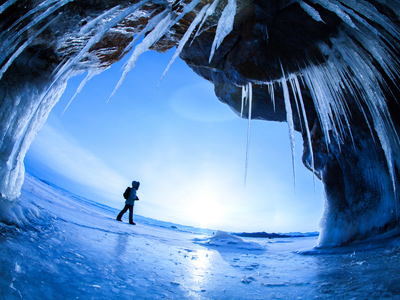
What do you know about ice? Try this quiz to find out.
Glacial Deposition Landscapes
Glaciers do not just erode; they also build landscapes. Discover how dropped rock and sediment create moraines, drumlins, and other glacial deposition landforms.
1 .
Which of the following statements is true?
The material deposited by a glacier was distributed throughout the ice
The material deposited by a glacier comes only from the terminal moraine
The material deposited by a glacier comes only from the lateral moraines
The material deposited by a glacier comes only from the top surface
Because of the way the glacier is formed and how it moves, the debris it carries is found throughout the ice
2 .
What is the correct name of the moraine that is deposited at the furthest point to which the ice extended?
End moraine
Terminal moraine
Lateral moraine
Medial moraine
Terminal is a general purpose word that can be used to describe the end of something
3 .
What is the name given to a moraine that is found in the area between the terminal moraine and the current snout of the glacier?
Receding moraine
Recessional moraine
Receded moraine
Recess moraine
Glaciers recede and advance throughout their existence. This type of moraine is left when a glacier has been longer than it is currently but shorter than it was during the ice age
4 .
What is the area called that is downslope from the terminal moraine?
Backwash
Distributary
Confluence
Outwash
The outwash is created by meltwater flowing out from the glacier as it is melting. The fast-flowing water moves the materials deposited by the glacier further down the valley, spreading them over a larger area
5 .
What is an erratic?
A renegade geographer
A boulder that has rolled down a hill in a zig-zag track
A boulder that is made from a rock type that is uncommon to the area where it has been deposited
A boulder that rocks backwards and forwards when you push it lightly with your hand
They can be used to find out at least part of the journey of the glacier that deposited them
6 .
The material deposited by a glacier or ice sheet is ...
sorted and smooth
sorted and angular
unsorted and smooth
unsorted and angular
A key characteristic of glacial deposits is that they are unsorted. Deposits left by water are usually sorted and often smoothed
7 .
When was the last ice age?
Cambrian period
Jurassic period
Devonian period
Quaternary period
It lasted for about one hundred and ten thousand years
8 .
A geographer studying a glacial valley finds a group of long, narrow hillocks that are no more than 50 metres high. These are:
drumlins
dramblins
drum moraines
oval moraines
Drumlins usually occur in groups called swarms and it is not known exactly how they form
9 .
A line of unsorted rock debris with steep sides that runs along the centre of the whole length of a U-shaped valley is most likely to have come from ...
a terminal moraine of the ice of a glacier that has melted
a medial moraine of the ice of a glacier that has melted
the rocks contained inside the ice of a glacier that has melted
freeze-thaw weathering of the ridges at either side of the valley
The clues are 'U-shaped valley' which tell you these are likely to have been deposited by a glacier and 'centre of the whole length' which is a characteristic of the deposition of a medial moraine
10 .
What happens when an ice sheet or glacier melts?
Everywhere gets flooded
The material it is carrying is left behind
It rains for 40 days and 40 nights
There is no more freeze-thaw weathering
Freeze-thaw and other weathering of mountain peaks and ridges leads to rocks being broken off. These roll downhill and end up on the glacier. When the glacier melts, these are left behind as the glacial deposits



**Unlimited Quizzes Await You! 🚀**
Hey there, quiz champ! 🌟 You've already tackled today's free questions.
Ready for more?
Ready for more?
🔓 Unlock UNLIMITED Quizzes and challenge yourself every day. But that's
not all...
not all...
🔥 As a Subscriber you can join our thrilling "Daily Streak" against other
quizzers. Try to win a coveted spot on our Hall of Fame Page.
quizzers. Try to win a coveted spot on our Hall of Fame Page.
Don't miss out! Join us now and keep the fun rolling. 🎉
**Unlimited Quizzes Await You! 🚀**
Hey there, quiz champ! 🌟 You've already tackled today's free questions. Ready for more?
🔓 Unlock UNLIMITED Quizzes and challenge yourself every day. But that's not all...
🔥 As a Subscriber you can join our thrilling "Daily Streak" against other quizzers. Try to win a coveted spot on our Hall of Fame Page.
Don't miss out! Join us now and keep the fun rolling. 🎉




© Copyright 2016-2026 - Education Quizzes
Work Innovate Ltd - Design | Development |
Marketing
