




Ask the AI Tutor
Need help with Rock Types and the Landscape? Ask our AI Tutor!
AI Tutor - Lucy
Connecting with Tutor...
Please wait while we establish connection
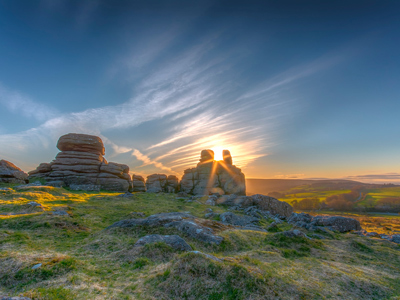
This is Hounds Tor, Dartmoor
Rock Types and the Landscape
Different rock types shape the landscape, from steep moors to fertile lowlands. This GCSE Geography quiz explores how rocks influence landforms, soils, and human land use.
1 .
Limestone pavement is created by which of the following processes?
Attrition
Solution
Saltation
Hydraulic action
Carbon dioxide (and pollutants like sulphur dioxide and nitrogen oxides from burning fossil fuels) make rainwater slightly acidic. This reacts chemically with the limestone, dissolving it away along lines of weaknesses like joints and bedding planes
2 .
Why do chalk downs have a low drainage density?
Chalk is porous and permeable
Chalk is neither porous nor permeable
Farmers have created underground channels to prevent water contamination
Chalk is only found in deserts
Any rain falling on to a chalk landscape will be absorbed into the ground
3 .
Granite forms which of the following types of landscape?
Plains
A dust bowl
Moorland
Fens
It is an impermeable rock that weathers only slowly, forming poor soils. As it is resistant to weathering, it usually forms areas of high land or even mountains
4 .
Why does a granite landscape have a high drainage density?
Granite is criss-crossed with underground aquifers
Granite is highly porous
Granite is an impermeable rock
The soil is very thin
Granite forms upland areas where rainfall tends to be high. Since granite is impermeable, the rain forms many streams and rivers
5 .
A geographer on a field trip noticed that the fields of barley around the study centre were waterlogged even though it hadn't rained for over a week. What might she guess about the underlying rocks?
It is probably chalk
It is probably limestone
It is probably granite
It is probably clay
There are two clues in the question. Firstly, waterlogging that lasts more than a few days suggests that the rock underneath is impermeable so that makes limestone and chalk less likely. Secondly, the fact that she was looking at fields of barley means it is not likely to be granite as that is not suitable for arable farming (nor are limestone and chalk so that also backs up her guess). That leaves clay
6 .
Which of the following is the least likely to be found in a granite landscape?
Underground caverns
High drainage density
Peat bog
Areas of standing water
Granite is impermeable
7 .
Which of the following statements about a chalk landscape is untrue?
It is most often located in the upland areas of Britain
Chalk forms white cliffs on the south coast
Chalk soils are thin and poor
Acid rain can dissolve chalk
Layers of chalk that are underground form good aquifers (areas underground that allow the storage of water because the rock is porous)
8 .
Clay is:
a hard and porous rock
a hard and impermeable rock
a soft and porous rock
a soft and impermeable rock
Layers of clay in porous or permeable rocks can trap liquids like oil and water underground
9 .
Which of the following is likely to be found in a limestone landscape.
Dry valleys
Swallow holes
Gorges
All of the above
Carboniferous limestone is permeable so water will often end up underground by going down swallow holes, leaving dry valleys. Gorges form when the roof of an underground watercourse or cave collapses
10 .
Which of the following features is most associated with granite landscapes in the south-west peninsula of England?
Stalactites and stalagmites
Tors
White cliffs
Underground streams
On the granite moorland of Dartmoor, there are at least 150 tors. These are rock outcrops formed by a combination of freeze-thaw weathering and hydrolysis that have not become covered in vegetation



**Unlimited Quizzes Await You! 🚀**
Hey there, quiz champ! 🌟 You've already tackled today's free questions.
Ready for more?
Ready for more?
🔓 Unlock UNLIMITED Quizzes and challenge yourself every day. But that's
not all...
not all...
🔥 As a Subscriber you can join our thrilling "Daily Streak" against other
quizzers. Try to win a coveted spot on our Hall of Fame Page.
quizzers. Try to win a coveted spot on our Hall of Fame Page.
Don't miss out! Join us now and keep the fun rolling. 🎉
**Unlimited Quizzes Await You! 🚀**
Hey there, quiz champ! 🌟 You've already tackled today's free questions. Ready for more?
🔓 Unlock UNLIMITED Quizzes and challenge yourself every day. But that's not all...
🔥 As a Subscriber you can join our thrilling "Daily Streak" against other quizzers. Try to win a coveted spot on our Hall of Fame Page.
Don't miss out! Join us now and keep the fun rolling. 🎉




© Copyright 2016-2026 - Education Quizzes
Work Innovate Ltd - Design | Development |
Marketing
