




Ask the AI Tutor
Need help with Britain: Warfare Between AD 50 and AD 1350? Ask our AI Tutor!
AI Tutor - Lucy
Connecting with Tutor...
Please wait while we establish connection
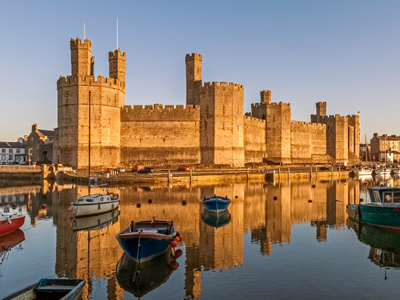
Edward I built many castles in Wales, like this one in Caernarfon.
Britain: Warfare Between AD 50 and AD 1350
This GCSE History quiz looks at warfare in Britain from Roman conquest to medieval times, exploring how armies, weapons, and tactics changed between AD 50 and AD 1350.
1 .
Who commanded the Scottish forces at the Battle of Bannockburn in 1314?
William Wallace
Macbeth
Edward Bruce
Robert the Bruce
Edward II sent a formidable army northwards in 1314, partly to relieve his beleaguered garrison in Stirling Castle
2 .
Which division of the Roman army contained between 4,000 and 6,000 soldiers?
Legion
Cohort
Century
Double Century
The Roman army was carefully structured into various sizes of infantry formations
3 .
What was the name of the coat of chainmail worn by Saxon troops?
Byrnie
Smock
Curthose
Surcoat
Saxon soldiers were well protected also by pointed helmets and wooden shields
4 .
What word is used to describe the circular configuration of Edward I's new castles in Wales?
Circular
Round
Concentric
Orotund
Edward subdued North Wales in the 1280's, and built many castles there in a relatively new style to secure his recent conquests
5 .
Which tribe formed the main part of Boudica's forces?
Trinovantes
Londinii
Iceni
Camulodi
Britain's native inhabitants were far from united, being divided into numerous tribal areas
6 .
What name is given to the war of which the Battle of Crecy is a part?
The 30 Years' War
The War of the Roses
The Great War
The Hundred Years' War
Crecy was the best known land battle of this war, occurring just after the naval engagement at Sluys in 1340. But the campaign dragged on
7 .
In the Saxon army what name was given to professional soldiers, paid by the king and other landowners and recruited while young?
Fyrdmen
Housecarls
Thegns
Eorls
The Saxons did not use cavalry, but deployed two categories of foot soldiers
8 .
Which of the following was not killed at Hastings?
Bishop Odo of Bayeux
Harold Godwinson
Gyrth Godwinson
Leofwine Godwinson
This was a long and closely fought battle with numerous casualties - as depicted in the Bayeux Tapestry
9 .
What was the name of Edward III's son, who fought at the Battle of Crecy In 1346?
Edward Longshanks
Piers Gaveston
Edward the Black Prince
John of Gaunt
War erupted in 1337 between England and France. Edward III decided to assert his claim to French land and titles by invading France in 1346
10 .
Who led the English forces at Hastings in 1066?
Harold Hardrada
Harold Godwinson
Leofwine
Gyrth
Having won the battle of Stamford Bridge in Yorkshire, the English marched south to Hastings to face Duke William's invading army in October 1066
You can find more about this topic by visiting BBC Bitesize - Britain, migration and empire overview, c790 - present day



**Unlimited Quizzes Await You! 🚀**
Hey there, quiz champ! 🌟 You've already tackled today's free questions.
Ready for more?
Ready for more?
🔓 Unlock UNLIMITED Quizzes and challenge yourself every day. But that's
not all...
not all...
🔥 As a Subscriber you can join our thrilling "Daily Streak" against other
quizzers. Try to win a coveted spot on our Hall of Fame Page.
quizzers. Try to win a coveted spot on our Hall of Fame Page.
Don't miss out! Join us now and keep the fun rolling. 🎉
**Unlimited Quizzes Await You! 🚀**
Hey there, quiz champ! 🌟 You've already tackled today's free questions. Ready for more?
🔓 Unlock UNLIMITED Quizzes and challenge yourself every day. But that's not all...
🔥 As a Subscriber you can join our thrilling "Daily Streak" against other quizzers. Try to win a coveted spot on our Hall of Fame Page.
Don't miss out! Join us now and keep the fun rolling. 🎉




© Copyright 2016-2026 - Education Quizzes
Work Innovate Ltd - Design | Development |
Marketing
