




Ask the AI Tutor
Need help with Germany: 1918-1939 - The Fall Of Weimar, 1929-1933? Ask our AI Tutor!
AI Tutor - Lucy
Connecting with Tutor...
Please wait while we establish connection
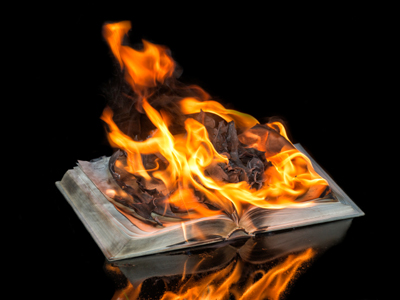
Books which the Nazis disapproved of were regularly burned.
Germany: 1918-1939 - The Fall Of Weimar, 1929-1933
Explore how the Weimar Republic collapsed between 1929 and 1933, as economic crisis, political extremism, and misjudged decisions opened the door for Hitler and the Nazis.
1 .
Who was the Weimar Republic's foreign minister who died on the 3rd of October 1929?
Franz von Papen
Gustav Stresemann
Hjalmar Schacht
Kurt von Schleicher
This death removed one of the few moderate Weimar politicians of any stature who was widely respected abroad
2 .
In February 1933 the Reichstag building burnt down. On which group did Hitler pin the blame?
Anarchists
Communists
Social Democrats
Nationalists
The real perpetrators of this crime have never been exposed, however the Nazis were able to discredit their political opponents by blaming them
3 .
In March 1933 Hitler forced through the Reichstag a bill that would enable him to rule by decree, thus removing from the Reichstag the power to control government decisions. What was the name of the resultant act?
The Special Powers Act
The Emergency Powers Act
The Enabling Act
The Empowerment Act
Once this bill was passed, thus becoming an act, Hitler could rule without any parliamentary restraint. He did, however, from time to time call meetings of the Reichstag to make set speeches on important occasions
4 .
What proportion of the votes cast did the Nazis win in the March 1933 General Election?
51.3%
43.9%
67%
49.9%
By March 1933 the Nazi Party controlled most of the media and the forces of law and order. They were keen to hold a further election to gain a majority of seats in the Reichstag, so that they could then dissolve it
5 .
Which Nazi minister presided over the first burning of books in Berlin during 1933?
Goering
Hess
Goebbels
Himmler
The Nazis would not tolerate any publications that challenged the mind set of the Third Reich. So works by distinguished German authors, like Heinrich Heine and Thomas Mann, were regularly burned
6 .
In 1933 the first of these institutions was set up to deal with Hitler's political opponents. Its name was Dachau. Which title best fits their nature and purpose?
Concentration Camps
Extermination Camps
Open Prisons
Adult Education Colleges
Over the years the Nazis established a network of these establishments throughout Germany, Austria and the occupied territories
7 .
In 1931 a major European bank, the Kreditanstalt, failed. In which state was it situated?
Switzerland
Austria
Germany
Luxemburg
The bank failure ruined many small account holders and sharply reduced sources of credit for those who were struggling to run businesses during the Depression
8 .
Which political party greatly increased its share of the vote in September 1930 to almost 19%, making it the second largest party in the Reichstag?
The KPD/German Communist Party
The NSDAP/Nazi Party
The Nationalist Party
The Social Democrat Parry
By 1930 all political parties had to provide policies to cope with the Great Depression. Parties that had not recently been in government found this task easier
9 .
Which of these organisations was a paramilitary outfit whose role was to protect Communist Party meetings, and to break up those of their opponents?
Reichsbanner
Stahlhelm
Sturmabteilung
Rotfrontkampfverbund
Every party had to be able to defend its activities during the Weimar Republic. The government was weak and the forces of law and order often sympathetic to one side or another
10 .
Who won the 1932 presidential election?
Hitler
Hindenburg
Bruning
Thalmann
The Presidency played an important role under the Weimar Constitution. Especially during a crisis, for the President appointed the Chancellor, whom he could allow to rule by decree in the event of a stalled Reichstag



**Unlimited Quizzes Await You! 🚀**
Hey there, quiz champ! 🌟 You've already tackled today's free questions.
Ready for more?
Ready for more?
🔓 Unlock UNLIMITED Quizzes and challenge yourself every day. But that's
not all...
not all...
🔥 As a Subscriber you can join our thrilling "Daily Streak" against other
quizzers. Try to win a coveted spot on our Hall of Fame Page.
quizzers. Try to win a coveted spot on our Hall of Fame Page.
Don't miss out! Join us now and keep the fun rolling. 🎉
**Unlimited Quizzes Await You! 🚀**
Hey there, quiz champ! 🌟 You've already tackled today's free questions. Ready for more?
🔓 Unlock UNLIMITED Quizzes and challenge yourself every day. But that's not all...
🔥 As a Subscriber you can join our thrilling "Daily Streak" against other quizzers. Try to win a coveted spot on our Hall of Fame Page.
Don't miss out! Join us now and keep the fun rolling. 🎉




© Copyright 2016-2026 - Education Quizzes
Work Innovate Ltd - Design | Development |
Marketing
