




Ask the AI Tutor
Need help with Russia: 1921-1924 - Lenin's Last Years? Ask our AI Tutor!
AI Tutor - Lucy
Connecting with Tutor...
Please wait while we establish connection
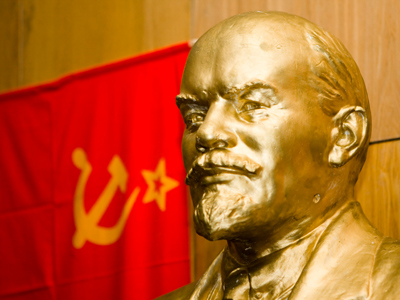
Lenin died on the 21st of January 1924 at the age of 53.
Russia: 1921-1924 - Lenin's Last Years
Explore how Lenin governed Soviet Russia in his final years, from the New Economic Policy to rising power struggles that shaped the USSR after his death in 1924.
1 .
What name was given to the economic policy that replaced "War Communism" as the official state programme in 1921?
The New Economic Policy
Revolutionary Capitalism
Socialism with a Human Face
The Third Way
Lenin was obliged to change his economic policy to deal with the dire conditions persisting in Russia by 1921 - including mass starvation. However, he also needed to persuade his colleagues that he was not betraying the communist revolution that had brought him to power
2 .
Under his new policy for the economy, from 1921 Lenin ensured that major industries remained in state hands. What were these major industries called?
"The commanding heights of the economy"
"The peaks of socialism"
"Irrevocable public ownership"
"The crown jewels of the Revolution"
Heavy industry, transport, banking and the like, had to remain in state hands for Lenin to convince his comrades that there was to be no return to the previous capitalist system
3 .
Lenin suffered at least three identical medical emergencies in 1922-1923. What medical condition was this?
Cancer
Heart attacks
Stroke
Brain tumours
A series of assassination attempts from 1918 did not help Lenin's general health. He died in January 1924 at the relatively young age of 53
4 .
What name was given to the Soviet Communist Party's youth movement, first founded in 1918?
Komsomol
Lenin Youth
Young Soviets
Soviet Pioneers
Communist and Fascist parties always started up youth movements to indoctrinate young people, and to perpetuate their beliefs
5 .
After the Revolution Stalin was given a job. He was made responsible for non-Russian minorities living in the USSR. What was the title of this post?
Commissar for Nationalities
Minister for Ethnic Minorities
Community Relations Commissar
Minister for Multiculturalism
Nearly half of all Soviet citizens were non-Russians, so the minister responsible for them occupied an important position
6 .
Stalin received further promotion in 1922, when he was given responsibility for keeping the Communist Party's membership records up to date. What was the title of this position?
General Secretary of the Communist Party
Secretary of the Communist Party
Principal Secretary of the Communist Party
Chief Secretary of the Communist Party
This post increased Stalin's power enormously, and he also kept the minorities post at the same time. He could advance or block people's status within the Communist Party, or even prevent them from becoming members in the first place. Moreover, if they were already members, he could ensure that they were dismissed
7 .
Which of the following leading Bolsheviks failed to attend Lenin's funeral in early 1924?
Stalin
Trotsky
Pyatakov
Zinoviev
When Lenin died it was important for those who wished to succeed him as Soviet leader to throw their hats into the ring. They could most easily do that by acting as pall-bearers at Lenin's funeral, to show their allegiance to their late leader
8 .
In 1921 a former enemy of the USSR signed a trade treaty with Lenin's regime, although he would not refrain from interfering in her South Asian colonies. To which "former enemy" are we referring?
France
Great Britain
The United States
The Netherlands
Lenin was keen to re-establish relations with former opponents who had supported the White side over the Red during the recent civil war. However, a trade deal was one thing: full-blown political recognition was another
9 .
One of the rival claimants for the Soviet leadership was Nikolai Bukharin, editor of the Communist Party's official newspaper. What was the title of this publication?
Iskra
Izvestia
Trud
Pravda
The editor of the official paper held enormous power, and should have been in a good position to bid for the leadership in 1924
10 .
In 1922 Lenin wrote his will or "political testament", in which he considered the suitability (or unsuitability) of his various comrades to succeed him as Soviet leader. Of which comrade did he write that he was: "...too rude and this defect...becomes quite intolerable..."?
Kamenev
Stalin
Trotsky
Rykov
Lenin's political testament was rigorously scrutinised by his surviving colleagues for an indication of any preference. In fact Lenin criticised all of the contenders for power, possibly favouring some form of collective leadership on his death



**Unlimited Quizzes Await You! 🚀**
Hey there, quiz champ! 🌟 You've already tackled today's free questions.
Ready for more?
Ready for more?
🔓 Unlock UNLIMITED Quizzes and challenge yourself every day. But that's
not all...
not all...
🔥 As a Subscriber you can join our thrilling "Daily Streak" against other
quizzers. Try to win a coveted spot on our Hall of Fame Page.
quizzers. Try to win a coveted spot on our Hall of Fame Page.
Don't miss out! Join us now and keep the fun rolling. 🎉
**Unlimited Quizzes Await You! 🚀**
Hey there, quiz champ! 🌟 You've already tackled today's free questions. Ready for more?
🔓 Unlock UNLIMITED Quizzes and challenge yourself every day. But that's not all...
🔥 As a Subscriber you can join our thrilling "Daily Streak" against other quizzers. Try to win a coveted spot on our Hall of Fame Page.
Don't miss out! Join us now and keep the fun rolling. 🎉




© Copyright 2016-2026 - Education Quizzes
Work Innovate Ltd - Design | Development |
Marketing
