




Ask the AI Tutor
Need help with World War One Aftermath: Hitler's Foreign Policy, 1933-1935? Ask our AI Tutor!
AI Tutor - Lucy
Connecting with Tutor...
Please wait while we establish connection
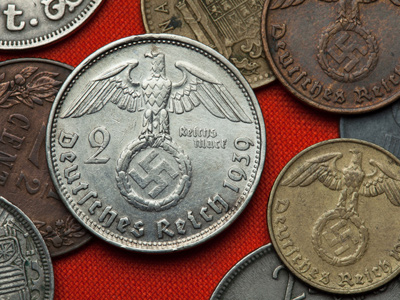
Hitler's Nazi Party came to power in 1933.
World War One Aftermath: Hitler's Foreign Policy, 1933-1935
Track how Hitler’s early foreign policy broke the Treaty of Versailles, from secret rearmament to bold diplomatic moves that challenged peace in Europe.
1 .
In 1933 Hitler announced German withdrawal from an international organisation set up in 1919 to preserve international peace. What was this body called?
The United Nations
The International Community
The League of Nations
The European Union
Hitler was showing that Germany would now act independently in foreign affairs, and not be beholden to any international body
2 .
Hitler also left another international organisation tasked with securing mutual disarmament, also in 1933. What was its name?
The Disarmament Conference
The Disarmament Commission
The Disarmament Committee
The Disarmament Council
Hitler was not interested in multilateral disarmament - rather he intended to break the disarmament clauses of the Treaty of Versailles and to rearm massively
3 .
In July 1934 Hitler used Austrian Nazis to try to overthrow the elected government there. What was the name of the Austrian Nazi leader who led this failed coup?
Artur von Seyss-Inquart
Reinhard Heydrich
Albert Speer
Ernst Roehm
The Nazi Party was well established in Austria, and it enjoyed considerable support there. Many Austrians resented the clause in the 1919 treaties that forbade the two nations to unite
4 .
Which Austrian Chancellor was murdered in the attempted coup of 1934?
Dollfuss
Von Habsburg
Schmeichel
Schusschnigg
Austria had an elected government that resisted the attempted Nazi seizure of power. Although this government was conservative and Catholic, it was far from being fascist
5 .
In 1934 Hitler signed a non-aggression pact with a nearby Slav state. Which one?
Poland
Czechoslovakia
Hungary
Russia
Hitler liked non-aggression pacts: they ensured that he would not be attacked by his new ally, while he threatened aggression elsewhere. Thus states could be lulled into a false sense of security - and Hitler could always revoke the pact when he wanted to
6 .
In 1935, at the annual September rally of the Nazi Party, Hitler made his usual keynote speech, outlining his plans for domestic and foreign policy for the forthcoming year. Where did these rallies traditionally take place?
Munich
Berlin
Nuremberg
Weimar
A huge parade ground in this city gave the Nazis scope to display their power. The leader would announce in his speech the projects for the following year - especially in foreign policy
7 .
In 1935 at the annual rally Hitler announced his rejection of one of the key planks of the Versailles Treaty. Which was this?
German disarmament
The payment of reparations
The loss of Germany's colonies
Giving up Alsace-Lorraine to France
Hitler had pledged to smash the Treaty of Versailles clause by clause. Then he was determined to unite all German-speakers in the German state. After that he had even more ambitious goals
8 .
Which former German province returned to Germany following a referendum held in 1935? The vote was overwhelmingly in favour of rejoining the Reich.
The Saarland
The Ruhr
Nordrhein-Westfalen
Rheinland-Pfalz
The Treaty of Versailles placed this area under the control of the League of Nations for a period of 15 years, after which a plebiscite would ensue. The population was almost entirely German, and the region had substantial coal and iron ore deposits. Thus, the "Yes" vote came as no great surprise
9 .
Which other dictatorship did Hitler assist when it invaded an independent African country in 1935?
Franco's Spain
Salazar's Portugal
Mussolini's Italy
Romania's Antonescu
Only two African states remained that had not been colonised by a European power. Most European countries had been affected to a greater or lesser extent by the Great Depression, and invasion of a "Third World" power could arouse patriotic passions, and thus encourage people to forget about their dire economic situation
10 .
Approximately what size had the German army reached by the end of 1935, according to Hitler's own admission?
500.000
150,000
250,000
450,000
Under the disarmament clauses of the Treaty of Versailles the German army was reduced to 100,000 men, recruited for a period of 12 years. This was intended to prevent Germany from ever being able to commit aggression again



**Unlimited Quizzes Await You! 🚀**
Hey there, quiz champ! 🌟 You've already tackled today's free questions.
Ready for more?
Ready for more?
🔓 Unlock UNLIMITED Quizzes and challenge yourself every day. But that's
not all...
not all...
🔥 As a Subscriber you can join our thrilling "Daily Streak" against other
quizzers. Try to win a coveted spot on our Hall of Fame Page.
quizzers. Try to win a coveted spot on our Hall of Fame Page.
Don't miss out! Join us now and keep the fun rolling. 🎉
**Unlimited Quizzes Await You! 🚀**
Hey there, quiz champ! 🌟 You've already tackled today's free questions. Ready for more?
🔓 Unlock UNLIMITED Quizzes and challenge yourself every day. But that's not all...
🔥 As a Subscriber you can join our thrilling "Daily Streak" against other quizzers. Try to win a coveted spot on our Hall of Fame Page.
Don't miss out! Join us now and keep the fun rolling. 🎉




© Copyright 2016-2026 - Education Quizzes
Work Innovate Ltd - Design | Development |
Marketing
