




Ask the AI Tutor
Need help with Forces - Hydraulics? Ask our AI Tutor!
AI Tutor - Lucy
Connecting with Tutor...
Please wait while we establish connection
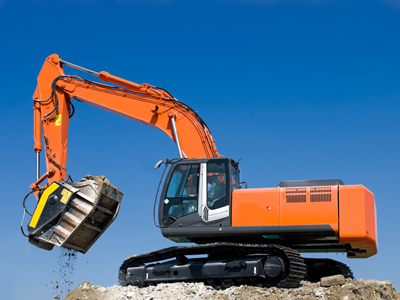
A digger benefits from the use of hydraulics.
Forces - Hydraulics
Find out how hydraulic systems use pressure in liquids to multiply forces in brakes, car jacks and machinery in this clear, exam-focused GCSE Physics quiz.
1 .
A 2 cm x 5 cm rectangle within a hydraulic system experiences a force of 50 N. What is the pressure within the system?
50 Pa
500 Pa
5 Pa
50,000 Pa
Always check units given in the question. It is common for measurements to be given in cm2 when a formula requires them to be in m2. 10 cm2 = 0.001 m2
2 .
What is the formula used to calculate pressure in different parts of a hydraulic system?
P = F x A
A = F x P
P = F⁄A
P = A⁄F
Pressure is a measure of the force per unit area
3 .
Different cross-sectional areas on the effort and load sides of a hydraulic system enables it to be used as a what?
Boat
Force multiplier
Mass multiplier
Electron multiplier
For a given pressure, if it acts over a larger area, the force will be greater
4 .
Which of the following can benefit from the use of hydraulics?
Digger
Glass cup
Printer
All of the above
Diggers and brakes are two common GCSE examples of the use of hydraulic systems
5 .
What is the length of a rectangle within a hydraulic system having a width of 5 m that is subjected to a pressure of 15 Pa and a force of 15 N?
0.1 m
0.2 m
0.5 m
1 m
Rearrange the pressure equation to work out the area. You know the length of one side of the rectangle and so you can work out the length of the other
6 .
If a system has an area of 2 m2 at its effort side and 5 m2 at its load side, how much more force does the load side experience?
100% more
200% more
250% more
300% more
Simple proportion
7 .
What fact can be said of liquids?
They are virtually incompressible
Easily compressible
All liquids have the same molecules
No liquid can be mixed with another liquid
Using a liquid in a hydraulic system is a good idea, as the liquid transfers the pressure from one side of the system to the other. Changes in the area of a section of the system can allow the force to be multiplied
8 .
How is pressure distributed in a liquid?
Non-uniformly in one direction
Equally in one direction
Equally in all directions
Non-uniformly in all directions
This is Pascal's law
9 .
What is the pressure of a system which experiences a force of 100 N over an area of 10 m2?
1 Pa
10 Pa
100 Pa
0.1 Pa
100 divided by 10
10 .
What are the units of pressure?
Coulombs
Pascals
Volts
Newtons
One pascal is a force of one newton acting over one metre squared so they are quite small units



**Unlimited Quizzes Await You! 🚀**
Hey there, quiz champ! 🌟 You've already tackled today's free questions.
Ready for more?
Ready for more?
🔓 Unlock UNLIMITED Quizzes and challenge yourself every day. But that's
not all...
not all...
🔥 As a Subscriber you can join our thrilling "Daily Streak" against other
quizzers. Try to win a coveted spot on our Hall of Fame Page.
quizzers. Try to win a coveted spot on our Hall of Fame Page.
Don't miss out! Join us now and keep the fun rolling. 🎉
**Unlimited Quizzes Await You! 🚀**
Hey there, quiz champ! 🌟 You've already tackled today's free questions. Ready for more?
🔓 Unlock UNLIMITED Quizzes and challenge yourself every day. But that's not all...
🔥 As a Subscriber you can join our thrilling "Daily Streak" against other quizzers. Try to win a coveted spot on our Hall of Fame Page.
Don't miss out! Join us now and keep the fun rolling. 🎉




© Copyright 2016-2026 - Education Quizzes
Work Innovate Ltd - Design | Development |
Marketing
