




Ask the AI Tutor
Need help with Chemistry - Crude Oil (AQA)? Ask our AI Tutor!
AI Tutor - Lucy
Connecting with Tutor...
Please wait while we establish connection
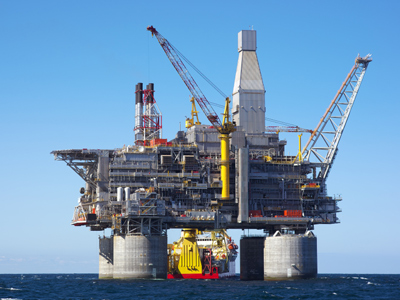
One of the ways we can extract oil which is trapped underground is by drilling from an oil rig.
Chemistry - Crude Oil (AQA)
Crude oil is a fossil fuel mixture. In GCSE Chemistry you learn how it is separated into useful fuels and why burning them affects the environment.
1 .
Crude oil is a mixture of what?
Two or more elements or compounds not chemically combined together
Two or more elements or compounds chemically combined together
Hydrocarbons combined together with water and gas
Mainly alkanes
The chemical properties of each substance in the mixture are unchanged. It is possible to separate the substances in a mixture by physical methods
2 .
What are hydrocarbons?
Long chain molecules made from water and carbon
Short chain molecules made from water and carbon
Chemicals made from hydrogen and carbon chemically joined together
A food group that provides energy
The hydrogen and carbon are covalently bonded. The carbon can be a single atom (for example, methane) or can be arranged as a chain (for example, octane has eight carbon atoms joined together in a chain)
3 .
Which of the following best describes most of the hydrocarbons in crude oil?
Saturated
Soaked
Soggy
Unsaturated
Saturated means that there are no double bonds in the molecule
4 .
Which of the following best describes the saturated hydrocarbons in oil?
Alcohols
Aldehydes
Alkenes
Alkanes
You should be able to recognise alkanes from their formulae (drawn or written) but you only need to know the names of the first four - methane, ethane, propane and butane - for the exam
5 .
The formula of any alkane can be worked out from which of the following?
CnH2n
CnH3n
CnH2n+2
CnHn
The letter 'n' represents the number of carbon atoms so an alkane with 20 carbon atoms would have 42 hydrogen atoms
6 .
How are the different hydrocarbons separated from crude oil?
Filtering
Centrifuging
Fractional distillation
Separating funnel
This is so-called because the crude oil is separated into fractions
7 .
Which of the following lists contains the words missing from the following passage in the correct order?
The many __________ in crude oil may be separated into fractions by ___________ the oil and allowing it to condense at a number of different ___________. This process is ___________ distillation.
The many __________ in crude oil may be separated into fractions by ___________ the oil and allowing it to condense at a number of different ___________. This process is ___________ distillation.
temperatures, evaporating, hydrocarbons, fractional
hydrocarbons, evaporating, temperatures, fractional
chemicals, evaporating, hydrocarbons, fractional
fuels, heating, places, evaporating
This is the first step to converting crude oil into useful products
8 .
Which of the following best describes the smaller hydrocarbons when compared to large hydrocarbons?
The smaller hydrocarbons are more viscous
The smaller hydrocarbons are less flammable
The smaller hydrocarbons are more volatile
The smaller hydrocarbons produce more soot when they burn
The smallest molecules from fractional distillation of crude oil are so volatile that they are gases at ordinary temperatures
9 .
The process of breaking down of the larger hydrocarbons to smaller, more useful chemicals is called what?
Smashing
Cracking
Splitting
Breaking
Cracking is carried out using heat and a catalyst
10 .
Crude oil is made from alkanes. During cracking what other type of hydrocarbon is produced and how is it different from the alkanes?
Ethene is produced and it is colourless
Alkyne is produced and it is odourless.
Alcohol is produced and it is inflammable
Alkene is produced and it has a double covalent bond
Cracking of a long chain alkane produces a shorter chain alkane and an alkene. The characteristic of an alkene is that it has at least one double bond between two adjacent carbon atoms
You can find more about this topic by visiting BBC Bitesize - Crude oil, hydrocarbons and alkanes - AQA



**Unlimited Quizzes Await You! 🚀**
Hey there, quiz champ! 🌟 You've already tackled today's free questions.
Ready for more?
Ready for more?
🔓 Unlock UNLIMITED Quizzes and challenge yourself every day. But that's
not all...
not all...
🔥 As a Subscriber you can join our thrilling "Daily Streak" against other
quizzers. Try to win a coveted spot on our Hall of Fame Page.
quizzers. Try to win a coveted spot on our Hall of Fame Page.
Don't miss out! Join us now and keep the fun rolling. 🎉
**Unlimited Quizzes Await You! 🚀**
Hey there, quiz champ! 🌟 You've already tackled today's free questions. Ready for more?
🔓 Unlock UNLIMITED Quizzes and challenge yourself every day. But that's not all...
🔥 As a Subscriber you can join our thrilling "Daily Streak" against other quizzers. Try to win a coveted spot on our Hall of Fame Page.
Don't miss out! Join us now and keep the fun rolling. 🎉




© Copyright 2016-2026 - Education Quizzes
Work Innovate Ltd - Design | Development |
Marketing
